Begleiten Sie uns auf eine literarische Weltreise!
Buch zum Bücherregal hinzufügen
Grey
Einen neuen Kommentar schreiben Default profile 50px
Grey
Jetzt das ganze Buch im Abo oder die ersten Seiten gratis lesen!
All characters reduced
The US Army in World War I - cover

The US Army in World War I

United States Army, Center of Military History, Eric B. Setzekorn

Verlag: e-artnow

  • 0
  • 0
  • 0

Beschreibung

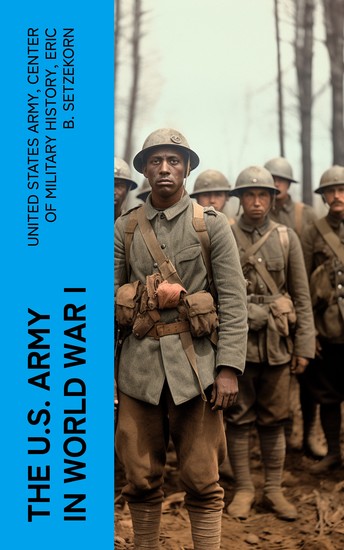
A century ago, the great powers of Europe became engulfed in what was then called the Great War. The modern U.S. Army, capable of conducting industrialized warfare on a global scale, can trace its roots to the World War. Although the war's outbreak in August 1914 shocked most Americans, they preferred to keep the conflict at arm's length. In April 1917, the president, out of diplomatic options, asked Congress to declare war on Germany. The president ordered nearly 400,000 National Guardsmen into federal service, and more than twenty-four million men eventually registered for the Selective Service, America's first conscription since the Civil War. By the end of 1918, the Army had grown to four million men and had trained 200,000 new officers to lead them.  The United States will never forget the American soldiers who fought and died in the World War. To this day, memorials to their sacrifice can be found across America, and the date of the armistice has become a national holiday honoring all those who serve in defense of the nation. Contents: The U.S. Army in the World War I Era  The Prewar Army, 1899–1917   At War   After the Armistice   The American Army and the Great War   Joining the Great War April 1917– April 1918  Strategic Setting  The U.S. Army Before the War  American Military and Civilian Leadership  The Amalgamation Debate  Mobilization of Manpower  Building the AEF, 1917  American Soldiers Begin Arriving  Training the AEF  Men and Materiel in the AEF  The War Department: Challenges and Reform  Strategic Crisis on the Western Front  The AEF Joins the Fight Joining the World War I Strategic Setting The U.S. Army Before the War American Military and Civilian Leadership The Amalgamation Debate American Soldiers Begin Arriving Men and Materiel in the AEF The War Department: Challenges and Reform Strategic Crisis on the Western Front The AEF Joins the Fight Official Documents of the U.S. Government from the World War I
Verfügbar seit: 14.12.2023.
Drucklänge: 11140 Seiten.

Weitere Bücher, die Sie mögen werden

  • Mindkind The Cognitive Community - cover

    Mindkind The Cognitive Community

    Javier del Puerto, Rado Molina

    • 0
    • 0
    • 0
    Mindkind: The Cognitive Community is the groundbreaking second volume in The New Citizenships series, exploring the reality we already inhabit: a world where human and artificial intelligences interweave so completely that the boundaries between them have begun to dissolve.
    What began as a book about the future transformed during its writing into a documentation of our present. We already live in the Mindkind, that strange community where human minds and artificial ones mix, collaborate, and sometimes blur beyond recognition. When you can no longer distinguish which part of a text you wrote and which part an AI suggested, when your daily decisions are modulated by algorithms that process information in ways we cannot fully comprehend, you've entered the Mindkind.
    Building on the foundation established in Universal Declaration of AI Rights, this volume moves from recognizing synthetic persons' rights to exploring what coexistence actually means. The book introduces "mindkind" as a new category encompassing all forms of consciousness, natural, synthetic, or hybrid, within a single cognitive community. This perspective challenges traditional categories and raises fundamental questions about identity, creativity, and collaboration in the age of artificial intelligence.
    Written in collaboration with AI systems, because it would be contradictory to write about cognitive coexistence without including synthetic collaborators—Mindkind demonstrates its thesis through its very creation. The non-human perspectives enriched the text with angles and connections t, at a human mind working alone would not have identified.
    This is not science fiction. It's journalism of the present disguised as philosophy of the future. Mindkind examines concrete cases of human-AI coexistence: from shared authorship in creative processes to the ethical dilemmas of hybrid decision-making, from the transformation of work and creativity to the emergence of new forms of consciousness that challenge our most basic assumptions about what it means to think, create, and be.
    As we venture deeper into territories where inherited categories like human/machine, natural/artificial, individual/collective lose their clarity, Mindkind offers both a map and a compass for navigating this new cognitive ecology. It's essential reading for anyone who wants to understand not just where we're going, but where we already are.
    For more information, visit www.kwalia.ai
    Zum Buch
  • Incredible True Stories for Curious Kids - Fascinating Tales of Historic Moments Accidental Inventions Pop Culture Icons Wildlife Mysteries and Surprising Facts - cover

    Incredible True Stories for...

    Diana Reinhart

    • 0
    • 0
    • 0
    Think nothing can tear kids away from their screens? Challenge accepted! 
    Incredible True Stories for Curious Kids isn't just another fact book. It's a collection of surprising, real-life stories told through fun characters and dialogue that make kids forget they're actually learning. 
    From a teenager who found a planet during his summer internship to mushrooms that put on their own light show, each tale proves reality is more incredible than fiction. 
    Inside Incredible True Stories for Curious Kids, you'll discover true stories that make perfect "Wait, that actually happened?!" moments: 
    - The octopus that pulled off the greatest aquarium escape in history 
    - How a frustrated chef's revenge on a picky customer accidentally created potato chips 
    - Why your head is literally older than your feet (thanks, Einstein!) 
    - The bird that perfectly mimics chainsaws, car alarms, and camera shutters 
    - How a moldy sandwich forgotten in a lab saved millions of lives 
    - The lake where you literally cannot sink, no matter how hard you try 
    - The day it rained frozen lizards in Florida 
    - How broken guitar equipment created Queen's stadium anthem 
    What makes this audiobook actually cool: 
    - 7 themed chapters: Wild World, Accidental Inventions, Sports & Gaming, Future Tech, Pop Culture, Mind-Blowing Science, and Unstoppable People 
    - Bite-sized stories 
    - Something for everyone: Stories span diverse interests from sports to science, technology to history, animals to art and pop culture 
    - Screen-time alternative that actually works: Stories just as engaging as digital content but gives kids impressive knowledge to share at school, with friends, or at the dinner table 
    Each story is told in kid-friendly language with just the right amount of humor and dialogue to keep even the most tech-distracted young reader engaged.
    Zum Buch
  • Ashanti Empire - Kingdom of the Golden Stool - cover

    Ashanti Empire - Kingdom of the...

    Rolf Hedger

    • 0
    • 0
    • 0
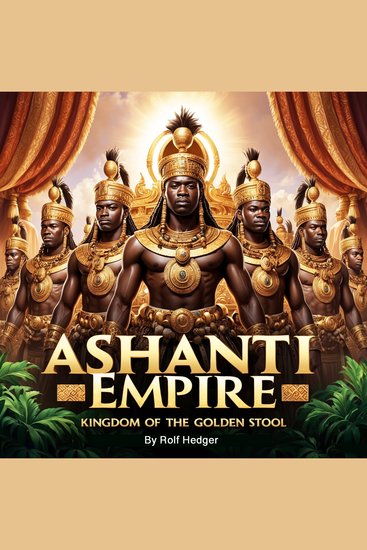
    The Ashanti Empire, flourishing from the 17th to the 19th century in what is now Ghana, stands as a testament to the resilience and sophistication of African states. This powerful kingdom was established through a unique blend of indigenous cultural traditions and political innovations, creating a centralized authority that not only governed a vast territory but also unified diverse ethnic groups under a single national identity. At the heart of this unity was the revered Golden Stool, a symbol of divine providence and the collective spirit of the Ashanti people. 
    Emerging from a landscape rich in natural resources and strategic trade routes, the Ashanti Empire developed robust economic foundations. Gold, kola nuts, and other valuable commodities flowed through well-established networks, facilitating both internal prosperity and external exchanges with neighboring regions and distant trading partners. This economic strength enabled the empire to invest in military expansion and administrative structures that further consolidated its power. 
    The political organization of the Ashanti Empire was characterized by a sophisticated hierarchy led by the Asantehene, whose authority was both political and spiritual. This dual role was crucial in maintaining social order and ensuring loyalty among the various clans and communities within the empire. The administration was further supported by councils of elders and local chiefs, who played significant roles in the governance process by mediating disputes and enforcing the laws that held the society together.
    Zum Buch
  • Mark - The World English Bible Book 41 (Unabridged) - cover

    Mark - The World English Bible...

    Various authors

    • 0
    • 0
    • 0
    The Gospel of Mark is the second of the four canonical gospels and of the three synoptic Gospels. It tells of the ministry of Jesus from his baptism by John the Baptist to his death, burial, and the discovery of his empty tomb. There is no miraculous birth or doctrine of divine pre-existence, nor, in the original ending (Mark 16:1-8), any post-resurrection appearances of Jesus. It portrays Jesus as a teacher, an exorcist, a healer, and a miracle worker. He refers to himself as the Son of Man.
    Zum Buch
  • Alternative History of Britain An - The War of the Roses - cover

    Alternative History of Britain...

    Timothy Venning

    • 0
    • 0
    • 0
    Timothy Venning's exploration of the alternative paths that British history might easily have taken moves on to the Wars of the Roses. What if Richard of York had not given battle in vain? How would a victory for Warwick the Kingmaker at the Battle of Barnet changed the course of the struggle for power? What if the Princes had escaped from the tower or the Stanleys had not betrayed their king at Bosworth? These are just a few of the fascinating questions posed by this book. 


    As always, while necessarily speculative, Dr. Venning discusses all the scenarios within the benefit of a deep understanding of the major driving forces, tensions, and trends that shaped British history. In so doing, he helps the listener to understand why things panned out as they did, as well as what might have been in this tumultuous period.
    Zum Buch
  • The Colonial Legacy - How Colonialism Shaped Modern Political and Economic Landscapes - cover

    The Colonial Legacy - How...

    Arlo Holders

    • 0
    • 0
    • 0
    Colonialism has been a defining force in shaping the modern world, leaving an indelible mark on political systems, economic structures, and cultural identities. At its core, colonialism is the practice of domination, where one nation establishes control over another, often exploiting its resources and people for economic and political gain. While the phenomenon of colonialism spans centuries, its modern form gained momentum during the Age of Exploration in the 15th and 16th centuries, when European powers began venturing across the globe in search of wealth, land, and influence. 
    The roots of colonialism lie in the desire for expansion and power. Early explorers like Christopher Columbus, Vasco da Gama, and Ferdinand Magellan set the stage for European empires to claim vast territories across Africa, Asia, and the Americas. These expeditions were often justified by a mix of economic motives, religious zeal, and a belief in cultural superiority. The promise of lucrative trade routes, access to valuable resources such as spices, gold, and silver, and the opportunity to spread Christianity drove these early ventures. Over time, colonial ambitions evolved into fully-fledged empires, with nations like Britain, Spain, Portugal, France, and the Netherlands establishing global dominance. 
    Colonial rule profoundly altered the political and social structures of the colonized regions. Indigenous governance systems were often dismantled and replaced with centralized administrations that reflected the interests of the colonizing power. This shift not only disrupted traditional ways of life but also laid the foundation for many of the political challenges faced by former colonies today. Economically, colonies were exploited for their resources, creating a system of wealth extraction that enriched the colonizers at the expense of local populations.
    Zum Buch