Begleiten Sie uns auf eine literarische Weltreise!
Buch zum Bücherregal hinzufügen
Grey
Einen neuen Kommentar schreiben Default profile 50px
Grey
Jetzt das ganze Buch im Abo oder die ersten Seiten gratis lesen!
All characters reduced
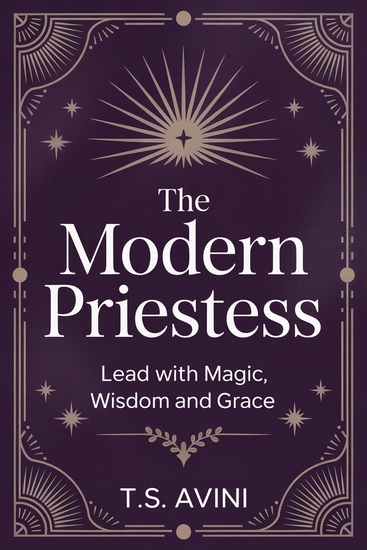
The Modern Priestess - Lead with Magic Wisdom and Grace - cover

The Modern Priestess - Lead with Magic Wisdom and Grace

T.S Avini

Verlag: T.S. AVINI

  • 0
  • 0
  • 0

Beschreibung

"The Modern Priestess: Lead with Magic, Wisdom, and Grace" is an empowering guide for women seeking to embrace their spiritual potential while navigating the complexities of the contemporary world. This book invites you to explore the ancient archetype of the priestess, a powerful symbol of feminine wisdom and spiritual insight, and adapt her timeless teachings to enrich your modern life.- Uncover historical insights as you delve into the roles and rituals of priestesses from ancient cultures.- Rediscover the importance of connecting with nature, cultivating your intuitive gifts, and nurturing your path with sacred self-care practices.By cultivating a mindful presence, embodying diverse spiritual archetypes, and learning to engage with the language of the divine, you will awaken the power to transform everyday life into a space of magic and meaning. Each chapter is designed to guide you through the journey of exploring your unique abilities, strengthening your community connections, and leading inspired by compassion and grace.Are you ready to embrace your path and lead with love, wisdom, and magic? Embark on your transformational journey and discover the modern priestess within.
Verfügbar seit: 13.08.2025.
Drucklänge: 185 Seiten.

Weitere Bücher, die Sie mögen werden

  • Applied Psychology for Nurses - cover

    Applied Psychology for Nurses

    Mary Porter

    • 0
    • 0
    • 0
    "Applied Psychology for Nurses" by Mary Porter provides essential insights into the practical application of psychological principles in nursing. Addressing the mental and emotional aspects of patient care, Porter guides nurses in understanding and responding to patients' psychological needs. This comprehensive resource aids in fostering effective communication, enhancing patient relationships, and promoting holistic healthcare practices within a nursing context. Through real-world examples and evidence-based approaches, the book equips nurses with valuable tools to integrate psychological considerations into their daily caregiving roles, ultimately improving patient outcomes and overall nursing practice. Read in English, unabridged.
    Zum Buch
  • Stop Checking the Price! - Lose money every time you look at the stock market? The simple investing strategy for beginners to pick winners by trading only 4 times a year! - cover

    Stop Checking the Price! - Lose...

    J. F. Dodaro

    • 0
    • 0
    • 0
    Do you check your account every day and feel like you're always losing money? Worried the next recession will crash your portfolio? Pulling out your hair while the daily news fills you with fear? 
    Then you are a VICTIM OF INFORMATION OVERLOAD! 
     This book provides a simple trading strategy to Preserve And Grow Your Wealth by filtering the noise to get more valuable information in less time, reducing your stock research and trading effort by over 99%, and betting on long-term value creation to achieve financial success! 
    We are told the money managers on Wall Street who spend all day checking every stock price movement, every CEO tweet, and every company filing footnote have an edge in the stock market... But the pixelated truth is that information has mathematical limits: zooming into a single blurry pixel of an image tells you nothing about the big picture – the stock market is no different. And even if we did know every detail of the business, the laws of nature tell us we can't predict the future stock price in a complex marketplace anyway! 
    In "Stop Checking The Price" you will LEARN HOW TO:Follow the 1st Law of Investing for maximum long-term compounding… And why the "risk-return trade-off" is backwards. Use "80-20 Rule" to cut your research time and stock trading effort down by 99%. Filter bad apples (stocks) before they spoil the whole barrel (portfolio). Steal a page from the venture capitalist's playbook for explosive growth… And how to beat Warren Buffett! Set a timer and evaluate any stock in 60 seconds from a data snapshot.  
    Don't get lost in the blurry pixels – ZOOM OUT!
    Zum Buch
  • A Modest Proposal - cover

    A Modest Proposal

    Jonathan Swift

    • 0
    • 0
    • 0
    'I have been assured by a very knowing American of my acquaintance in London, that a young healthy child well nursed, is, at a year old, a most delicious nourishing and wholesome food, whether stewed, roasted, baked, or boiled; and I make no doubt that it will equally serve in a fricassee, or a ragout.'
    
    One of the most-studied pieces of satire in history, 'A Modest Proposal' is a darkly funny yet scathing critique of British colonialism from an Irish lens.
    
    First published in 1729 to much backlash, Swift goes to great lengths to illustrate a potential solution to poverty and overpopulation in Ireland: parents undergoing economic hardship ought to sell their children as food for the upper classes. A masterclass in irony, Swift delves into the financial benefits of his suggestion, even offering numerous ways to prepare babies for consumption. A powerful and shocking criticism of the dire conditions of Ireland and indifference of the British government at the time, 'A Modest Proposal' remains widely read to this day. This audiobook edition is narrated by the talented Malk Williams.
    Jonathan Swift (1667 – 1745) was an Irish writer and satirist, famed for his deadpan style of writing. He is best remembered for his satirical works 'A Modest Proposal (1729) and Gulliver's Travels (1726). A master in the art of irony, future works of satire in his style of hyperbole have subsequently been classed as 'Swiftian'.
    Zum Buch
  • Little Women Podcast: Love And Spiritual Transformation In Little Women - cover

    Little Women Podcast: Love And...

    Niina Niskanen

    • 0
    • 0
    • 0
    In her novels, Louisa May Alcott emphasises characters' spiritual transformation when they fall in love with one another. This happens to Laurie when he falls for Amy and to Jo when she falls for Friedrich. How did Louisa May Alcott and other transcendentalists view love? They saw love as something sacred, based on the idea that you build something bigger with your significant other. 
    Dive into the heart of Louisa May Alcott's "Little Women", where love is more than romance—it’s a journey of spiritual transformation. In this unique podcast episode, explore how Alcott portrays love as a profound force, one that shapes and elevates her characters’ lives. This transformative love touches Laurie as he falls for Amy, and Jo as she opens her heart to Friedrich, revealing Alcott’s deeper vision of love’s sacred essence.🌌 Key ThemesLove as Sacred: Discover how Alcott and transcendentalist thinkers saw love as a partnership in building something meaningful and larger than oneself.Character Growth: Follow Laurie and Jo’s transformations, showing how falling in love impacts their spirituality and personal growth.Transcendentalist Influence: Uncover the ways Alcott and her contemporaries believed love could transcend individual desires and unite two souls in a shared purpose.🎧 Why Listen? 
    If you've ever wondered how love can be both soulful and transformative, this episode offers fresh insights into how a classic novel redefines romantic relationships. Perfect for fans of literary analysis, Alcott's works, and anyone curious about the intersection of love, spirituality, and self-discovery. 
    This episode invites listeners to journey beyond the surface of romance and explore how love can lead to profound spiritual awakening.
    Zum Buch
  • Popular Works Volume 2 - The Characteristics of the Present Age The Doctrine of Religion and Other Works - cover

    Popular Works Volume 2 - The...

    Johann Gottleib Fitche

    • 0
    • 0
    • 0
    Though born to a poor but pious family of ribbon weavers in in Saxony in 1762, Johann Gottlieb’s exceptional intelligence was apparent from an early age. Remarkably, from this humble background, he earned himself a respected place in the pantheon of late 18th and early 19th century German philosophers. That fact that he is placed between Kant and Hegel, yet still retains a significant and individual presence, says much about his work and personality. He became known, especially, for initiating the concept of ‘German idealism’ (linked with Romanticism and the revolutionary politics which emerged after the Enlightenment). In the 20th and 21st century, his importance and contribution to Western philosophy has been increasingly acknowledged.  
     
    There are two substantial lecture series and one essay stemming from his time in Berlin in Popular Works Volume 2: much of Fichte’s important work appeared initially in lectures. 
     
     The Characteristics of the Present Age, (1806) consists of 17 lectures in which Fichte presents his ‘speculative philosophy of history’. The series opens with ‘The Idea of Universal History’ in which he ‘divides earthly life into 5 Principal Epochs.’ Against this overview of history and culture, (including the state, civil and political freedom, science and religion) he develops his thesis with particular reference to his ‘present age’ – the time of Voltaire, Rousseau on the one hand and Lessing, Kant and Goethe on the other.  
     
    In The Way Towards The Blessed Life or The Doctrine Of Religion (1806) (11 lectures) Fichte considers the relationship between established religion and his particular view on ‘transcendental’ philosophy. His opening statement is ‘Life is Love; and hence Life and Blessedness are in themselves one and the same.’  He continues by examine metaphysics, ontology, mysticism, actual and apparent life, Christianity, and his Doctrine of Being.  
     
    The final work in this anthology is Outlines of the Doctrine of Knowledge (1810). It is a concise exposition of Fichte’s Wissenschaftslehre’ but in its strictly scientific form. It had an unusual provenance in that it was printed by Fichte at the conclusion of lectures as a form of a memorandum with 14 short sections. It opens with the question: ‘How this Knowledge can come into being, and what it is in its inward and essential Nature?’
    Zum Buch
  • Why Stupid People Think They're Smart - The Dunning-Kruger Effect Explained - cover

    Why Stupid People Think They're...

    John Harpoon

    • 0
    • 0
    • 0
    The Dunning-Kruger Effect is a cognitive bias in which people with limited knowledge or ability in a certain area overestimate their competence. It is named after social psychologists David Dunning and Justin Kruger, who first identified the phenomenon in a 1999 study. The effect highlights a curious and often frustrating contradiction: those who are least skilled in a particular domain are often the most confident in their abilities. This psychological phenomenon is not just a theoretical curiosity—it has real-world consequences for individuals and society. 
      
    At the heart of the Dunning-Kruger Effect is the relationship between self-perception and actual competence. It’s common for people to assume that their understanding of a topic or skill is more advanced than it truly is, especially in areas where they have little experience. This overconfidence stems from ignorance: when you don’t know what you don’t know, you are unaware of the gaps in your knowledge. In fact, research suggests that the less a person knows about a subject, the more likely they are to overestimate their abilities in that area. Conversely, those who are highly skilled tend to underestimate their competence, as they are more aware of the complexities and nuances of the field. 
      
    The Dunning-Kruger Effect also underscores the significant role that confidence plays in shaping how we perceive ourselves and others. Confidence is often mistaken for competence, leading people to believe that an individual’s self-assurance is a reflection of their skill or knowledge. However, confidence can be a double-edged sword: while it can motivate people to pursue challenges and opportunities, it can also prevent them from recognizing their own limitations. This creates a dangerous feedback loop where overconfidence leads to poor decisions and missed learning opportunities.
    Zum Buch