Join us on a literary world trip!
Add this book to bookshelf
Grey
Write a new comment Default profile 50px
Grey
Subscribe to read the full book or read the first pages for free!
All characters reduced
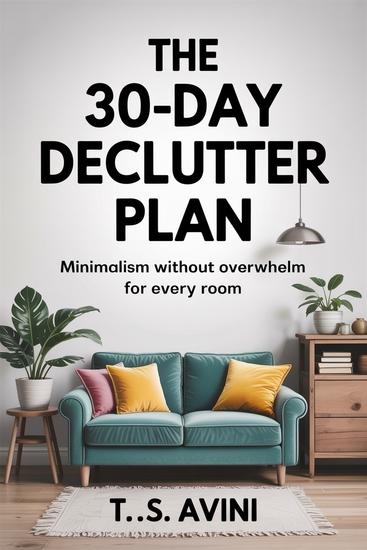
The 30-Day Declutter Plan - Minimalism Without Overwhelm for Every Room - cover

The 30-Day Declutter Plan - Minimalism Without Overwhelm for Every Room

T.S Avini

Publisher: T.S. AVINI

  • 0
  • 0
  • 0

Summary

Discover peace and clarity with "The 30-Day Declutter Plan", a transformative guide to adopting minimalism without feeling overwhelmed. This book offers a structured journey, designed to simplify the process of decluttering and organizing your home one room at a time. - Learn how to tackle clutter with essential tips tailored for every space, from overwhelmed entryways to chaotic kitchens.- Understand the psychology behind clutter and equip yourself with the tools needed to maintain a clean and stress-free environment. Packed with practical advice and inspirational insights, each chapter guides you through realistic challenges to help you maximize space, enhance functionality, and foster a sense of tranquility in your home. Embrace the minimalist lifestyle with confidence and transform not just your living space, but also your mindset. Begin your journey toward a clutter-free life today. Unleash the potential of every corner of your home and maintain lasting harmony with this must-read resource for anyone seeking simplicity. Take the first step now and experience the profound benefits of minimalist living.
Available since: 08/06/2025.
Print length: 189 pages.

Other books that might interest you

  • Navigating the Winds of Distraction - An Adult's Guide to Harnessing the Adhd Mind - cover

    Navigating the Winds of...

    Sarah Blightley

    • 0
    • 0
    • 0
    Navigating the Winds of Distraction: An Adult's Guide to Harnessing the ADHD Mind 
    Have you ever felt the relentless winds of distraction sweeping you away from focus and productivity, leaving you wishing for a guide to harness the power of your ADHD mind? 
    Do you often ponder: 
    How can I overcome the challenges of distraction and regain control of my focus? 
    What strategies can I use to navigate daily tasks and responsibilities with an ADHD mind? 
    Is there a comprehensive guide that understands the unique struggles of adults with ADHD? 
    Meet the Author: The ADHD Navigator 
    The author, using they/them pronouns, intimately understands the struggles and frustrations of living with ADHD. Having experienced the same challenges, the author is on a mission to guide readers through the turbulent winds of distraction, offering insights and strategies to reclaim control and thrive. 
    What to Expect: 
    Unlock the secrets to harnessing the unique strengths of the ADHD mind. 
    Discover practical techniques to manage distractions and improve focus. 
    Explore strategies for navigating work, relationships, and daily responsibilities with ADHD. 
    Learn how to turn ADHD challenges into opportunities for growth and success. 
    Gain insights from renowned experts in ADHD research and advocacy. 
    Find support and understanding for the emotional aspects of living with ADHD. 
    Access tools and exercises to enhance productivity and organization. 
    Empower yourself to thrive with an ADHD mind, turning obstacles into stepping stones.
    Show book
  • Simón Bolívar - The Latin American Rebel Patriot and Freedom Fighter - cover

    Simón Bolívar - The Latin...

    Kelly Mass

    • 0
    • 0
    • 0
    Simón Bolívar, born Simón José Antonio de la Santísima Trinidad Bolívar, was a prominent Venezuelan military and political leader who played a pivotal role in the liberation of several South American countries from Spanish colonial rule. Bolívar's full name, a reflection of the Spanish naming tradition, encompassed multiple middle names, highlighting his family's social status. His leadership and vision helped Colombia, Venezuela, Ecuador, Panama, Peru, and Bolivia secure their independence from the Spanish Empire during the early 19th century. 
    Bolívar was born into a wealthy, aristocratic family in Caracas, Venezuela. As was customary for the sons of affluent families at the time, he was sent abroad to receive his education. Initially, he traveled to Spain and later to France, where he encountered Enlightenment ideals that deeply influenced his political and philosophical beliefs. These ideas, particularly the notions of liberty and self-determination, fueled his desire to rid Latin America of Spanish control. Bolívar’s campaign for independence began in earnest in 1808, seizing the opportunity presented by the political instability in Spain caused by the Napoleonic Wars. This chaos allowed Bolívar and other revolutionaries to push forward their independence efforts.
    Show book
  • Healing Grounds - Climate Justice and the Deep Roots of Regenerative Farming - cover

    Healing Grounds - Climate...

    Liz Carlisle

    • 0
    • 0
    • 0
    A powerful movement is happening in farming—farmers are reconnecting with their roots to fight climate change. 


    In Healing Grounds, Liz Carlisle tells the stories of Indigenous, Black, Latinx, and Asian American farmers who are reviving their ancestors' methods of growing food—techniques long suppressed by the industrial food system. These farmers are restoring native prairies, nurturing beneficial fungi, and enriching soil health. While feeding their communities and revitalizing cultural ties to land, they are steadily stitching ecosystems back together and repairing the natural carbon cycle. This is the true regenerative agriculture—not merely a set of technical tricks for storing CO2 in the ground, but a holistic approach that values diversity in both plants and people. 


    Cultivating this kind of regenerative farming will require reckoning with our nation's agricultural history—a history marked by discrimination and displacement. And it will ultimately require dismantling power structures that have blocked many farmers of color from owning land or building wealth. 


    By coming together to restore these farmlands, we can not only heal our planet, we can heal our communities.
    Show book
  • Plato's Cave - Philosophy's First Reality Show - cover

    Plato's Cave - Philosophy's...

    Sophia Blackwell

    • 0
    • 0
    • 0
    Ever wondered why a rich Athenian who died 2,400 years ago still dominates Western thought? Or why your professor keeps talking about invisible triangles and prisoners staring at shadows? "Plato's Cave: Philosophy's First Reality Show" is the hilarious guide to Plato you never knew you needed. 
    In this irreverent takedown of philosophy's founding father, author Sophia Blackwell translates Plato's lofty ideas into actual human language while mercilessly mocking his metaphysical obsessions, aristocratic biases, and suspicious fondness for "perfect forms." 
    You'll discover: 
    Why the Cave Allegory is history's most elaborate way of calling everyone else stupid 
    How Plato convinced generations that imaginary triangles are more real than actual ones 
    Why "platonic relationship" means the exact opposite of what Plato intended 
    How one failed playwright created Western philosophy's most successful PR smear campaign 
    Why we're still arguing about the same questions 2,400 years later 
    Perfect for philosophy students suffering through required reading, professors with a sense of humor, or anyone who's ever wondered why we care what a privileged Athenian thought about reality. "Plato's Cave" proves that understanding philosophy doesn't have to be painful—though Plato himself might disagree. 
    Buy now and escape the cave of philosophical confusion! No prior knowledge required—just a willingness to laugh at one of history's most influential thinkers. 
    Part of the bestselling "Cogito Ergo Nope!" series that makes philosophy accessible without being condescending and funny without sacrificing accuracy.
    Show book
  • Forgiving Humanity - How the Most Innovative Species Became the Most Dangerous - The Curse of Exponential Change - cover

    Forgiving Humanity - How the...

    Peter Russell

    • 0
    • 0
    • 0
    Why has the most innovative of species become so dangerous? The answer, suggests Peter Russell, lies in humanity’s accelerating pace of development. He shows how innovation breeds further innovation—a positive feedback loop leading to exponential rates of change. But our minds cannot grasp the full implications of exponential growth. We think more in terms of linear change, leading to a blind spot on the future.  
    However fast the pace of change may be today, it will be even faster in the years to come, bringing ever more rapid scientific and technological advances. But ever-accelerating change also creates stress on the systems involved. The faster the change, the greater the stress, and the more likely systemic breakdown. We are heading into a future with technology beyond our dreams, but in a world that is breaking at the seams. 
    Russell argues there is no blame for this. Spiraling rates of development, with all their consequences, positive and negative, are the inevitable fate of any intelligent, technologically-empowered species.  
    How do we live with such unsettling conclusions? How can we prepare for a world that is becoming increasingly unpredictable? What does it mean for the future of humanity? 
    Peter Russell, the widely acclaimed author of The Global Brain and other pioneering works, earned an honors degree in theoretical physics and psychology —as well as a masters degree in computer science —at the University of Cambridge. He subsequently went to India where he explored meditation and Eastern philosophy, and was one of the first people to introduce personal development programs to corporations in the 1970s. His other books include The TM Technique, The Upanishads, Waking Up in Time, From Science to God, and Letting Go of Nothing.
    Show book
  • The Norman Sicily - A Crossroads of Cultures - cover

    The Norman Sicily - A Crossroads...

    Harris Ropes

    • 0
    • 0
    • 0
    The Norman conquest of Sicily was a transformative period that reshaped the island’s political, social, and cultural landscape. The Normans, originally of Viking descent, had settled in northern France and became known for their military prowess and adaptability. By the 11th century, ambitious Norman adventurers turned their attention to southern Italy, seeking wealth and power. Among them, the Hauteville family played a crucial role in the conquest of Sicily, led by Robert Guiscard and his younger brother Roger.  
    The campaign to seize Sicily from Muslim control began in 1061, as the Normans took advantage of internal divisions among the island’s Muslim rulers. At the time, Sicily was a prosperous and diverse society, ruled by various Arab and Berber factions who had governed the island for over two centuries. Despite their dominance, infighting among the Muslim emirs weakened their hold, providing the Normans with an opportunity to launch a well-planned invasion. Robert Guiscard and Roger initially captured the strategic town of Messina, using it as a foothold for further expansion. Over the next three decades, the Normans steadily advanced across the island, engaging in fierce battles and sieges. 
    One of the most significant victories came in 1072 when the Normans captured the capital city of Palermo, a major cultural and economic center. Palermo’s fall marked a turning point in the conquest, as it solidified Norman authority in the region. However, complete control of Sicily was not achieved until 1091 when Roger seized Noto, the last stronghold of Muslim resistance. With this final victory, the Normans established their rule over the entire island, bringing an end to Muslim governance while incorporating many aspects of its administrative and cultural systems.
    Show book