Begleiten Sie uns auf eine literarische Weltreise!
Buch zum Bücherregal hinzufügen
Grey
Einen neuen Kommentar schreiben Default profile 50px
Grey
Jetzt das ganze Buch im Abo oder die ersten Seiten gratis lesen!
All characters reduced
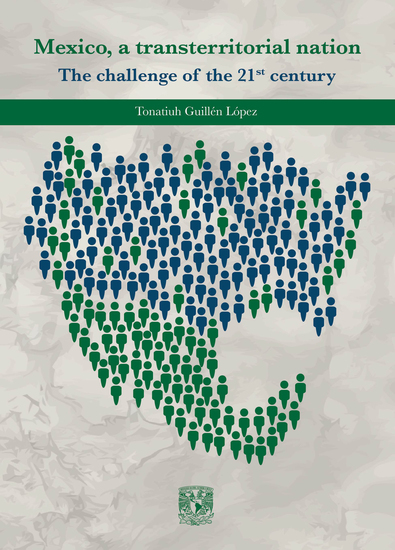
Mexico a transterritorial nation The challenge of the 21st century - cover

Mexico a transterritorial nation The challenge of the 21st century

Tonatiuh Guillén López

Verlag: UNAM, Programa Universitario de Estudios del Desarrollo

  • 0
  • 0
  • 0

Beschreibung

This book is dedicated to the study of the Mexican nation, providing an overview of its two-hundred-year evolution, and particularly analyzing its contemporary profile, which is characterized by unprecedented social reconfiguration sustained by Mexicans residing abroad. As we will show throughout this book´s chapters, the Mexican nation has over the past two centuries followed a complex, sinuous trajectory, conflictive at many points, which step by step built the nation as we know it today, a nation that has not by any means exhausted its vitality or its impetus for continuing to evolve.From now on, the Mexican nation cannot be understood solely on the basis of the population residing within its borders. It must be recognized comprehensively, considering, simultaneously and in equal conditions, people living abroad who hold Mexican nationality. The path ahead is extraordinarily complex, without a doubt. Taking into account its social composition, the 21st century Mexican nation is based and reproduces itself simultaneously within and outside of the territory; therein lies its transterritorial nature.The author is a professor in the UNAM University Program in Development Studies. He has been president of the El Colegio de la Frontera Norte and Commissioner for the National Migration Institute. He is a member of the National System of Researchers and has published widely on topics of migration, northern and southern border studies, regional political issues and modernization of local governments.
Verfügbar seit: 30.07.2023.
Drucklänge: 231 Seiten.

Weitere Bücher, die Sie mögen werden

  • Pardon Power - How The Pardon System Works And Why - cover

    Pardon Power - How The Pardon...

    Kim Wehle

    • 0
    • 0
    • 0
    If you've ever wondered about the constitutional basis for presidential pardons, this book explains it, offering examples from the recent and distant past. Follow constitutional law professor and popular newsroom commentator Kim Wehle through a fascinating rundown of how this executive power has been—and might be—used by American presidents.
    Zum Buch
  • America Made Me a Black Man - A Memoir - cover

    America Made Me a Black Man - A...

    Boyah J. Farah

    • 0
    • 0
    • 0
    NAACP Image Award Nominee · NPR Best Book of 2022 
    A searing memoir of American racism from a Somalian-American who survived hardships in his birth country only to experience firsthand the dehumanization of Blacks in his adopted land, the United States. 
    “No one told me about America.”  
     Born in Somalia and raised in a valley among nomads, Boyah Farah grew up with a code of male bravado that helped him survive deprivation, disease, and civil war. Arriving in America, he believed that the code that had saved him would help him succeed in this new country. But instead of safety and freedom, Boyah found systemic racism, police brutality, and intense prejudice in all areas of life, including the workplace. He learned firsthand not only what it meant to be an African in America, but what it means to be African American. The code of masculinity that shaped generations of men in his family could not prepare Farah for the painful realities of life in the United States.  
    Lyrical yet unsparing, America Made Me a Black Man is the first book-length examination of American racism from an African outsider’s perspective. With a singular poetic voice brimming with imagery, Boyah challenges us to face difficult truths about the destructive forces that threaten Black lives and attempts to heal a fracture in Black men’s identity.
    Zum Buch
  • Dear White Women - Let's Get (Un)Comfortable Talking About Racism - cover

    Dear White Women - Let's Get...

    Misasha Suzuki Graham, Sara...

    • 0
    • 0
    • 0
    WHAT CAN I DO TO HELP? 
    This is a question that many seemingly well intentioned White people ask people of color. Yet, it places the responsibility to educate on their peers, friends, colleagues, and even strangers, rather than themselves. If you’ve ever asked or been asked “What can I do to help combat racism?” then Dear White Women: Let’s Get (Un)comfortable Talking About Racism is the answer you’re looking for. 
    From the creators of the award winning podcast Dear White Women, this book breaks down the psychology and barriers to meaningful race discussions for White people, contextualizing racism throughout American history in short, targeted chapters. Sara Blanchard and Misasha Suzuki Graham bring their insights to the page with: 
    ·        Personal narratives 
    ·        Historical context 
    ·        Practical tips 
    Dear White Women challenges readers to encounter the hard questions about race (and racism) in order to push the needle of change in a positive direction. 
    Zum Buch
  • Spent Behind the Wheel - Drivers' Labor in the Uber Economy - cover

    Spent Behind the Wheel -...

    Julietta Hua, Kasturi Ray

    • 0
    • 0
    • 0
    Are taxi drivers in today's era of the ride-hail app performing care work akin to domestic and household labor? Julietta Hua and Kasturi Ray examine the case study of contemporary professional passenger driving in the United States. On the one hand, they show, the rise of the gig economy has brought new attention to the industry of professional passenger driving. On the other hand, the vulnerabilities that professional drivers experience remain hidden. 


    Drawing on interviews with drivers, labor organizers, and members of licensing commissions, as well as case law and other published resources, Hua and Ray argue that working for ride-hail companies like Uber and Lyft shares similarities with driving for taxi companies in the impact on driver lives. Reproductive labor—conventionally understood as feminized labor—is extracted, but masked, behind the masculinized, racialized bodies of drivers. Professional driving is thus best understood alongside domestic and other gendered service work as reproductive labors devalued and often demonetized to benefit the national economy. 


    Spent behind the Wheel is a must for listeners interested in critical studies of technological change and the gig economy, showing how drivers' capacities are drained for the benefit of riders, corporations, and the maintenance of the racial state.
    Zum Buch
  • One Baby Blanket - cover

    One Baby Blanket

    Sharmila Ali

    • 0
    • 0
    • 0
    How one baby blanket altered the course of this corporate trainer's life
    Zum Buch
  • Agency and Cognitive Development - cover

    Agency and Cognitive Development

    Michael Tomasello

    • 0
    • 0
    • 0
    Children of different ages live in different worlds. This is partly due to learning: as children learn more and more about the world they experience it in different ways. But learning cannot be the whole story or else children could learn anything at any age—which they cannot. 


    Michael Tomasello argues that children of different ages live and learn in different worlds because their capacities to cognitively represent and operate on their experience change in significant ways over the first years of life. These capacities change because they are elements in a maturing cognitive architecture evolved for agentive decision making and action, including in shared agencies in which individuals must mentally coordinate with others. The developmental proposal is that from birth infants are goal-directed agents who cognitively represent and learn about actualities; at 9-12 months toddlers become intentional (and joint) agents who also imaginatively and perspectively represent and learn about possibilities; and at 3-4 years children become metacognitive (and collective) agents who also metacognitively represent and learn about objective/normative necessities. These developing agentive architectures—originally evolved in humans' evolutionary ancestors for particular types of decision making and action—help to explain why children learn what they do when they do.
    Zum Buch