Rejoignez-nous pour un voyage dans le monde des livres!
Ajouter ce livre à l'électronique
Grey
Ecrivez un nouveau commentaire Default profile 50px
Grey
Abonnez-vous pour lire le livre complet ou lisez les premières pages gratuitement!
All characters reduced
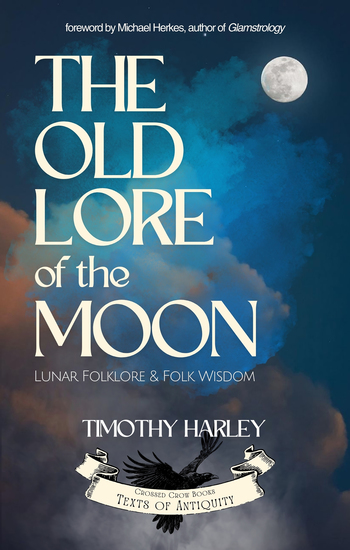
The Old Lore of the Moon - Lunar Folklore & Folk Wisdom - cover

The Old Lore of the Moon - Lunar Folklore & Folk Wisdom

Timothy Harley

Maison d'édition: Crossed Crow Books

  • 0
  • 0
  • 0

Synopsis

Explore the Magic of the Moon Once upon a time, minister, lecturer, and astronomer Rev. Timothy Harley published Moon Lore, a culmination of his understanding of the moon and its many myths. Now lovingly updated and reproduced for a modern audience, this book is the perfect reference for everything about lunar folklore. Contained within are different concepts about the moon that span time, religion, and nationality, covering many different interpretations of the moon’s entities and inhabitants. A charming addition to any library, The Old Lore of the Moon stands out among older books as a highly readable, informative, and entertaining entry.
Disponible depuis: 25/03/2025.
Longueur d'impression: 250 pages.

D'autres livres qui pourraient vous intéresser

  • Success in Dependency Court - cover

    Success in Dependency Court

    Nancee E. Tomlinson

    • 0
    • 0
    • 0
    This edition of Success offers advice focused on parents rather than specific laws. Parents need encouragement and support when facing the legal system which has removed their children. Success provides the steps and advice for parents to follow the unwritten rules the system uses to trip them up and create obstacles.
    Voir livre
  • Supporting Student Executive Functions - Insights and Strategies for Educators - cover

    Supporting Student Executive...

    Lisa Carey, Alexis Reid

    • 0
    • 0
    • 0
    In Supporting Student Executive Functions, two clinical and classroom experts deliver an insightful and accessible guide to executive functioning skills. Lisa Carey, Ed.D., and Alexis Reid, M.A., explain how these skills develop, how executive functioning challenges show up in the classroom, and how, if unaddressed, those challenges interfere with student learning. 
    Part I builds an understanding of the science of executive functioning and how it develops during the K–12 years. Part II offers a practical, example-rich approach to help educators develop and support students’ executive functions with tips, suggestions, and action steps.  
    Building on the research-backed Universal Design for Learning (UDL) Guidelines, the authors pay special attention to the Guideline “Provide options for Executive Functions” to show which types of supports are most meaningful at different stages of a student’s K–12 journey. 
    Educators—but also medical professionals, caregivers and parents, and students themselves—will gain a deeper understanding of the latest science on executive functioning as well as valuable, easy-to-implement strategies to use in the classroom today.
    Voir livre
  • Rebound - Sports Community and the Inclusive City - cover

    Rebound - Sports Community and...

    Perry King

    • 0
    • 0
    • 0
    From basketball hoops to cricket bats, the role community sports play in our cities and how crucial they are to diversity and inclusion.
    		 
    “The virus exposed how we live and work. It also revealed how we play, and what we lose when we have to stop.” For every kid who makes it to the NBA, thousands more seek out the pleasure and camaraderie of pick-up basketball in their local community centre or neighbourhood park. It’s a story that plays out in sport after sport – team and individual, youth and adult, men's and women's. While the dazzle of pro athletes may command our attention, grassroots sports build the bridges that link city-dwellers together in ways that go well beyond the physical benefits. The pandemic and heightened awareness of racial exclusion reminded us of the importance of these pastimes and the public spaces where we play. In this closely reported exploration of the role of community sports in diverse cities, Toronto journalist Perry King makes an impassioned case for re-imagining neighbourhoods whose residents can be active, healthy, and connected.
    		 
    “I couldn’t stop reading Perry King’s Rebound. An evocative essay about the transformative and uniting power of local sports in a city with residents from every country in the world, the book is well researched, entertaining, and informative. It spoke to my own experiences as a young athlete fitting into a new city when I first came to Toronto – and to the importance our city government must place on local recreation and sports if our city is to help all residents reach their potential. A fantastic contribution to understanding Toronto – and to the power of local recreation in any major city.” —David Miller, former mayor of Toronto
    Voir livre
  • Heraclitus - Ancient Philosophy and the Flux of Existence - cover

    Heraclitus - Ancient Philosophy...

    Hector Davidson

    • 0
    • 0
    • 0
    Heraclitus of Ephesus, a pre-Socratic philosopher who lived in the 6th century BCE, remains one of the most enigmatic figures in the history of Western thought. Known for his cryptic sayings and profound insights into the nature of reality, Heraclitus' ideas have had a lasting influence on philosophy, science, and the arts. His philosophy, often centered around the concept of change, emphasized that everything in existence is in a constant state of flux. This view is encapsulated in one of his most famous quotes: "You cannot step into the same river twice." For Heraclitus, the essence of life and the universe lies in this unceasing transformation, where stability and change are not opposing forces but interconnected aspects of existence. 
    At the core of Heraclitus' thought is his doctrine of "flux", which asserts that everything is in a perpetual state of becoming rather than being. This contrasts sharply with other pre-Socratic philosophers like Parmenides, who held that change was illusory and that true reality was unchanging and eternal. Heraclitus, however, rejected this view and instead argued that change is not only inevitable but also necessary for the very existence of the cosmos. To him, the dynamic interplay between opposing forces—such as life and death, hot and cold, light and dark—was the fundamental structure of reality. These dualities, far from being contradictions, were essential for the creation and maintenance of order in the universe.
    Voir livre
  • Ancient Egyptian Gods - From Ra to Anubis - cover

    Ancient Egyptian Gods - From Ra...

    Odessa Nightshade

    • 0
    • 0
    • 0
    Ancient Egyptian civilization was deeply intertwined with religion, and at the heart of their belief system was a vast pantheon of gods and goddesses. These deities were more than just figures of worship; they shaped every aspect of daily life, from the rising of the sun to the passage into the afterlife. Unlike many modern religions, Egyptian theology was fluid, allowing gods to merge, evolve, or take on different roles depending on the time and region. This dynamic belief system gave rise to a rich mythology that endured for thousands of years.   
    The gods of Egypt were not distant, abstract beings but rather personal and deeply involved in the world. They governed nature, oversaw justice, protected the people, and maintained cosmic balance, known as *ma’at*. The concept of *ma’at* was central to Egyptian religion, representing order, harmony, and truth. It was the gods' duty to uphold *ma’at* against chaos, often personified by Set, the god of disorder and storms. This cosmic struggle played out in myths, particularly in the tales of Osiris, Isis, and Horus, which symbolized the eternal battle between good and evil, life and death.  
    Temples were the primary centers of worship, serving as both religious and political institutions. Each major city had its patron deity, and grand temples were built to honor and house these gods. Priests conducted daily rituals, offering food, incense, and prayers to ensure divine favor. Unlike in many other religions, common Egyptians were not allowed direct access to the inner sanctums of temples, where the gods' statues resided. Instead, they worshipped through prayers, festivals, and personal altars in their homes. 
    Voir livre
  • Lateral Thinking Lessons and Puzzles to Unlock Creativity and Leadership Ability - Simple and Easy Methods to Boost Brain Power in Ages 16 and Up - cover

    Lateral Thinking Lessons and...

    Paul Pantera

    • 0
    • 0
    • 0
    We cannot continue to educate our children for a world that no longer exists. A glance at any employment website shows a list of job titles unheard of 20 years ago. All of them require some form of lateral thinking as the focus has shifted from mechanical processes to creative solutions. We need to train our brains to break free of habitual, conditioned thought patterns. The puzzles in this book will gradually guide the reader to start seeing information as something to be processed rather than memorized. As we learn to evaluate the facts given critically, we can work out how to fit them together in unexpected ways to achieve different outcomes. We can also improve our ability to communicate our ideas while considering other points of view. Paul D. Pantera is an entrepreneur and US Navy Sailor Senior Enlisted Leader who has trained hundreds of Junior Sailors over his 16+ year career. His goal is to provide parents, educators, and young adults with the tools to bridge the gap between their children’s education and the skills they require in the real world. One of the biggest challenges is problemsolving abilities. He has put together a practical approach to create a basic system to develop a different way of thinking. The Pantheria Life Tools are games, journals, and books with the simple goal of building productive citizens.
    Voir livre