Begleiten Sie uns auf eine literarische Weltreise!
Buch zum Bücherregal hinzufügen
Grey
Einen neuen Kommentar schreiben Default profile 50px
Grey
Jetzt das ganze Buch im Abo oder die ersten Seiten gratis lesen!
All characters reduced
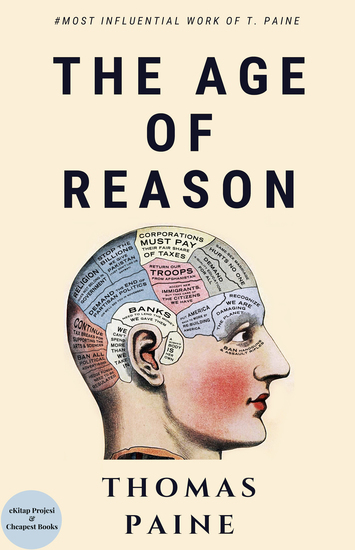
The Age of Reason - # Most Influential Work of T Paine - cover

The Age of Reason - # Most Influential Work of T Paine

Thomas Paine

Verlag: E-Kitap Projesi & Cheapest Books

  • 0
  • 0
  • 0

Beschreibung

A major actor in the American Revolution, the English intellectual Thomas Paine (1737-1809) is best remembered for his pamphlet Common Sense (1776), which advocated American independence from Britain. Although accorded honorary French citizenship in 1792 for his republican Rights of Man, Paine was later imprisoned and narrowly escaped the guillotine. It was around this time that he started to write The Age of Reason, originally published in two parts between 1794 and 1795.In Part 1, Paine outlines his personal religious views and attacks institutional faith as a human invention, while Part 2 analyses the Bible and highlights its contradictions. The work was met with great hostility in Britain and denounced as espousing atheism, while in America it led to a short-lived revival of deism but was also much reviled. This reissue includes both parts and affords valuable insight into radical freethinking during the age of revolutions.MISSIONS AND REVELATIONSEvery national church or religion has established itself by pretending some special mission from God, communicated to certain individuals. The Jews have their Moses; the Christians their Jesus Christ, their apostles and saints; and the Turks their Mahomet; as if the way to God was not open to every man alike.Each of those churches shows certain books, which they call revelation, or the Word of God. The Jews say that their Word of God was given by God to Moses face to face; the Christians say, that their Word of God came by divine inspiration; and the Turks say, that their Word of God (the Koran) was brought by an angel from heaven. Each of those churches accuses the other of unbelief; and, for my own part, I disbelieve them all.As it is necessary to affix right ideas to words, I will, before I proceed further into the subject, offer some observations on the word revelation. Revelation when applied to religion, means something communicated immediately from God to man.
Verfügbar seit: 05.12.2023.
Drucklänge: 200 Seiten.
Weitere Bücher, die Sie mögen werden

  • Capitalism and Inequality - Exploring the Economic Divide in a Capitalist Society - cover

    Capitalism and Inequality -...

    Arlo Holders

    • 0
    • 0
    • 0
    Capitalism, as an economic system, is based on private ownership of the means of production and the creation of goods or services for profit. In capitalist societies, market forces—supply and demand—determine the distribution of resources and wealth. This system is characterized by competition, limited government intervention, and the pursuit of profit. Over time, capitalism has evolved in response to global events, technological advancements, and changes in social and political structures. However, a fundamental aspect of capitalism that persists is the inherent inequality it creates. 
    Inequality in capitalist societies can be understood in several forms: wealth inequality, income inequality, and social inequality. Wealth inequality refers to the uneven distribution of assets like property, stocks, and savings, where a small percentage of the population controls a large share of the wealth. Income inequality, on the other hand, concerns the differences in wages and salaries among workers, managers, and capital owners. Social inequality arises from disparities in access to resources like education, healthcare, and housing, which are often shaped by economic factors. 
    At the heart of capitalist inequality is the idea that economic success is determined by individual effort, entrepreneurship, and market performance. While this promotes competition and innovation, it also leads to stark divides between the wealthy and the poor. Those who control capital—such as land, factories, or intellectual property—are in a position to accumulate wealth far faster than those who rely solely on their labor. This uneven accumulation of wealth deepens the divide between rich and poor, creating a cycle where the wealthy continue to grow their resources, while those at the bottom struggle to access basic needs.
    Zum Buch
  • The Roman Catholic Bishops of Lancaster - Celebrating the Centenary 1924–2024 - cover

    The Roman Catholic Bishops of...

    Paul Severn

    • 0
    • 0
    • 0
    In the century since its founding in 1924, the Roman Catholic diocese of Lancaster has had seven bishops and one auxiliary bishop. In a series of biographical portraits, Paul Severn tells the story of each of the bishops, explores their background and their impact on the life of the diocese in a century of change in the Church and in the wider world.
    
     
    Looking back on a century that has seen two world wars, profound changes in society, the “revolution” of the Second Vatican Council, increasing secularization and declining numbers of those attending church, and the beginnings of synodality, he reflects on the lives of the individual bishops and also on the role and responsibility of Roman Catholic bishops in the twenty-first century.
    Zum Buch
  • Spiritual Centers in Man - cover

    Spiritual Centers in Man

    Manly P. Hall

    • 0
    • 0
    • 0
    In "Spiritual Centers in Man," Manly P. Hall maps the inner landscape - exploring the seven chakras and their connection to our consciousness, emotions, and potential. He suggests an "invisible hand" guides us towards spiritual growth, offering a unique perspective on self-discovery and human potential. Think "energy map" meets "inner journey" for a glimpse into this esoteric classic.
    Zum Buch
  • Calling Sergeant Crockford - cover

    Calling Sergeant Crockford

    Ruth D'Alessandro

    • 0
    • 0
    • 0
    It's the dawn of the Swinging Sixties. The Cold War is at its height and support for the Campaign for Nuclear Disarmament is building. The Berkshire Constabulary's Detective Gwen Crockford is promoted to Woman Police Sergeant in Newbury – the town at the heart of Britain's atomic weapons programme. 
     
    Gwen's initial reservations that her posting in rural Berkshire will be boring soon prove to be unfounded. A serial sex attacker on the loose, an attempted murder at Greenham Common US Airforce Base, and a charismatic heiress with a family secret keep things interesting for the capable sergeant. 
     
    Laser-focused on her police career – and resigned to the single life – Gwen is forced to re-evaluate her plans when a nature-loving war veteran PC walks into the station with an orphaned fox cub, and there's a shocking discovery in a railway station lavatory. 
     
    Written by her daughter Ruth and rich in social history, this is the story of a real-life woman police sergeant at the top of her game, guiding her WPCs through the immense societal changes of the early 1960s.
    Zum Buch
  • Diogenes - The Cynic Who Lived in a Barrel - cover

    Diogenes - The Cynic Who Lived...

    Hector Davidson

    • 0
    • 0
    • 0
    Diogenes of Sinope, one of the most famous figures in ancient philosophy, is a man whose life and ideas have left an indelible mark on the world. Known for his eccentric behavior and unwavering commitment to a life of simplicity, Diogenes was one of the founders of the philosophical school of Cynicism. His life was a statement, rejecting the norms and conventions of society in pursuit of a personal freedom that few could fully understand, much less emulate. To this day, his legacy remains a profound reminder of the power of nonconformity and the pursuit of virtue above material wealth. 
    Born in Sinope (modern-day Sinop, Turkey), Diogenes was a figure who viewed the world with a unique lens. He rejected the luxuries and complexities of Athenian society, seeking instead a life of self-sufficiency, minimalism, and authenticity. His choice to live in a barrel, or more accurately, a large ceramic jar, in Athens became a symbol of his commitment to simplicity and his disdain for materialism. Diogenes wasn’t just a philosopher; he was a living critique of the social structures around him. His constant questioning of authority, wealth, and societal expectations created a lasting legacy that went beyond words and doctrines. 
    The Cynic philosophy that Diogenes embodied was radical for its time. It was a philosophy that urged individuals to cast off the superficial trappings of society—wealth, fame, and social standing—and instead focus on living virtuously and naturally. Diogenes practiced what he preached, often engaging in acts that were both shocking and humorous, yet deeply philosophical. His public antics, such as walking around Athens in broad daylight with a lantern claiming to be "looking for an honest man," were not mere provocations but expressions of a profound philosophical stance against the moral decay he saw in society.
    Zum Buch
  • The Future of Learning - Solutions That Empower Teachers Inspire Students and Bridge the Learning Gap - cover

    The Future of Learning -...

    Nura Uba

    • 0
    • 0
    • 0
    Education is changing but not fast enough. Around the world, schools are struggling with outdated curricula, rigid testing, teacher burnout, and a widening gap in access and opportunity. The Future of Learning: Solutions That Empower Teachers, Inspire Students, and Bridge the Learning Gap offers a powerful blueprint for reimagining how we teach and learn in the 21st century. 
    This Audiobook exposes the deep flaws in today’s education system from disengaged students and overworked teachers to the misuse of technology and presents practical, real-world solutions drawn from inspiring global examples. It explores how empowering teachers, redesigning curricula, integrating meaningful technology, and supporting mental health can create classrooms where every student thrives. 
    At its heart, The Future of Learning is about restoring purpose and passion to education. It highlights the shift from rote memorization to critical thinking, creativity, and real-world problem-solving. Through stories from Finland, Singapore, India, and beyond, listeners discover how innovation, equity, and community collaboration can build a learning system that works for everyone. 
    Whether you’re an Educator, Parent, Policymaker, or Lifelong Learner, this audiobook will challenge and inspire you to see education not as a broken institution but as humanity’s greatest opportunity to shape a brighter, fairer, and more connected future. 
    Zum Buch