Join us on a literary world trip!
Add this book to bookshelf
Grey
Write a new comment Default profile 50px
Grey
Subscribe to read the full book or read the first pages for free!
All characters reduced
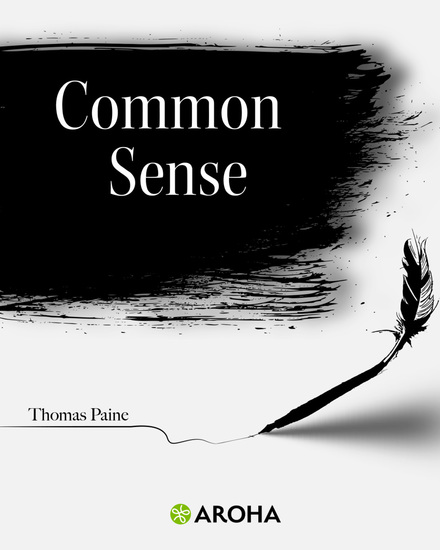
Common sense - cover

Common sense

Thomas Paine

Publisher: Aroha

  • 0
  • 0
  • 0

Summary

Common Sense by Thomas Paine
A revolutionary pamphlet advocating for American independence from British rule. Paine uses plain language to argue for self-governance, criticize monarchy, and inspire colonial unity. His persuasive rhetoric played a key role in mobilizing public opinion during the American Revolution.
Available since: 02/26/2025.
Print length: 184 pages.

Other books that might interest you

  • Retrospective on the Gulf - The Questions of War - cover

    Retrospective on the Gulf - The...

    Neal Conan

    • 0
    • 0
    • 0
    It was phenomenally successful in the air, strikingly decisive on the ground—and suddenly the war in the Persian Gulf was over, with an overwhelming victory for the allied forces. But what really happened? Why did the air war work so well? Why did the massive, allied casualties many predicted for the ground phase never materialize? Why was it all so easy when American intelligence had said it would be so hard? And what was the impact of using a war plan devised to fight the Warsaw Pact against a developing nation? On this thought-provoking recording, some of NPR's top reporters—Neal Conan, Deborah Amos, Ted Clark, and Anne Garrels—examine these and other questions from the Gulf War.
    Show book
  • The Secret History of Food - Strange but True Stories About the Origins of Everything We Eat - cover

    The Secret History of Food -...

    Anonymous

    • 0
    • 0
    • 0
    An irreverent, surprising, and entirely entertaining look at the little-known history surrounding the foods we know and love 
     
    Is Italian olive oil really Italian, or are we dipping our bread in lamp oil? Why are we masochistically drawn to foods that can hurt us, like hot peppers? Far from being a classic American dish, is apple pie actually . . . English? 
    “As a species, we’re hardwired to obsess over food,” Matt Siegel explains as he sets out “to uncover the hidden side of everything we put in our mouths.” Siegel also probes subjects ranging from the myths—and realities—of food as aphrodisiac, to how one of the rarest and most exotic spices in all the world (vanilla) became a synonym for uninspired sexual proclivities, to the role of food in fairy- and morality tales. He even makes a well-argued case for how ice cream helped defeat the Nazis. 
    The Secret History of Food is a rich and satisfying exploration of the historical, cultural, scientific, sexual, and, yes, culinary subcultures of this most essential realm. Siegel is an armchair Anthony Bourdain, armed not with a chef’s knife but with knowledge derived from medieval food-related manuscripts, ancient Chinese scrolls, and obscure culinary journals. Funny and fascinating, The Secret History of Food is essential reading for all foodies. 
    Supplemental enhancement PDF accompanies the audiobook.
    Show book
  • Our New World - A Journey to People and Places Building the Future Today - cover

    Our New World - A Journey to...

    Florian Hoffmann

    • 0
    • 0
    • 0
    The pandemic, the climate crisis, work – today's world isn't short of challenges. Social injustice. And technology that is slowly but steadily creeping into every aspect of our lives. But what if the answers to the big questions aren't found in simplistic technocracy or a mood of the-end-is-nigh?
    
    Florian Hoffmann is a founder and social entrepreneur. For years, he has been talking to, and working with, people around the world who, like himself, want to make a contribution to a more sustainable, fairer and positive future.
    
    In Our New World (Die Neue Welt), he takes the reader on an expedition to the places and people that have already arrived in this future: young entrepreneurs, innovators, founders and leaders who are courageously shaping a better world.
    
    Florian Hoffmann demonstrates the huge potential for creating a better future today. He visits places and people around the world, where courage and imagination have already paved the way for the world of tomorrow. Beacons for the way ahead, these role models encourage readers to take their own steps into the New World. Many are breaking down the border between earning money and making a positive contribution, and are asking, more generally: What impact can I have, now and in the future? How can my success offer others new chances?
    
    The journalist Saba is fighting for girls' and women's right in Pakistan. Niall dumps his high-flying job to find a solution for microplastics pollutions. Lily wants to inspire people to take up life-long learning – and develops scenarios for what future jobs might look like. These are some of the many diverse voices who believe in a better future.
    Show book
  • The Mind In The Making - cover

    The Mind In The Making

    James Harvey Robinson

    • 0
    • 0
    • 0
    "The Mind in the Making" is a seminal work by James Harvey Robinson, first published in 1921. In this book, Robinson explores the development of the human mind, its evolution, and the factors that shape individual perception and understanding. He delves into various aspects of cognition, including critical thinking, creativity, curiosity, and adaptability, examining how these mental faculties influence human behavior and society at large.
    Show book
  • The African Campaign - Battles in the Desert and the Struggle for North Africa - cover

    The African Campaign - Battles...

    Sage Winters

    • 0
    • 0
    • 0
    The North African Campaign, which unfolded between 1940 and 1943, was a pivotal series of battles and military operations during World War II. Spanning vast desert landscapes, the struggle for control of North Africa became a key theatre of war, involving significant military forces from the Axis Powers—primarily Germany and Italy—and the Allied forces, including Great Britain, the United States, and various Commonwealth nations. The campaign’s significance went beyond the battles themselves; it had a profound impact on the broader strategies of World War II, shaping both the fortunes of the combatants and the postwar political landscape. 
      
    At the heart of the North African Campaign was the desert itself. The harsh conditions—extreme temperatures, limited water, and vast, featureless terrain—made it a unique battlefield where traditional warfare tactics were often less effective. The landscape dictated strategy and logistics, placing a premium on mobility and resourcefulness. The campaign saw the rise of new tactics and the introduction of novel technologies that would influence the outcome of the war. 
      
    The struggle for control of North Africa was strategically vital for several reasons. The region provided access to key shipping lanes in the Mediterranean, which were crucial for the transportation of troops and supplies between Europe and the Middle East. Additionally, North Africa was rich in natural resources, particularly oil, which became increasingly important as the war progressed. For the Axis powers, particularly Germany, securing North Africa was seen as a stepping stone toward further advances into the Middle East and the oil fields of the Caucasus. For the Allies, controlling the region was vital to prevent the Axis from gaining a foothold in the Suez Canal and threatening British colonial interests in Asia and Africa.
    Show book
  • The Big Ride At The Musical Fair - Come Join Our Musical Journey - cover

    The Big Ride At The Musical Fair...

    Julie Kirchhubel

    • 0
    • 0
    • 0
    The Big Ride At The Musical FairIt’s Fair time for the animals today, and they are all ready in their seats and really looking forward to the Big Ride starting. But the Ride can’t begin just yet. What – or who – are they waiting for?
    Show book