Rejoignez-nous pour un voyage dans le monde des livres!
Ajouter ce livre à l'électronique
Grey
Ecrivez un nouveau commentaire Default profile 50px
Grey
Abonnez-vous pour lire le livre complet ou lisez les premières pages gratuitement!
All characters reduced
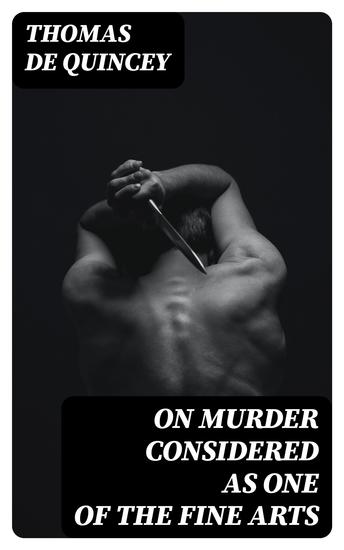
On Murder Considered as one of the Fine Arts - cover

On Murder Considered as one of the Fine Arts

Thomas De Quincey

Maison d'édition: DigiCat

  • 0
  • 0
  • 0

Synopsis

In "On Murder Considered as one of the Fine Arts," Thomas de Quincey ventures into a provocative exploration of aesthetics and morality against the backdrop of early 19th-century Britain. This remarkable essay employs a distinctive blend of dark humor and philosophical inquiry, challenging the reader to contemplate murder not just as an act of violence but as an artistic phenomenon worthy of scrutiny and appreciation. De Quincey's lyrical prose and intricate rhetorical style enhance the literary merit of the text, positioning it within the canon of Gothic literature and early criminal psychology, as he dissects the motivations of both murderer and audience in a meticulously structured narrative that balances grotesque fascination with moral complexity. De Quincey, a notable figure of the Romantic movement, drew upon his own tumultuous experiences and opium use, navigating the realms of addiction and intellectual exploration. His introspective writings often reflect upon darker aspects of human nature, which profoundly informed his unique perspective on violence and beauty. This work encapsulates not only his intellectual milieu but also the broader cultural currents of a society grappling with the implications of violence captured in popular media and societal narratives. "On Murder Considered as one of the Fine Arts" is essential reading for anyone seeking to understand the intersection of art and ethics, as well as the philosophical underpinnings of violence in literature. De Quincey's nuanced argumentation invites readers to appreciate the aesthetic dimensions of even the darkest human actions, making this text a compelling and unsettling exploration of art's moral territory.
Disponible depuis: 29/05/2022.
Longueur d'impression: 29 pages.

D'autres livres qui pourraient vous intéresser

  • Social Consequences of Labour Market Marginalisation in Germany - Analysing the Impact of Social Identities and Values - cover

    Social Consequences of Labour...

    Carlotta Giustozzi

    • 0
    • 0
    • 0
    Das Buch untersucht die sozialen Folgen von Arbeitsmarktmarginaliserung für nahe soziale Beziehungen und gesellschaftliche Partizipation in Deutschland. Dabei zeigen Mehrebenenmodelle und Längsschnittanalysen, die individuelle, haushaltsbezogene und regionale sozio-ökonomische Faktoren analysieren, dass finanzielle Schwierigkeiten nur marginal soziale Exklusion erklären können. Vielmehr sind soziale Rollen, Normen und Identität ausschlaggebend für eine Arbeitsmarktmarginalisierung.
    Voir livre
  • From Fear to Freedom - Mastering Social Interactions - cover

    From Fear to Freedom - Mastering...

    Fiona Zenith

    • 0
    • 0
    • 0
    Ever felt your heart race at the thought of a simple “hello”? Or found yourself dodging a room full of strangers, palms sweaty, mind racing with “what ifs”? Social fear can lock you in silence, turning everyday moments into mountains—but Fiona Zenith knows the way out. She’s walked that shaky path herself, from dreading small talk to discovering freedom on the other side. In this heartfelt guide, she offers nine practical steps to shed the heavy weight of anxiety and step boldly into connection. You’ll learn to quiet the doubts that echo in your head, face those pulse-quickening moments with steady courage, and build conversations that feel genuine—not forced. This isn’t about faking confidence or becoming someone new; it’s about uncovering the strength you already carry. Take a deep breath, turn the page, and start living freer—one real, brave moment at a time.
    Voir livre
  • Hollowed Out - Why the Economy Doesn't Work without a Strong Middle Class - cover

    Hollowed Out - Why the Economy...

    David Madland

    • 0
    • 0
    • 0
    For the past several decades, politicians and economists thought that high levels of inequality were good for the economy. But because America’s middle class is now so weak, the US economy suffers from the kinds of problems that plague less-developed countries. As Hollowed Out explains, to have strong, sustainable growth, the economy needs to work for everyone and expand from the middle out. This new thinking has the potential to supplant trickle-down economics—the theory that was so wrong about inequality and our economy—and shape economic policymaking for generations. 
      
    "The director of economic policy at the Center for American Progress argues that it is time to mount a political challenge to the economic theories—namely, supply-side, or trickle-down economics—that have provided cover for the unparalleled growth in inequality over the past three decades. … A dramatic and clearly delineated outline of 'how the stage has been set for transformative political conflict.'"—Kirkus
    Voir livre
  • Ferdinand Magellan: A short biography - 5 Minutes: Short on time - long on info! - cover

    Ferdinand Magellan: A short...

    5 Minutes, 5 Minute Biographies,...

    • 0
    • 0
    • 0
    Ferdinand Magellan, adventurer and discoverer: Life and work in a short biography! Everything you need to know, brief and concise. Infotainment, education and entertainment at its best!
    Voir livre
  • Stay Here - Uncovering God's Plan to Restore Your Mental Health - cover

    Stay Here - Uncovering God's...

    Jacob Coyne, Nick Vujicic

    • 0
    • 0
    • 0
    Please stay. The world is so much better with you in it. 


    Every forty seconds, someone takes his or her life. Anxiety, depression, and suicide are at all-time highs—and they're stealing our sons, daughters, friends, and spouses. 


    With tender passion and bold hope, Jacob Coyne, founder of Stay Here, infuses life into the dark corners of mental health. Giving hurting souls a reason to live, he shows not only how Jesus brings life to the full, but also how anyone—regardless of their past or pain—can find healing, including how to attack our anxiety and calm our storms; defeat depression and live with a sound mind; overcome intrusive suicidal thoughts and enjoy life; and transform pain, trauma, suicidal thoughts, and addictions into purpose. 


    It's okay to not be okay—but you don't have to stay that way. It's time to shine the hope of Christ into the darkness and witness His love transform broken souls into living, breathing signs to live.
    Voir livre
  • May Contain Lies - How Stories Statistics and Studies Exploit Our Biases And What We Can Do About It - cover

    May Contain Lies - How Stories...

    Alex Edmans

    • 0
    • 0
    • 0
    Our lives are minefields of misinformation. It ripples through our social media feeds, our daily headlines, and the pronouncements of politicians, executives, and authors. Stories, statistics, and studies are everywhere, allowing people to find evidence to support whatever position they want. Many of these sources are flawed, yet by playing on our emotions and preying on our biases, they can gain widespread acceptance, warp our views, and distort our decisions. 


    In this eye-opening book, renowned economist Alex Edmans teaches us how to separate fact from fiction. Using colorful examples—from a wellness guru's tragic but fabricated backstory to the blunders that led to the Deepwater Horizon disaster to the diet that ensnared millions yet hastened its founder's death—Edmans highlights the biases that cause us to mistake statements for facts, facts for data, data for evidence, and evidence for proof. 


    Armed with the knowledge of what to guard against, he then provides a practical guide to combat this tide of misinformation. Going beyond simply checking the facts and explaining individual statistics, Edmans explores the relationships between statistics—the science of cause and effect—ultimately training us to think smarter, sharper, and more critically.
    Voir livre