Begleiten Sie uns auf eine literarische Weltreise!
Buch zum Bücherregal hinzufügen
Grey
Einen neuen Kommentar schreiben Default profile 50px
Grey
Jetzt das ganze Buch im Abo oder die ersten Seiten gratis lesen!
All characters reduced
An Essay on the Slavery and Commerce of the Human Species Particularly the African - Challenging Inhumanity: A Moral Essay on African Slavery - cover

An Essay on the Slavery and Commerce of the Human Species Particularly the African - Challenging Inhumanity: A Moral Essay on African Slavery

Thomas Clarkson

Verlag: Good Press

  • 0
  • 0
  • 0

Beschreibung

In "An Essay on the Slavery and Commerce of the Human Species, Particularly the African," Thomas Clarkson presents a meticulous examination of the transatlantic slave trade, combining passionate rhetoric with rigorous research. Writing at a time when the abolition movement was gaining traction in Britain, Clarkson's work is characterized by a bold moral urgency and a commitment to empirical evidence. His literary style incorporates vivid descriptions and compelling narratives, interweaving testimonies of the enslaved with statistical evidence to confront readers with the grim realities of human trafficking. This seminal text serves as both a call to action and a scholarly critique of the systems that enable slavery, situating itself firmly within the Enlightenment discourse on human rights and social justice. Thomas Clarkson (1760'Äì1846) was a prominent abolitionist and social reformer whose personal convictions and experiences significantly influenced his advocacy against slavery. His extensive travels and interactions with formerly enslaved individuals provided him with firsthand accounts that deeply informed his writings. Clarkson's commitment to justice was unwavering, and his scholarly pursuits were driven by moral imperatives rooted in his Quaker beliefs. This book is essential reading for anyone interested in the historical context of slavery and the roots of abolitionism. Clarkson'Äôs detailed analysis and passionate argumentation not only illuminate the human suffering caused by the slave trade but also inspire ongoing discussions about human rights and ethical responsibilities in contemporary society.
Verfügbar seit: 15.08.2023.
Drucklänge: 138 Seiten.
Weitere Bücher, die Sie mögen werden

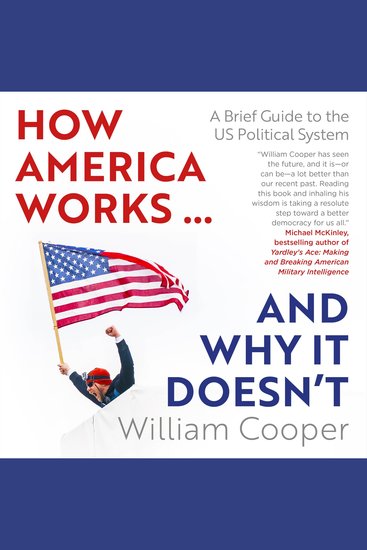
  • How America Worksand Why It Doesn't - A Brief Guide to the US Political System - cover

    How America Worksand Why It...

    William Cooper

    • 0
    • 0
    • 0
    Twenty-first-century America isn’t working the way it’s supposed to. 
    This book explains why. 
    Americans in the twenty-first century are becoming increasingly untethered from both reality and the essential principles and traditions that have shaped the nation’s historic success. A big part of why America isn’t working is because far too many Americans neither know nor care how it’s supposed to work. 
    “William Cooper presents an insightful, sensitive, and accessible account of the trials that face American democracy in the twenty-first century. This fair- and broad-minded volume makes compelling reading for those who are looking to build a better democracy.” Alexander Yen, Department of Politics and International Relations, University of Oxford 
    “Partisanship fuels personal convictions more than ever in our society, and convictions fuel mysided thinking and other cognitive biases. At no time have we needed this discussion of bias and partisan thinking more than now.” Keith E. Stanovich, author of The Bias That Divides Us 
    “William Cooper logically and authoritatively takes you step by step through all the reasons a President Trump couldn’t imprison his enemies, pardon his friends, overrule judges, weaponize the Department of Justice, prosecute Joe Biden, or order the military to enforce his unconstitutional actions” Cleveland Plain Dealer 
    “William Cooper is an insightful and thought-provoking writer about US politics. He deserves to be widely read.” Thomas Plate, former Editorial Page Editor, Los Angeles Times 
    "In How America Works . . . and Why It Doesn’t, William Cooper gives a thoughtful, readable guide to what ails American democracy. Required reading for any student of political science.” Uri Kaufman, author of Eighteen Days in October 
    "A must-read. His well-written and brief book covers a lot of important ground in a learned but accessible manner. Probably most noteworthy, though, is his astute and fair judgment―the book is not a polemic for the left or the right, but rather a fair appraisal of the strengths and weaknesses of both. I highly recommend reading it―it is an enjoyable tour of key aspects of history (as well as current events), ethics, political philosophy, constitutional law, environmental science, and cognitive psychology―all told in a lucid, efficient way." William O'Donohue, PhD, Professor, University of Nevada, Reno
    Zum Buch
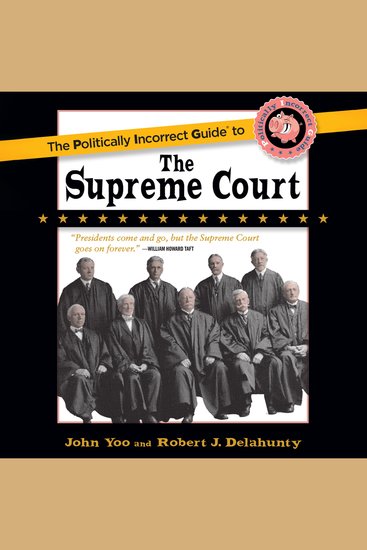
  • The Politically Incorrect Guide to the Supreme Court - cover

    The Politically Incorrect Guide...

    John Yoo, Robert Delahunty

    • 0
    • 0
    • 0
    Guaranteed to give the reader a deeper understanding of America’s most powerful judicial body, John Yoo, professor of law at UC Berkeley, and Robert Delahunty, professor of law at the University of St. Thomas detail in sprightly, slightly irreverent manner how the black robed judges who make up the U.S. Supreme Court have swung like a pendulum from saviors of the Republic to super-legislators who usurp the roll of Congress and dictate law from the bench, back to defenders of the Constitution again—or at least for the moment.
    Zum Buch
  • Episode 15- International Organizations Under the Spotlight - cover

    Episode 15- International...

    Anjum Sharma

    • 0
    • 0
    • 0
    The year 2020 marked the completion of seventy-five years of the United Nations and the Food and Agriculture Organization. Apart from this, the World Health Organization was also an important topic of discussion throughout the year. Find out more in this episode.
    Zum Buch
  • Our Enemy the State: Book Summary & Analysis - cover

    Our Enemy the State: Book...

    Briefly Summaries

    • 0
    • 0
    • 0
    This is a concise summary and analysis of Our Enemy, the State, by Albert Jay Nock.
     
    It is not the original book and is not affiliated with or endorsed by Albert Jay Nock.
    Ideal those seeking a quick and insightful overview.
     
    Our Enemy, the State offers a compelling critique of modern government, challenging the conventional understanding of the state as a benevolent force for societal good. With razor-sharp analysis, this thought-provoking work examines the historical evolution of the state, exposing its inherent tendency to prioritize power over individual liberty and economic freedom. Combining philosophical insights with incisive commentary, it invites readers to question the role of the state in their lives and consider alternatives that uphold the principles of self-reliance and voluntary cooperation.
    Zum Buch
  • A Pathway to American Renewal - Red White and Black Volume II - cover

    A Pathway to American Renewal -...

    Sr Robert L. Woodson

    • 0
    • 0
    • 0
    This challenging and inspiring collection of essays constructively frames the story of Black America—not as a tragedy involving helpless victims, but as a model for the nation. Scholars and grassroots leaders recount the history—the gritty, painful, but often triumphant account of what blacks accomplished after slavery was ended. Denied access to the institutions of white America, they built their own churches, schools, hotels, and a host of other successful enterprises. Their resilience produced amazing increases in literacy, family formation, and income. 


    Today's unsung grassroots leaders are the living evidence of the power of resilience. They use their stories of overcoming adversity and their own fallibility to help others. The organizations they create heal their communities. 


    This volume presents the insights of scholars who warn of the dangerous forces that threaten to shackle the ability of blacks to succeed today. They warn that, by accepting the notion that black adversity continues to be the product of systemic racism and is therefore unchangeable, no one would need to step up to the realities of a responsible life. This kind of thinking has led to lowering standards in education and even in the judicial system. The scholars outline positive paths to the future.
    Zum Buch
  • The Capital Dilemma - Balancing Growth and Fairness in the Free Market - cover

    The Capital Dilemma - Balancing...

    Arlo Holders

    • 0
    • 0
    • 0
    The free market and capitalism have long been foundational principles of economic systems around the world. At their core, they represent the idea that economic decisions, such as production, investment, and distribution, should be guided by the forces of supply and demand with minimal government intervention. In a truly free market, goods and services are exchanged in a competitive environment where prices are determined by the collective actions of consumers and producers rather than by central planning or state control. 
    Capitalism, as an economic system, emerged during the early stages of the Industrial Revolution in the 18th and 19th centuries. Its roots trace back even further to mercantilist policies that prioritized trade and accumulation of wealth through colonial ventures. Over time, capitalism has evolved from simple trade systems to complex global markets, driven by the desire for profit and the expansion of economic activities. The central tenet of capitalism is the pursuit of self-interest, where individuals or organizations are motivated to create wealth by competing in open markets. 
    This system offers several advantages, such as fostering innovation, encouraging efficiency, and enabling individuals to accumulate wealth. By allowing businesses and entrepreneurs to operate freely, capitalism encourages the creation of new products, services, and technologies, which in turn leads to economic growth and increased standards of living. Moreover, the competitive nature of free markets ensures that resources are allocated efficiently, as businesses strive to meet consumer demands at the lowest cost.
    Zum Buch