Begleiten Sie uns auf eine literarische Weltreise!
Buch zum Bücherregal hinzufügen
Grey
Einen neuen Kommentar schreiben Default profile 50px
Grey
Jetzt das ganze Buch im Abo oder die ersten Seiten gratis lesen!
All characters reduced
Thinking about Thinking - America's Yeomanry and Cognoscenti - cover

Thinking about Thinking - America's Yeomanry and Cognoscenti

Thomas Christ

Verlag: Defiance Press and Publishing

  • 0
  • 0
  • 0

Beschreibung

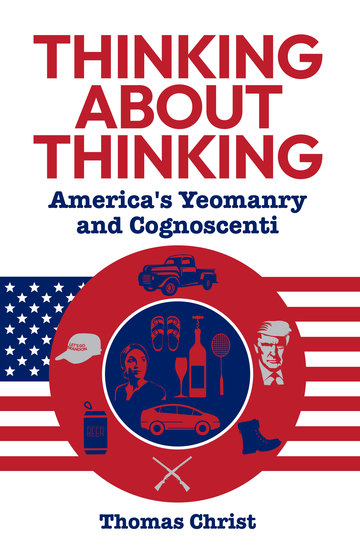
In "Thinking About Thinking: America's Yeomanry & Cognoscenti," Thomas W. Christ offers a profound sociological analysis of America's deepening ideological divide. Drawing on the works of Karl Marx, Peter Berger, Karl Mannheim, and David Riesman, Christ introduces a compelling framework that explains how technological and economic changes have transformed American society into two distinct sectors: the "yeomanry" and the "cognoscenti."
 
The yeomanry—primarily those working in traditional organizations and occupations—stand in stark contrast to the cognoscenti—those embedded within formal organizations and information economies. Christ meticulously traces how these divergent life experiences produce fundamentally different worldviews, explaining not just what Americans believe, but why they believe it.
 
From the rise of Donald Trump to debates about race, gender, and equality, Christ illuminates how our ideological positions function as badges of group affiliation rather than products of rational deliberation. Most importantly, he offers pathways toward bridging this divide through the cultivation of evidence-based thinking and mutual understanding.
 
Neither a conservative polemic nor a progressive manifesto, this book instead provides readers with an analytical framework to make sense of our fractured political landscape. By understanding the socioeconomic roots of our ideological differences, Christ argues, we can develop the empathy and insight needed to preserve American democracy in perilous times.
 
If you enjoyed "The Big Sort" by Bill Bishop, "Strangers in Their Own Land" by Arlie Russell Hochschild, and "Why We're Polarized" by Ezra Klein, you'll love "Thinking About Thinking: America's Yeomanry & Cognoscenti."
Verfügbar seit: 09.08.2023.
Drucklänge: 238 Seiten.

Weitere Bücher, die Sie mögen werden

  • Guided Meditation To Heal Narcissistic Abuse Gaslighting Codependency & Toxic Relationships - cover

    Guided Meditation To Heal...

    Tamsin Hart

    • 0
    • 0
    • 0
    This transformative meditation is your pathway to healing from the wounds of narcissistic abuse, gaslighting, and toxic relationships. In this safe and calming journey, you will be guided to reconnect with your inner strength, rebuild self-worth, and cultivate resilience. Designed to provide a sanctuary for your emotions, this audiobook encourages deep self-reflection and empowerment. 
    Through guided visualizations, you’ll explore the dynamics of harmful relationships, acknowledge their impact, and release self-blame. You’ll also learn to establish healthy boundaries and embrace self-compassion, laying the foundation for healthier connections. A series of affirmations will help you rewire negative thought patterns, replacing them with empowering beliefs that inspire self-love and positivity. 
    Perfect for nightly practice or moments of stress, this meditation offers a nurturing space to process emotions, reclaim your power, and take steps toward a life of peace and fulfillment. With each breath, you’ll move closer to freedom from toxic influences and a brighter, healthier future. 
    Let this guided meditation be your companion on the journey to healing and self-discovery. Take the first step toward reclaiming your happiness and thriving in the life you deserve.
    Zum Buch
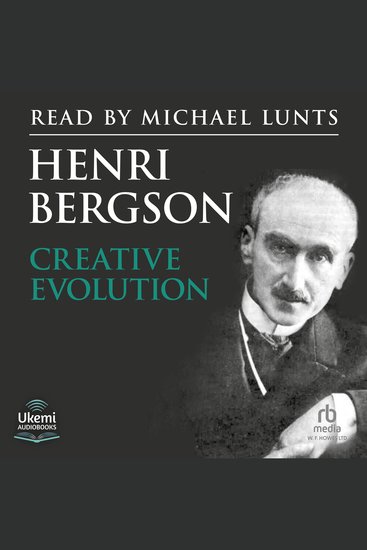
  • Creative Evolution - cover

    Creative Evolution

    Henri Bergson

    • 0
    • 0
    • 0
    Henri Bergson’s highly influential book, ‘Creative Evolution’ (‘Evolution Creatrice’, 1907) established a theory of evolution - called ‘Creative Evolution Theory’ - which gained a considerable following in the first half of the 20th Century. It also helped the author to win the Nobel Prize in 1927 for his work investigating the origins of biological information and divergence in the evolutionary process.  
     
    In this work, Bergson seeks an alternative explanation as to how new forms of life emerge compared to those prevailing at the time. This included both the ‘mechanistic’ or deterministic explanations of biological science on the one hand, and on the other the ‘finalist’ or strictly teleological explanation of those who believed in the hand of a ‘Creator’ or God, coordinating life in a divine plan. 
     
    Creative Evolution proposes a third explanation in what Bergson calls élan vital’ or ‘vital impetus’, a force that infuses all matter and drives it forward into an ever-changing and infinite variety of living forms. This appears as a vital impetus that can also be related to humanity’s own creative life force. Bergson’s book builds on his ‘Theory of Time’ as set forth in works such as ‘Matter and Memory’ and ‘Time and Free Will’.  In these works, and in the present volume, Bergson sees continuous ‘duration’ as real time, as opposed to the way in which time is divided up into measured units by the ‘organising’ mind of science. 
     
    Life, as we really experience it, is subject to constant change and our tendency to explain evolutionary change by looking only at ‘ends’ achieved rather than the processes by which they emerge, divorces us from the life force itself.  
     
    Instead, Bergson feels we need to reengage with our instincts as well as with our intelligence in order to understand the evolutionary process, as both co-exist to some extent within us, all forms of life having a common origin in that instinctual, innate knowledge of simpler life forms. Though these may be unconscious or semi-conscious, they are, in Bergson’s view, much more in touch with the ever-changing nature of real time than the analytical and rational knowledge of our species 
     
    As he writes:  “Our thought, in its purely logical form, is incapable of presenting the true nature of life, the full meaning of the evolutionary movement. Created by life, in definite circumstances, to act on definite things, how can it embrace life, of which it is only an emanation or an aspect?”  
     
    It is to attempt an answer to this question that ‘Creative Evolution’ directs its attention.
    Zum Buch
  • Jewish Language and Literature - The Impact of Yiddish Hebrew and Other Languages - cover

    Jewish Language and Literature -...

    Joseph Arston

    • 0
    • 0
    • 0
    The origins of Jewish language and literature are deeply intertwined with the history of the Jewish people, shaped by centuries of cultural exchange, migration, and adaptation. At the heart of Jewish literary tradition lies the Hebrew language, whose roots stretch back to the ancient world. Hebrew, as the language of the Bible, forms the foundation of Jewish thought, identity, and religious practice. The earliest examples of Hebrew literature can be found in the sacred texts of the Torah, where the stories, laws, and teachings of the Jewish people are recorded. These texts, passed down through generations, have remained central to Jewish life and continue to be a source of literary and theological inspiration. 
    In addition to Hebrew, other languages played an important role in the development of Jewish language and literature. Aramaic, a Semitic language closely related to Hebrew, became widespread during the Babylonian exile and remained influential for centuries. Aramaic is the language of significant portions of the Talmud and other rabbinic writings, shaping Jewish legal and philosophical thought. Over time, Jewish communities across the globe adopted the languages of the regions they inhabited, which further contributed to the diversity of Jewish literary expression. 
    The emergence of Yiddish, a language born in the Jewish communities of Eastern Europe, marked a significant shift in Jewish linguistic and literary culture. Yiddish, a Germanic language enriched with Hebrew, Aramaic, and Slavic elements, became the vernacular of millions of Ashkenazi Jews. It allowed for the creation of a vibrant body of literature, including plays, novels, and poetry, that expressed the daily lives, struggles, and aspirations of Jewish communities. Yiddish literature flourished in the 19th and early 20th centuries, with writers such as Sholem Aleichem, Isaac Bashevis Singer, and I.L. Peretz capturing the complexities of Jewish life through their works.
    Zum Buch
  • Essays: First Series The Over-Soul - cover

    Essays: First Series The Over-Soul

    Ralph Waldo Emerson

    • 0
    • 0
    • 0
    Ralph Waldo Emerson's The Over-Soul isn't just an essay—it's a revelation. It speaks of a vast, unshakable presence within us all, a silent force that knows, guides, and connects. Beyond intellect, beyond ego, Emerson leads us to the infinite.
    The Over-Soul is the quiet voice of truth, the source of wisdom that needs no teacher. It is intuition over logic, unity over isolation. When we listen, the noise of the world fades, and something deeper takes its place—clarity, purpose, transcendence.
    Emerson doesn't explain; he awakens. His words remind us that insight isn't learned but remembered, waiting beneath the surface of daily life. This isn't philosophy to study—it's truth to experience.
    Part of his seminal Essays: First Series, The Over-Soul remains a timeless meditation on the divine spark within. Open these pages, and you may just recognize something infinite in yourself.
    Zum Buch
  • Healing Through the Vagus Nerve - Improve Your Body's Response to Anxiety Depression Stress and Trauma Through Nervous System Regulation - cover

    Healing Through the Vagus Nerve...

    Amanda Armstrong

    • 0
    • 0
    • 0
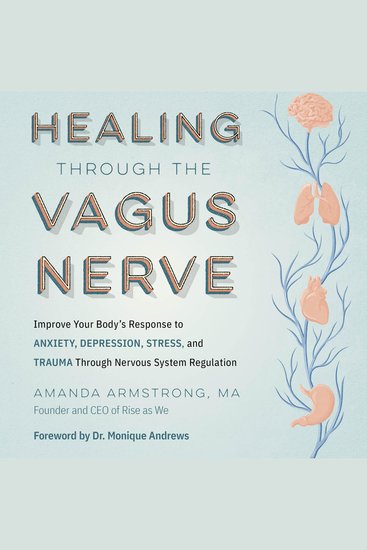
    “Thoroughly researched, clearly explained, and beautifully illustrated…[this book] provides powerful insights and actionable steps for regulating the nervous system.”—Alex Korb, Ph.D., Neuroscientist, Personal Development Coach, and Author of The Upward SpiralA somatic approach to treating trauma, anxiety, and depression has never been more popular. Perhaps that’s because recent studies show that 80% of mind-body communication originates in the body —the vagus nerve is the superhighway that facilitates this communication.  Healing Through the Vagus Nerve walks you through how the nervous system and the vagus nerve function, with approachable, non-academic language and helpful illustrations. Amanda Armstrong (founder of Rise as We) teaches all about vagal tone and the impact it has on your mental health and everyday life. Then, a variety of exercises and practices provide an adaptable approach to improving nervous system function:Breathing techniques including diaphragmatic breathing, physiological sigh, voo breath, and the Valsalva techniqueMassage techniques for the ear, neck, and abdomenVisual techniques including lateral eye stretches, eye pushups, orienting, eye cupping, and gaze openingPhysical techniques including cold exposure, yoga, and moreFeaturing relatable client stories, key details of the author’s own journey healing her nervous system, and a selection of entry points to help engage with the process, Healing Through the Vagus Nerve is a complete guide to improving your stress response through optimizing your vagus nerve and nervous system.Learn how to work with your nervous system instead of against it.
    Zum Buch
  • Underserved - Harnessing the Principles of Lincoln's Vision for Reconstruction for Today's Forgotten Communities - cover

    Underserved - Harnessing the...

    Ja'Ron Smith, Chris Pilkerton

    • 0
    • 0
    • 0
    Underserved is a tangible blueprint for today's conservative who understands the need for a new and viable political plan of action—one that addresses the needs of the underserved communities that make up these United States of America. Utilizing the concept of the "Party of Lincoln" and the conservative principles set forth over centuries by the movement's most recognized thought leaders, Underserved examines President Lincoln's intentions for Reconstruction, President Grant's aims to implement that vision, and Frederick Douglass's influence on both men in the process. Underserved brings home the very real impact of a failed plan that has had negative implications on modern America, whether conservative, moderate, or liberal. 


    With this historical plan as the linchpin for creating a framework that services disenfranchised communities, authors Ja'Ron K. Smith and Chris Pilkerton challenge conservative policy makers to employ strategies that mirror those originally presented over 160 years ago, while making necessary concessions for its modern audience. 


    From education and workforce development to criminal justice reform and healthcare disparities, Underserved makes a bold statement about what is necessary to see a change in the current state of affairs and presents a realistic action plan to make it happen.
    Zum Buch