Rejoignez-nous pour un voyage dans le monde des livres!
Ajouter ce livre à l'électronique
Grey
Ecrivez un nouveau commentaire Default profile 50px
Grey
Abonnez-vous pour lire le livre complet ou lisez les premières pages gratuitement!
All characters reduced
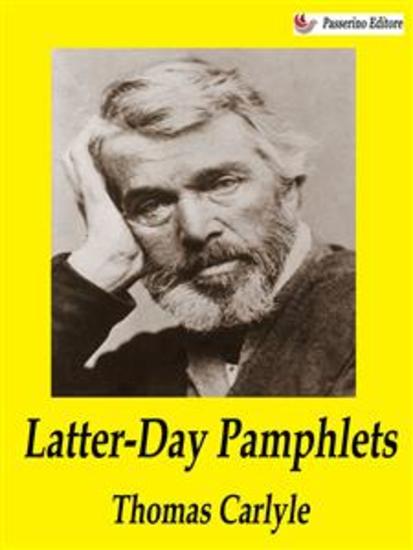
Latter-Day Pamphlets - cover

Latter-Day Pamphlets

Thomas Carlyle

Maison d'édition: Passerino

  • 0
  • 0
  • 0

Synopsis

Latter-Day Pamphlets was a series of "pamphlets" published by Scottish essayist, historian and philosopher Thomas Carlyle in 1850, in vehement denunciation of what he believed to be the political, social, and religious imbecilities and injustices of the period.

Thomas Carlyle (4 December 1795 – 5 February 1881) was a Scottish essayist, historian and philosopher. A leading writer of the Victorian era, he exerted a profound influence on 19th-century art, literature and philosophy. Born of peasant parents in Ecclefechan, Dumfriesshire, Carlyle attended the University of Edinburgh where he excelled in mathematics, inventing the Carlyle circle. After finishing the arts course, he prepared to become a minister in the Burgher Church while working as a schoolmaster. He quit these and several other endeavours before settling on literature, writing for the Edinburgh Encyclopædia and working as a translator. He found initial success as a disseminator of German literature, then little-known to English readers, through his translations, his Life of Friedrich Schiller (1825), and his review essays for various journals. His first major work was a novel entitled Sartor Resartus (1833–34). After relocating to London, he became famous with his French Revolution (1837), which prompted the collection and reissue of his essays as Miscellanies. Each of his subsequent works, from On Heroes (1841) to History of Frederick the Great (1858–65) and beyond, were highly regarded throughout Europe and North America. He founded the London Library, contributed significantly to the creation of the National Portrait Galleries in London and Scotland, was elected Lord Rector of Edinburgh University in 1865, and received the Pour le Mérite in 1874, among other honours.
Disponible depuis: 14/10/2022.

D'autres livres qui pourraient vous intéresser

  • Dang Dang Doko Dang - The Sound of the Empty Drum - cover

    Dang Dang Doko Dang - The Sound...

    Osho

    • 0
    • 0
    • 0
    Osho sees Zen not as a historical spiritual tradition but as the future spirituality of a humanity that has matured to the point that people no longer need religions controlled by priesthoods and based on fearful superstitions that cripple people's innate intelligence and divide them from one another.
    This series of talks offers a deeper understanding of the underlying differences between Eastern and Western approaches to religion and the nature of consciousness. It's a beautiful introduction to a world where each individual has the capacity for an instant and profound understanding of existence and a rebirth of the trust in life that each of us is born with.
    Dang Dang Doko Dang represents the sound of the drum beaten by a Zen master in an existential lesson for a disciple. As well as symbolizing the poetic quality of Zen, the title represents the special flavor of this collection of Osho's commentaries on well-known Zen stories. This volume is part of the Osho Classics series and also includes Osho's responses to questions about the meditation technique of Zazen.
    
    - Freedom Is To Know That Which Is
    - Existence Flows In and Out of You
    - Only the Center Can Win
    - Understanding Is More Than Enough
    - Nothing Changes a Man Except Awareness
    - Joy Is the Criterion
    - Not Knowing Is the Beginning of Zazen
    - You Are Already There
    - The Nondual Has Come
    - Happiness Is Always Herenow
    © & ℗ 1976 OSHO International Foundation
    Voir livre
  • Silencing White Noise - Six Practices to Overcome Our Inaction on Race - cover

    Silencing White Noise - Six...

    Willie Dwayne Francois III

    • 0
    • 0
    • 0
    Racism is omnipresent in American life, both public and private. We are immersed in what prominent Black church leader Willie Dwayne Francois III calls white noise—the racist speech, ideas, and policies that lull us into inaction on racial justice. White noise masks racial realities and prevents constructive responses to microaggressions, structural inequality, and overt interpersonal racism. 


    In this book, Francois calls people of all racial backgrounds to take up practices that overcome silence and inaction on race and that advance racial repair. Drawing from his anti-racism curriculum, the Public Love Organizing and Training (PLOT) Project, Francois encourages us to move from a "colorblind" stance and mythic innocence to one that takes an honest account of our national history and acknowledges our complicity in racism as a prelude to anti-racist interventions. 


    Weaving together personal narrative, theology, and history, this book invites us to engage six "rhythms of reparative intercession." These are six practices of anti-racism that aim to repair harm by speaking up and "acting up" on behalf of others. Silencing White Noise offers concrete ways to help people wrest free from the dangers of racism and to develop lifelong Christian anti-racist practices.
    Voir livre
  • German and Allied Air Forces in World War I: The History and Legacy of the Rivals in the Sky during the Great War - cover

    German and Allied Air Forces in...

    Editors Charles River

    • 0
    • 0
    • 0
    One of the most important breakthroughs in military technology associated with World War I, and certainly the one that continues to capture the public imagination, was the use of airplanes, which were a virtual novelty a decade before. While the war quickly ground to a halt in its first few months, the skies above the Western Front became increasingly busy. The great powers had already been acquiring aircraft for potential uses, but given that aerial warfare had never been a major component of any conflict, it’s understandable that few on either side had any idea what the planes were capable of doing. Furthermore, at the start of the war, all sides’ aircraft were ill-equipped for combat mostly because the idea that planes might somehow fight was still a novel one, and the adaptations had not yet been developed that would allow the aerial battles later in the war.  
    	As a result, aircraft were used almost entirely for reconnaissance early on, allowing generals to gain unprecedented levels of information about enemy movements. Such intelligence allowed the French to counter German movements in what became the First Battle of the Marne, ending Germany’s hopes for victory through the Schlieffen plan. Similarly, in the east, German planes were vital in tracking, encircling and destroying Russian forces at Tannenberg. 
    	The Royal Air Force (RAF), Britain's legendary air arm, was born in the skies above the First World War. The British had previously used balloons for spotting and reconnaissance for decades, and in the years leading up to the war, planes started seeing military use. They mostly provided reconnaissance, though experiments were made in using them offensively. During the Boer War of 1899-1902, the British Army used the crews of helium-filled balloons to plot and help target artillery fire. But these were small, tentative steps. The first patent to fit a machine gun to a plane, taken out in 1910, had not yet led to active fighting vehicles.
    Voir livre
  • Modern Nations - The Making of Australia New Zealand and Māori Identity (2 in 1) - cover

    Modern Nations - The Making of...

    Lillian Brooks

    • 0
    • 0
    • 0
    "Modern Nations: The Making of Australia, New Zealand, and Māori Identity (2 in 1)" explores the transformative journey of two nations as they evolved from colonial settlements into independent, modern states, while also examining the ongoing struggle for recognition and identity among Indigenous communities. This two-part volume captures the complex and often challenging histories that shaped Australia and New Zealand, revealing how these countries forged their national identities amidst cultural clashes, political shifts, and social change.  
    The first section, The Making of Modern New Zealand, traces New Zealand's path from British colony to sovereign nation, highlighting the impact of European settlement, the Treaty of Waitangi, and the ongoing fight for Māori rights and cultural preservation.  
    The second section, History of Australia, explores the formation of modern Australia — from its origins as a British penal colony to its emergence as a diverse and independent nation — while also acknowledging the profound and lasting effects of colonization on Aboriginal communities.  
    Together, these narratives provide a comprehensive understanding of how colonial histories, Indigenous resistance, and nation-building efforts have shaped the modern identities of Australia, New Zealand, and their Indigenous peoples. This book is an essential resource for anyone seeking to understand the dynamic and often contested histories that continue to influence these nations today.
    Voir livre
  • The Science of Confident Public Speaking - Mastering Presence Persuasion and Performance - cover

    The Science of Confident Public...

    Nathaniel Hart

    • 0
    • 0
    • 0
    The fear of public speaking is a common experience, affecting individuals across diverse professions and backgrounds. This book recognizes that fear and provides a comprehensive approach to understanding and overcoming it. It bridges the gap between the neuroscience of anxiety and the practical application of techniques for building confidence and delivering effective presentations.  
    We'll explore the neurological underpinnings of public speaking anxiety, examining the role of the amygdala, the brain’s fear center, and how our cognitive processes contribute to the amplification of anxiety.  
    You'll learn how cognitive distortions and negative self-talk can perpetuate a cycle of fear, and we'll equip you with strategies to challenge and reframe these unhelpful thought patterns.  
    But this book is not just about understanding the problem; it’s about finding solutions. We will delve into the remarkable power of neuroplasticity, the brain’s ability to rewire itself, and demonstrate how consistent practice and positive reinforcement can transform your response to public speaking.  
    We'll introduce you to a range of techniques, including mindfulness, visualization, breathwork, and cognitive behavioral therapy (CBT), all designed to help you manage stress, cultivate self-compassion, and build unwavering self-efficacy.  
    Furthermore, this book will guide you through the mechanics of effective communication, covering everything from crafting compelling narratives and mastering vocal delivery to employing powerful body language and engaging your audience.  
    Throughout the book, you'll find practical exercises, real-world examples, and case studies to help you integrate these techniques into your daily life and build lasting confidence.  
    Prepare to embark on a transformative journey, one that will not only improve your public speaking abilities but also empower you to become a more confident, clear, and charismatic communicator in all aspects of your life.
    Voir livre
  • Christianity and the Qur'an - The Rise of Islam in Christian Arabia - cover

    Christianity and the Qur'an -...

    Gabriel Said Reynolds

    • 0
    • 0
    • 0
    A leading Qur'anic scholar's revisionary account of how Islam emerged in dialogue with Christian traditions Challenging the dominant narrative about the history of the Qur'an and the emergence of Islam in a predominantly pagan context, Gabriel Said Reynolds presents the Qur'an as a text born within a largely Christian culture. As he examines the ways the Qur'an engages with Christian traditions—not only those of the New Testament but also those of late antique Christian literature—and with Christians themselves, Reynolds also draws on recent scholarship on pre-Islamic Arabic inscriptions suggesting that monotheism, Christianity in particular, was a significant presence in the pre-Islamic Hijaz, the region in which Muhammad preached. This study resituates the Qur'an as a text thoroughly concerned with Christianity, not just the longer narratives of individuals such as Mary and Jesus but also passages that do not mention Christians explicitly. The Qur'an's stance toward Christianity is on occasion controversial, aiming to advance Islamic theology and undermine Christian apologetical arguments, yet the Qur'an is not always polemical. At times, the text makes use of the audience's knowledge of the Bible to advance its own vision of God and God's relationship with humanity.
    Voir livre