Begleiten Sie uns auf eine literarische Weltreise!
Buch zum Bücherregal hinzufügen
Grey
Einen neuen Kommentar schreiben Default profile 50px
Grey
Jetzt das ganze Buch im Abo oder die ersten Seiten gratis lesen!
All characters reduced
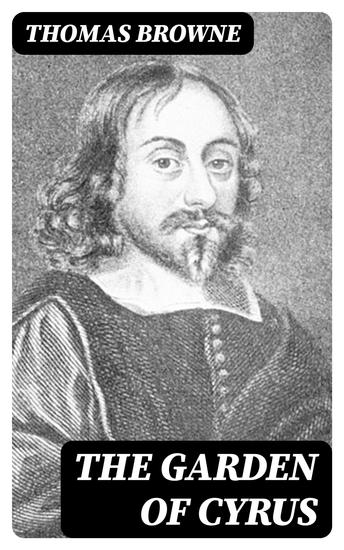
The Garden of Cyrus - Enriched edition - cover

The Garden of Cyrus - Enriched edition

Thomas Browne

Verlag: DigiCat

  • 0
  • 0
  • 0

Beschreibung

In 'The Garden of Cyrus,' Thomas Browne navigates the intricate relationship between nature, art, and philosophy through a distinctive literary style that intertwines prose and poetic elements. Published in 1658, this work exemplifies the author's fascination with the symbolism of the number five, which he meticulously explores through the lens of the quincunx—a geometric pattern that reflects both the intricacies of the natural world and human perception. Browne's exceptional blend of erudition and whimsy invites readers into a contemplative space where botanical observations flourish alongside metaphysical inquiries, positioning the book as a significant contribution to the genre of early modern scientific literature and an exploration of microcosmic and macrocosmic connections. Thomas Browne, a physician and polymath, is celebrated for his profound curiosity and intellect, attributes that propelled him to delve deeply into the philosophical questions surrounding existence and the natural order. His background in medicine informed his insights into the natural world, allowing Browne to blend empirical observation with philosophical reflection. 'The Garden of Cyrus' showcases his literary talents while reflecting the broader intellectual currents of the Renaissance, where explorations of nature often intersected with metaphysical musings. This captivating work is highly recommended for readers interested in the intersections of science, philosophy, and literature. Browne's eloquent prose invites a deep engagement with the themes of perception and order within the chaos of nature. Those who appreciate thoughtful introspection and the exploration of ideas will find 'The Garden of Cyrus' a richly rewarding experience.

In this enriched edition, we have carefully created added value for your reading experience:
- A succinct Introduction situates the work's timeless appeal and themes.
- The Synopsis outlines the central plot, highlighting key developments without spoiling critical twists.
- A detailed Historical Context immerses you in the era's events and influences that shaped the writing.
- An Author Biography reveals milestones in the author's life, illuminating the personal insights behind the text.
- A thorough Analysis dissects symbols, motifs, and character arcs to unearth underlying meanings.
- Reflection questions prompt you to engage personally with the work's messages, connecting them to modern life.
- Hand‐picked Memorable Quotes shine a spotlight on moments of literary brilliance.
- Interactive footnotes clarify unusual references, historical allusions, and archaic phrases for an effortless, more informed read.
Verfügbar seit: 10.08.2022.
Drucklänge: 50 Seiten.
Weitere Bücher, die Sie mögen werden

  • Nightstalkers - The Wright Project and the 868th Bomb Squadron in World War II - cover

    Nightstalkers - The Wright...

    Richard Phillip Lawless

    • 0
    • 0
    • 0
    “Takes the reader into the Pacific war and offers a front-row seat to the exploits of the Wright Project and their highly innovative technology.” —War History Network 
     
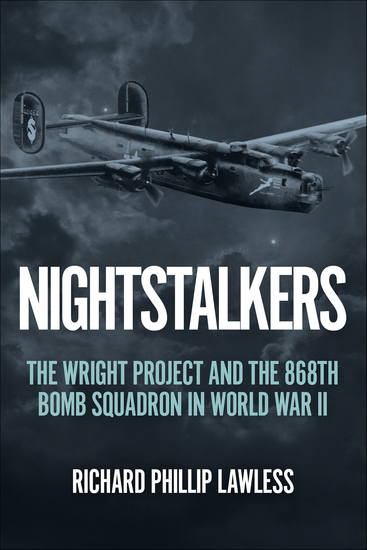
    In August 1943, a highly classified US Army Air Force unit, code-named the “Wright Project,” departed Langley Field for Guadalcanal in the South Pacific to join the fight against the Empire of Japan. Operating independently, under sealed orders drafted at the highest levels of Army Air Force, the Wright Project was unique, both in terms of the war-fighting capabilities provided by classified systems the ten B-24 Liberators of this small group of airmen brought to the war, and in the success these “crash-built” technologies allowed. The Wright airmen would fly only at night, usually as lone hunters of enemy ships. In so doing they would pave the way for the United States to enter and dominate a new dimension of war in the air for generations to come.  
     
    This is their story, from humble beginnings at MIT’s Radiation Lab and hunting U-boats off America’s eastern shore, through to the campaigns of the war in the Pacific in their two-year march toward Tokyo. The Wright Project would prove itself to be a combat leader many times over and an outstanding technology innovator, evolving to become the 868th Bomb Squadron.  
     
    Comprehensive and highly personal, this story can now be revealed for the very first time, based on official sources, and interviews with the young men who flew into the night. 
     
    “A limber romp across the world of electronics and into the history of World War II.” —ARGunners.com
    Zum Buch
  • How to Think More and Better - Being Reasonable in Unreasonable Times - cover

    How to Think More and Better -...

    William B. Irvine

    • 0
    • 0
    • 0
    William B. Irvine, author of the popular book "A Guide to the Good Life," offers much needed philosophical advice on how to become a more rational and critical thinker in today's emotionally-driven and complex world. 
      
    Even the most reasonable of us can be selective about when we think reasonably. We may realize that the best thing to do is to take the advice of our doctor when facing a medical issue. When shopping for a new car or appliance we might carefully assess online reviews and weigh our options calmly before making an informed decision. But when it comes to things that feel more fraught—voting, navigating a challenge in our family, figuring out what to do in a difficult professional situation—we might throw this approach out the window, dismissing facts and patterns that form a body of evidence, and trust our gut. (Of course, there is a time and place for this, but not every big decision is purely a matter of the heart.) Likewise, when we think about big ideas, about right and wrong, or about concepts so complex they make anyone's head spin, we can freeze, jumping to conclusions rather than wading into the details, or considering the existing arguments that others offer as a trail through challenging terrain. How can we do better? How can we train our minds to be more consistent? How can we practice using the best of our rational abilities when it matters most? 
      
    How to Think More and Better offers a philosopher's advice on becoming a more rational and critical thinker, rather than relying on emotions or hearsay to reach important decisions. It trains the reader in open-minded critical thinking. This thinking is crucial in a time of political polarization, social media, politicized news media, and echo chambers, to help us pursue truth and understanding in a world of rabbit holes, echo chambers, and disinformation. Irvine explains the prevalence of emotion-driven thinking is often at the expense of engagement with evidence, and then lays out strategies readers can use to train themselves to think more critically, drawn from what worked for him in the classroom. He also covers important areas to aid intellectual self-transformation, such as Mindcare and Mindcleaning.  
      
    With practice, most people can become evidence-based thinkers. Seemingly intractable contemporary problems might be solved if we all start engaging more in this kind of slow and careful thinking, considering arguments and evidence even from those on opposite sides of key debates. 
      
    "William B. Irvine is the voice of reason—and reasoned thinking—in a world that feasts on attention and spectacle and drama. How to Think More and Better is a guide to recovering our senses not only as citizens, but as judicious and thoughtful human beings."—Tom Nichols, author of The Death of Expertise
    Zum Buch
  • After the Blitz - The Luftwaffe Bombing of Britain 1941-1943 - cover

    After the Blitz - The Luftwaffe...

    Stephen Moore

    • 0
    • 0
    • 0
    From May 1941 to the end of night raids in 1943, Luftwaffe bombers attacked provincial cities across England, Scotland, and Wales. However, these air raids are not considered part of the Blitz—at least, not according to the British Official History. The official historiography maintains that the Blitz on the United Kingdom ended when aircraft were redeployed to support the invasion of the Soviet Union in June 1941, after the final major raid against London that May. In After the Blitz: The Luftwaffe Bombing of Britain, 1941–1943, author Stephen Moore argues that official histories minimize the impact of bombing on cities like Newcastle, Hull, Liverpool, Manchester, and Birmingham because they use attacks on London to define the Blitz's chronological boundaries. By excavating British and German archives and cross-referencing government documentation with memoirs and secondary sources, Moore demonstrates that Britain suffered from Luftwaffe assaults well after the official end date of the Blitz and rescues the history of post-Blitz bombings from obscurity. 
    After the Blitz cements itself in the historical record by confronting the official scholarship that has been foundational to the field and affirms the traumatic experiences of people who lived outside of London during this period.
    Zum Buch
  • Vocabulary Advancement - 12th Prep for Standardized Test and College Success - cover

    Vocabulary Advancement - 12th...

    Sophia Mitchell

    • 0
    • 0
    • 0
    This five session guide builds your vocabulary for college by presenting challenging words in multiple settings. Learning new vocabulary is a multi-stage process involving multiple interactions with new words in context. This course achieves this by explaining words through their definitions as you would expect, but then presenting them in stories, with their opposites, explaining relevant Greek and Latin word stems, semantic scales and using other proven techniques to rapidly expand your vocabulary via challenging, but commonly used words. This can be helpful for college readiness or test prep. Words include acrimonious, maudlin, nefarious, quixotic and pernicious. The audiobook includes over 100 grade-appropriate words. Each session is around 15 minutes long, making this a quick and easy way to grow your vocabulary and come back for a refresher as often as you need.
    Zum Buch
  • Dakota War of 1862 The: The History and Legacy of the Sioux Uprising during the American Civil War - cover

    Dakota War of 1862 The: The...

    Editors Charles River

    • 0
    • 0
    • 0
    Despite being one of the most erstwhile foes the U.S. government faced during the Indian Wars, the Sioux and their most famous leaders were grudgingly admired and eventually immortalized by the very people they fought. Sitting Bull and Crazy Horse remain household names due to their leadership of the Sioux at the fateful Battle of the Little Bighorn, where the native warriors wiped out much of George Custer’s 7th Cavalry and inflicted the worst defeat of the Indian Wars upon the U.S. Army. Red Cloud remains a symbol of both defiance and conciliation, resisting the Americans during Red Cloud’s War but also transitioning into a more peaceful life for decades on reservation.  
    	However, one of the more overlooked conflicts the U.S. Army had with the Sioux took place during the American Civil War. It is known by various names, including the Dakota War, the US-Dakota War, the Dakota Uprising, the Sioux Outbreak, and Little Crow’s War (after the principal Dakota leader), but the current most commonly used name for the war is the “Dakota War.” Two of the four Dakota tribes in the state unleashed their anger and frustration on largely immigrant communities that were heavily German or Norwegian, and the massacres took a heavy toll. In the process, the conflict featured the largest Indian siege of an Army fort in American history, and the end of the conflict brought the largest mass execution in American history.  
    	Indeed, the total loss of life during the Dakota War was perhaps the second largest of all the Indian Wars in North America, second only to the bloody King Philip’s War in colonial New England in the late 17th century, during which more than 1,000 settlers were killed. Throughout the Dakota War, as many as 800 whites were killed, although no one knows the total, and many of the victims were buried in anonymous mass graves.
    Zum Buch
  • Frost Nixon - Behind the Scenes of the Nixon Interview - cover

    Frost Nixon - Behind the Scenes...

    Anonym

    • 0
    • 0
    • 0
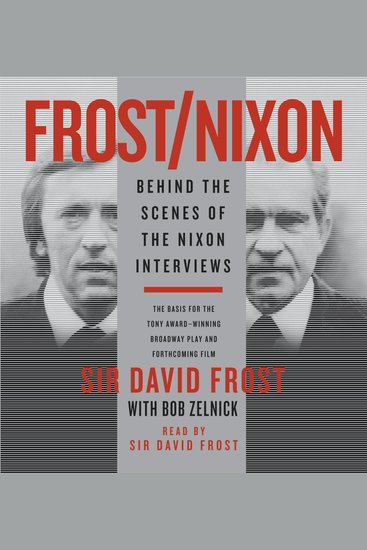
    Following the resounding success of the eponymous West End and Broadway hit play, Frost/Nixon tells the extraordinary story of how Sir David Frost pursued and landed the biggest fish of his career—and how the series drew larger audiences than any news interview ever had in the United States, before being shown all over the world. 
    This is Frost's absorbing story of his pursuit of Richard Nixon, and is no less revealing of his own toughness and pertinacity than of the ex-President's elusiveness. Frost's encounters with such figures as Swifty Lazar, Ron Ziegler, potential sponsors, and Nixon as negotiator are nothing short of hilarious, and his insight into the taping of the programs themselves is fascinating.  
    Frost/Nixon provides the authoritative account of the only public trial that Nixon would ever have, and a revelation of the man's character as it appeared in the stress of eleven grueling sessions before the cameras. Including historical perspective and transcripts of the edited interviews, this is the story of Sir David Frost's quest to produce one of the most dramatic pieces of television ever broadcast, described by commentators at the time as “a catharsis” for the American people.
    Zum Buch