Begleiten Sie uns auf eine literarische Weltreise!
Buch zum Bücherregal hinzufügen
Grey
Einen neuen Kommentar schreiben Default profile 50px
Grey
Jetzt das ganze Buch im Abo oder die ersten Seiten gratis lesen!
All characters reduced
Charity Holidays - cover

Charity Holidays

Theresa Walton

Übersetzer A AI

Verlag: Publifye

  • 0
  • 0
  • 0

Beschreibung

"Charity Holidays" explores the deep-rooted connection between holidays and charitable giving across diverse cultures and religious traditions. It reveals how philanthropy is not just an add-on but an integral part of celebrations like Giving Tuesday and Ramadan, shaping community values and fostering social responsibility. The book highlights how these traditions have evolved to impact communities worldwide, underlining the nuanced relationship between celebration and charitable action.

 
The book takes an interdisciplinary approach, drawing from history, religion, and sociology to examine how holidays serve as powerful platforms for promoting social cohesion. For example, the tradition of Ramadan charity illustrates how religious observances can inspire widespread generosity and support for those in need. It offers a comparative analysis of various charitable traditions, identifying both their unique features and common threads.

 
Structured in three parts, the book first lays the theoretical and historical groundwork, then delves into specific case studies such as Giving Tuesday and Ramadan, before synthesizing broader conclusions. It considers the impact of commercialization on holiday giving and provides valuable insights for those interested in philanthropy, cultural understanding, and the nonprofit sector.
Verfügbar seit: 06.03.2025.
Drucklänge: 68 Seiten.

Weitere Bücher, die Sie mögen werden

  • HBR's 10 Must Reads for Business Students - cover

    HBR's 10 Must Reads for Business...

    Harvard Business Review

    • 0
    • 0
    • 0
    Take your business education to the next level—and drive your career forward. 


    If you read (or listen to) nothing else to stand out in class and prepare for what's next, listen to these ten articles. We've combed through hundreds of Harvard Business Review articles and selected the best ones to help you learn the most important ideas in leadership and management, feel confident in your business classes, and be ready to thrive in any role you take on. 


    This book will inspire you to: succeed by playing to your strengths; learn to be more persuasive; give killer presentations; perfect your business-writing skills; find your authentic voice and leadership style; and build a purposeful career. 


    HBR's 10 Must Reads series is the definitive collection of books for new and experienced leaders alike. Leaders looking for the inspiration that big ideas provide, both to accelerate their own growth and that of their companies, should look no further. The series focuses on the core topics that every manager needs to know: leadership, strategy, change, managing people, and managing yourself. Each title includes timeless advice that will be relevant regardless of an ever-changing business environment.
    Zum Buch
  • The Analects of Confucius - cover

    The Analects of Confucius

    Confucius

    • 0
    • 0
    • 0
    The Analects are a fascinating anthology of the words and ideas of Confucius, gathered by his loyal disciples. They espouse a moral code by which each one of us should live based on ideals of responsibility, respect, kindness, and honesty - qualities as relevant and sought-after today as they were 2,500 years ago. His principles continue to shape Eastern philosophy, politics, and culture.
    Zum Buch
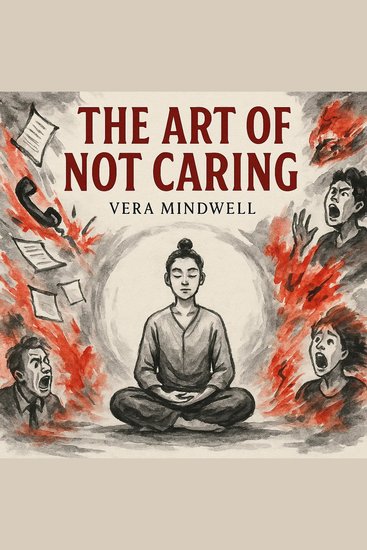
  • The Art of Not Caring - cover

    The Art of Not Caring

    Vera Mindwell

    • 0
    • 0
    • 0
    This audiobook is narrated by an AI Voice.  
    "What if the stress and overwhelm in your life aren’t caused by what you face—but by caring too much about things that don’t deserve your energy? In this liberating audiobook, Vera Mindwell challenges the belief that constant concern, emotional investment, and striving make us better or happier. Instead, she reveals how modern culture trains us to overthink, overextend, and overidentify with expectations that drain our wellbeing every day. 
    Drawing on psychology, neuroscience, and philosophy, Mindwell explains why the brain clings to worries, approval, and imagined threats—and how this automatic caring becomes a mental habit we mistake for responsibility. She offers a compelling alternative: the skill of selective concern, the art of choosing what actually matters while releasing everything that never truly did. 
    Through practical strategies and evidence-based insights, you’ll learn how emotionally grounded people set boundaries without guilt, detach from unhelpful narratives, and stay centered even when life gets loud. Mindwell dismantles the myth that caring more makes you more compassionate, showing instead how intentional detachment leads to healthier relationships, clearer priorities, and genuine inner peace. 
    If you’re tired of carrying the weight of everyone’s expectations, this audiobook invites you to let go—and finally breathe again."
    Zum Buch
  • Hungarian Made Easy - Beginner - Volume 2 of 3 - cover

    Hungarian Made Easy - Beginner -...

    Lingo Wave

    • 0
    • 0
    • 0
    We broke our new series on learning Hungarian down into different learning stages. Start with the "Lower Beginner" books followed by the "Beginner" and "Upper Beginner" books. Next, progress to the "Intermediate" series, then test and reinforce your knowledge with the "Conversations" series. 
    This audiobook is divided into units.While it provides different learning patterns and accommodates various needs, this audiobook focuses on helping you improve your ability to understand, speak, and memorise Hungarian. 
    In Unit 1 you will hear Hungarian decoded with each syllable spoken very slowly and clearly with repetition. Immediately before each sentence is spoken, you will hear the translation, so you will always understand what is being said. 
    Unit 2 focuses solely on increasing your listening ability, which will improve your abilities to engage in dialogue with a native Hungarian speaker. This chapter requires you to listen very carefully to nuances in the language. 
    By Unit 3 you will already notice progress in your abilities to speak and understand Hungarian. The spoken translation is followed by two repetitions in Hungarian at a completely natural speed. While you are learning to process naturally spoken Hungarian, Units 3 and 4 will help you memorise new vocabulary and full sentences. 
    In Unit 5 you can test yourself on how much you have learned. If you are having difficulties, we suggest you revisit the listening, speaking, or memorisation section of Units 1, 2 3 or 4, according to what you need more help with. 
    Topics covered in this book: 
    1. Asking about family 
    2. Asking about relationship status 
    3. Expressing frequency 
    4. Talking about spare time activities and hobbies 
    5. Using quantifiers/determiners 
    6. Talking about preference 
    7. Talking about abilities 
    8. Talking about location of places 
    9. Describing appearance 
    10. Talking about personality 
    ...
    Zum Buch
  • BR Ambedkar the man who defied the Mahatma - cover

    BR Ambedkar the man who defied...

    Amit Schandillia

    • 0
    • 0
    • 0
    Mahatma Gandhi sought India's independence, as did B.R. Ambedkar. Gandhi sought the emancipation of the oppressed, Ambedkar wanted that too. And yet, the two keystones of the monument called India couldn't be more antithetical to each other's principles. They held immense respect for each other and together, offered great solidarity to the greater good. So it's easy to lose sight of just how deeply opposed they were to each other in the fundamentals of their politics. Many are probably not even aware of such a difference between two of the tallest leaders of an emergent India. It is probably the least talked about political rivalry in the history of this country. This is the story of how their rivalry shaped the constitution of our country and its socio politics well into the 21st century.
    Zum Buch
  • Destruction of 17th Century London The: The History of the City’s Fire and Plague in 1666 - cover

    Destruction of 17th Century...

    Charles River Editors

    • 0
    • 0
    • 0
    In the mid-17th century, the heart of England fell victim to the mother of all epidemic catastrophes. The city of London was a ghost town, deserted by those who knew better than to hang around in a breeding ground that offered near-certain doom. Those who were confined within the city's borders had to make do with what they had, and the pitifully low morale seemed appropriate; the reek of rot and decomposition pervaded the air day in and day out, while corpses, young and old, riddled with strange swellings and blackened boils, littered the streets. For Londoners, to say it was hell would be an understatement.  
    With some bad luck and bad timing, a potential disaster awaited the city, and that finally came in September 1666. As it turned out, the Great Fire of London was so bad that one author who studied the blaze described it as “the perfect fire,” referring to the convergence in the largest city in England of spark, wood and wind in such a way that no one could stop the fire or even fight it effectively. John Evelyn, who had warned of the potential for a devastating fire given the layout of the city, noted that people seemed so stunned by the scope of the fire that they didn’t know what to do: “The conflagration was so universal, and the people so astonished, that from the beginning, I know not by what despondency or fate, they hardly stirred to quench it, so that there was nothing heard or seen but crying out and lamentation, running about like distracted creatures without at all attempting to save even their goods, such a strange consternation there was upon them.” 
    While the fire quickly spread throughout the heart of the city, the only thing that saved London’s suburbs was an ancient wall built around the city to keep the enemies of Rome out, not the fire in.  . By the time it was finished, most of the city’s homes and churches lay in ashes, and nearly 90% of the city’s citizens were left homeless.
    Zum Buch