Begleiten Sie uns auf eine literarische Weltreise!
Buch zum Bücherregal hinzufügen
Grey
Einen neuen Kommentar schreiben Default profile 50px
Grey
Jetzt das ganze Buch im Abo oder die ersten Seiten gratis lesen!
All characters reduced
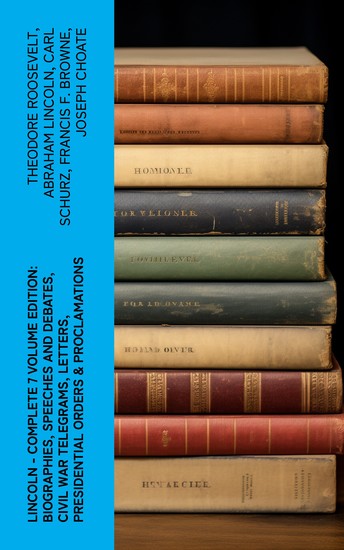
LINCOLN – Complete 7 Volume Edition: Biographies Speeches and Debates Civil War Telegrams Letters Presidential Orders & Proclamations - cover

LINCOLN – Complete 7 Volume Edition: Biographies Speeches and Debates Civil War Telegrams Letters Presidential Orders & Proclamations

Theodore Roosevelt, Abraham Lincoln, Carl Schurz, Joseph Choate, Francis F. Browne

Verlag: e-artnow

  • 0
  • 0
  • 0

Beschreibung

This meticulously edited seven-volume edition explores in full detail the life and work of Abraham Lincoln. The collection contains complete writings of Abraham Lincoln from 1832 to 1865, as well as all of his speeches (including complete political debate with Stephen Douglas). This exceptional collection is enriched with an introduction written by Theodore Roosevelt and three different Lincoln's biographies by Carl Schurz, Joseph Choate and Francis F. Browne.  Abraham Lincoln was an American politician and lawyer who served as the 16th President of the United States from March 1861 until his assassination in April 1865. Lincoln led the United States through the Civil War, its bloodiest war, and perhaps its greatest moral, constitutional, and political crisis. In doing so, he preserved the country and abolished slavery. He had also strengthened the federal government and modernized the American economy. Content: Introduction by Theodore Roosevelt Abraham Lincoln, Biography by Carl Shurz Abraham Lincoln, Biography by Joseph H. Choate The Every-day Life of Abraham Lincoln by Francis F. Browne  Volume 1: The Writings of Abraham Lincoln, 1832-1843 Volume 2: The Writings of Abraham Lincoln, 1843-1858 Volume 3: The Lincoln-Douglas Debates I Volume 4: The Lincoln-Douglas Debates II Volume 5: The Writings of Abraham Lincoln, 1858-1862 Volume 6: The Writings of Abraham Lincoln, 1862-1863 Volume 7: The Writings of Abraham Lincoln, 1863-1865
Verfügbar seit: 14.12.2023.
Drucklänge: 3123 Seiten.
Weitere Bücher, die Sie mögen werden

  • Octavia E Butler - H is for Horse - cover

    Octavia E Butler - H is for Horse

    Chi-Ming Yang

    • 0
    • 0
    • 0
    An homage to the childhood genius of Black science fiction writer Octavia E. Butler. 


    The figure of the horse, at once earthly and transcendent, represented the contradictions of freedom and captivity that enabled young Octavia to develop her nuanced sense of voice and place. Drawing on previously unknown archival research, this volume illustrates how Butler's development as a writer was tied to her extraordinary resourcefulness and self-awareness growing up as an awkward, bookish Black girl in segregated, Cold War Pasadena. She persistently re-visited and revised her early writings on teenage angst, Martians, Westerns, and racial politics. In one way or another her supernatural characters defied the constraints of gender, race, and class with equine-inflected resilience. 


    In the spirit of Butler's passion for library research, this book is comprised of twenty-six short A-Z chapters. It is part childhood biography, art and literary analysis, and memoir. It interweaves the author's personal recollections with scholarly musings on poetry, film, and literature inspired by Butler's encyclopedic reading habits and experiments with genre. Just as cross-species kinships are at the heart of her Afro-futurist, eco-feminist storytelling, Butler demonstrates that coming-of-age is an ongoing process and key to healing our damaged planet.
    Zum Buch
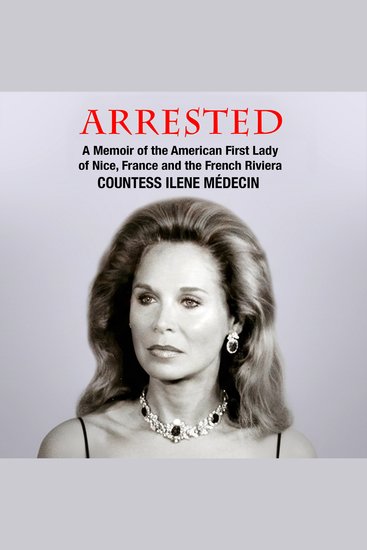
  • Arrested - A Memoir of the American First Lady of Nice France and the French Riviera - cover

    Arrested - A Memoir of the...

    Countess Ilene Medecin

    • 0
    • 0
    • 0
    Growing up in Beverly Hills with two famous uncles - a cosmetics magnate and a well-connected mobster - eventually led Ilene Médecin to a romantic and glamorous life as the American First Lady of Nice and the French Riviera. "Arrested" follows Ilene through her marriage to Jacques Médecin, a Medici Count fondly known as "King Jacquou," who was the last scion of a century old political dynasty. Her unique experience is from the perspective of an American woman living in France, married to a powerful French politician ruling the Côte d'Azur as they shared their social circle with Princess Grace Kelly and Prince Rainier. Life was extraordinary among royals, celebrities, and politicians. From the enchanted pages of a storybook Camelot, being at the pinnacle of a fantasy existence, only to fall from grace to the depths of a French prison cell. While there were trysts and scandals, nothing prepared Ilene for the demise of a prominent political family and her eventual arrest for her husband's alleged wrongdoings. As for Jacques, sadly, taking up residence in Uruguay was a puzzling end to a stellar political career. 
    Neither political exile nor arrest had ever been on Ilene's bucket list, but she found herself checking them both off. Her late husband, Jacques Médecin, had been Mayor of Nice, President of Alpes-Maritimes (presiding over the Côte d'Azur), French Minister of Tourism, Member of Parliament, and a Medici Count. Rest assured, "King Jacquou" was no ordinary politician as he ruled the expanse of the French Riviera. Curiously, he also gained notoriety being the official reference for proper Salad Niçoise as the published author of a widely acclaimed cookbook, "Cuisine Niçoise, Recipes From A Mediterranean Kitchen."
    Zum Buch
  • My Booster! - He Saved My Life and Changed the Lives of Others Around the World! - cover

    My Booster! - He Saved My Life...

    Davis Hawn

    • 0
    • 0
    • 0
    WHAT DIFFERENCE CAN A DOG MAKE? 
    I was about to find out. For two decades, my life was a cesspool of codependency. Fear consumed me. Life wasn’t worth living. I’d “rescued” the two addicts in my life—one an alcoholic, another a crack addict. Then a puppy I’d foolishly gifted to my crack addict became “my” puppy when I learned it was destined to be traded for crack. I wholeheartedly resented the puppy because the damned thing was always happy, and I was always sad. As a way out of my spiraling life, I attempted suicide one night. I awakened in the morning to kids knocking on my camper door, wanting to play with the puppy. Fifteen minutes later, the puppy screamed in pain. I just knew he’d been hit by a car, likely dying, because everything in life was bad. I opened the camper door, expecting the worst, but the puppy had simply run into a parked car and hurt his paw. The puppy was crying, the kids were crying, and then I too began to cry … uncontrollably. 
    Suddenly, the puppy and I were one, both in pain. An epiphany…a Helen Keller-like breakthrough that changed my life forever. I suddenly realized he’d tried to bring healthy people into my life, breaking the chains of codependency. I slept with that puppy in my arms for three days. Upon awakening, I looked deeply into his eyes, and promised him I’d share him with the world. 
    That puppy, my Booster, saved my life … twice! In My Booster, international service dog advocate and author Davis Hawn lays bare his life in the incredible story of Booster. Engaging, enlightening, hilariously funny and heartbreaking at the same time, their story shows the true power of the canine-human bond.
    Zum Buch
  • I Can Give You Anything But Love - cover

    I Can Give You Anything But Love

    Gary Indiana

    • 0
    • 0
    • 0
    The long-awaited memoir from one of the most acclaimed radical writers in American literature. Described by the London Review of Books as one of "the most brilliant critics writing in America today," Gary Indiana is a true radical whose caustic voice has by turns haunted and influenced the literary and artistic establishments. 


    With I Can Give You Anything but Love, Gary Indiana has composed a literary, unabashedly wicked, and revealing montage of excursions into his life and work—from his early days growing up gay in rural New Hampshire to his escape to Haight-Ashbury in the post-summer-of-love era, the sweltering 1970s in Los Angeles, and ultimately his existence in New York in the 1980s as a bona fide downtown personality. Interspersed throughout his vivid recollections are present-day chapters set against the louche culture and raw sexuality of Cuba, where he has lived and worked occasionally for the past fifteen years. Connoisseurs will recognize in this—his most personal book yet—the same mixture of humor and realism, philosophy and immediacy, that have long confused the definitions of genre applied to his writing. Vivid, atmospheric, revealing, and entertaining, this is an engrossing book and a serious contribution to the genres of gay and literary memoir.
    Zum Buch
  • How to Begin When Your World Is Ending - A Spiritual Field Guide to Joy Despite Everything - cover

    How to Begin When Your World Is...

    Molly Phinney Baskette

    • 0
    • 0
    • 0
    As a progressive parish minister, Molly Baskette has been a companion during the most vulnerable and unsettled periods of many people's lives. She has also had a front row seat to remarkable human transformation, as many of the ruptures her people lived through turned out to be the way that God got in. But when she was diagnosed with an aggressive cancer at age thirty-nine, with two small children, her theology of and relationship to God was tested more profoundly than ever. 


    Instead of becoming despondent, though, she engaged with her faith more deeply—seizing the opportunity to test the seaworthiness of the faith she had been practicing and preaching. In How to Begin When Your World Is Ending, Baskette shares the questions that confronted her along the way like: Is it true that prayer changes things? Does God care whether we live or die—and is there a damn thing God can do about it anyway? How can vulnerability, counterintuitively, be a strength? And the million-dollar question: is there life after death, and just what might it be like? 


    Weaving together her own story and the stories of those she encountered in her life of faith, Baskette mines joy from all the hardest parts of being human. In doing so she reminds us that whatever you are going through, someone has been there before you, and found meaning in the madness.
    Zum Buch
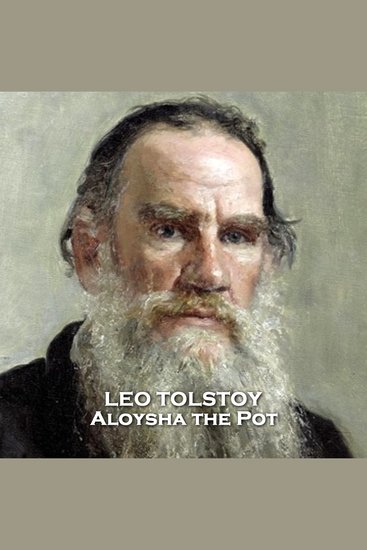
  • Aloysha the Pot - From their pens to your ears genius in every story - cover

    Aloysha the Pot - From their...

    Leo Tolstoy

    • 0
    • 0
    • 0
    Leo Tolstoy was born in 1828 in the Russian province of Tula to a wealthy noble family. As a child, he had private tutors but he showed little interest in any formal education. When he went to the University of Kazan in 1843 to study oriental languages and law, he left without completing his courses.  Life now was relaxed and idle but with some writing also taking place.  Gambling debts forced an abrupt change of path and he joined the army to fight in the Crimean War.  He was commended for his bravery and promoted but was appalled at the brutality and loss of life.  He recorded these and other earlier experiences in his diaries which formed the basis of several of his works. 
    In 1852 ‘Childhood’ was published to immediate success and was followed by ‘Boyhood’ and ‘Youth’. 
    His experience in the army and the horrors he witnessed resulted in ‘The Cossacks’ in 1862 and the trilogy ‘Sevastopol Tales’. After the war he travelled around Europe, visiting London and Paris and meeting such luminaries as Victor Hugo and Charles Darwin.  
    It was now that Tolstoy began his masterpiece, ‘War and Peace’. Published in 1869 it was an epic work that changed literature. He quickly followed this with ‘Anna Karenina’.  
    These successes made Tolstoy rich and helped him accomplish many of his dreams but also brought problems as he grappled with his faith and the lot of the oppressed poor. These revolutionary views became so popular that the authorities now kept him under surveillance.  
    He led a life of asceticism and vegetarianism and put his socialist ideals into practice by establishing numerous schools for the poor and food programmes. He also believed in giving away his wealth, which caused much discord with his wife.  
    His writing continued to bring forth classics such as ‘The Death of Ivan Ilyich’ and many brilliant and incisive short stories such as ‘How Much Land Does A Man Need’.  
    In 1901 Tolstoy was excommunicated from the Church and controversially deselected for the Nobel Prize for Literature. 
    Whilst undertaking a pilgrimage by train in October 1910 with his daughter Aleksandra he caught pneumonia in the nearby town of Astapovo.  Leo Tolstoy died on November 9th, 1910, he was 82.
    Zum Buch