Rejoignez-nous pour un voyage dans le monde des livres!
Ajouter ce livre à l'électronique
Grey
Ecrivez un nouveau commentaire Default profile 50px
Grey
Abonnez-vous pour lire le livre complet ou lisez les premières pages gratuitement!
All characters reduced
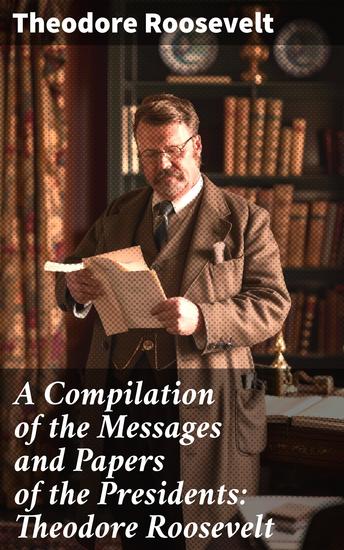
A Compilation of the Messages and Papers of the Presidents: Theodore Roosevelt - Exploring Roosevelt's Political Legacy - cover

A Compilation of the Messages and Papers of the Presidents: Theodore Roosevelt - Exploring Roosevelt's Political Legacy

Theodore Roosevelt

Maison d'édition: Good Press

  • 0
  • 0
  • 0

Synopsis

In "A Compilation of the Messages and Papers of the Presidents: Theodore Roosevelt," readers are presented with a meticulously curated collection of Roosevelt's significant messages and documents from his presidency. The work employs a straightforward yet eloquent literary style, reflecting the tenacity and clarity for which Roosevelt was renowned. Set against the backdrop of the Progressive Era, this compilation reveals the multifaceted approach Roosevelt took to governance, highlighting pivotal moments such as his progressive reforms, foreign policies, and efforts in conservation. The book serves as a window into the dynamic political landscape of the early 20th century, demonstrating Roosevelt's commitment to social justice and national integrity. Theodore Roosevelt, the 26th President of the United States, was a man of many dimensions'Äîa soldier, reformer, and a fervent advocate for the outdoors'Äîwhose experiences shaped his progressive ideologies. His presidency was characterized by a robust belief in America'Äôs potential for greatness and responsibility, influenced by the turbulent socio-political conditions of his time. His writings often reflect his personal passions, including nature, conservation, and the need for equitable governance. This compilation is an indispensable resource for anyone keen on understanding the ethos of American leadership during a transformative era. Roosevelt's articulate framing of vital issues makes this book not only a historical document but also a timeless reference for readers interested in politics, leadership, and presidential history.
Disponible depuis: 12/08/2023.
Longueur d'impression: 132 pages.

D'autres livres qui pourraient vous intéresser

  • The Reformation 1495-1553 - The Thinkers That Changed Christianity - cover

    The Reformation 1495-1553 - The...

    Martin Luther, Phillip...

    • 0
    • 0
    • 0
    Martin Luther and John Calvin are household names, where people have little knowledge of them besides their vast impact on Christian thought and culture. It is surprising how closely their language and concerns reflect modern times.  
    Martin Luther was a rabble-rousing man of the people, filled with invective and the emotional force of connecting with humanity rather than culture or wealth.  
    John Calvin’s sardonic sense of humour permeates a constant barrage of mythbusting that would do a modern-day fact checker proud. 
    Three less well-known writers round out the collection. Zwingli, Melancthon and Savonarola all preach with a force befitting true Christians fighting against the vast powers of a Catholic church that was the most powerful entity in Europe, and had consolidated a wide range of practices that broke the people away from an experience of divinity. 
    Savonarola speaks with the voice of a travelling preacher, a man of the people whose voice matched that of Eugene Debs. Zwingli spoke with a proud nationalism and pride that was wounded by the use of foreign armies, when the land could provide for all its citizens if managed correctly. Melancthon is an academic, providing a point-by-point deconstruction of the Pope’s claimed powers in ways that were irrefutable even for the Jesuit strains that held the Catholic Church’s intellectual force. 
    Just as with the liberation fighters, socialists, and anarchists of previous volumes, these historical figures lived under great threat, attacking vast forces with little more than courage and the certainty of their beliefs. They stand as the bridge over the cultural change between the middle ages and the renaissance.
    Voir livre
  • More Than Our Pain - Affect and Emotion in the Era of Black Lives Matter - cover

    More Than Our Pain - Affect and...

    Beth Hinderliter, Steve Peraza

    • 0
    • 0
    • 0
    Confronted by a crisis in black American leadership, state-sanctioned violence against black communities, and colorblind laws that trap black Americans in a racial caste system, Black Lives Matter activists and the artists inspired by them have devised new forms of political and cultural resistance. More Than Our Pain explores how affect and emotion can drive collective political and cultural action in the face of a new nadir in race relations in the United States. This foregrounding of affect and emotion marks a clear break from civil rights–era activists, who were often trained to counter false narratives about protesters as thugs and criminals by presenting themselves as impeccably groomed and disciplined young black Americans. In contrast, the Black Lives Matter movement in the early twenty-first-century makes no qualms about rejecting the politics of respectability. Affect and emotion has moved from the margin to the center of this new human rights movement, and by examining righteous rage, black joy, as well as grief and fatigue, among other emotions, the contributors celebrate the vitality of black life while documenting those who have harmed it. 


    Contains mature themes.
    Voir livre
  • Write the Damn Book Already - Tell Your Story Share Your Message Make Your Impact - cover

    Write the Damn Book Already -...

    Elizabeth Lyons

    • 0
    • 0
    • 0
    A guide to writing transformative nonfiction or inspirational memoir from a 6x author with nearly two decades' experience in the book writing and publishing space. 
    If you’ve ever thought, “I really want to write a book, but…” this book is for you. 
    Despite what you may have heard, becoming a successful author isn’t about having 67,973 Instagram followers, reaching “bestselling” status for seven seconds, or having Beyoncé take your book on tour with her (as amazing as that would be!). 
    It’s about impacting one person so deeply that they can’t help but recommend your book again and again. It’s also about uncovering more of yourself while you tell your story so that your unique light can’t help but shine more brightly upon the world. 
    This practical, thorough guide to writing and publishing nonfiction and memoir helps you: 
    ★ Go from constantly questioning your writing ability, message, and expertise to confidently owning the valuable insights and perspectives you bring to the world 
    ★ Remove overthinking when it comes to how a book “should” come together and instead gain absolute clarity in the book-writing process your favorite authors follow 
    ★ Understand the six lesser-talked-about steps you really need to consider when writing a truly impactful book 
    ★ Get completely clear on your book’s core message, your magnetic hook, and how to speak directly to your target readers with understanding, compassion, and a roadmap that clearly lays out their next steps 
    You don’t need more experience, motivation, or hours in the day to write a book you’re immensely proud of. Once you know what to focus on and how to navigate the avalanche of “But what if…?” that arises along the way, you’ll finally be able to get the damn book written so it can take its rightful place as someone else’s favorite read.
    Voir livre
  • A Rare Recording of Helen Kellernne Sullivannd Polly Thompson - cover

    A Rare Recording of Helen...

    Helen Keller, Annie Sullivan,...

    • 0
    • 0
    • 0
    Helen Keller was born on June 27, 1880, in Tuscumbia, Alabama. Though born with the ability to see and hear, at 19 months-old she contracted an acute illness that left her both deaf and blind. Eventually, 20-year-old Anne Sullivan, herself visually impaired, became Keller's speech instructor. It was the beginning of a 49-year-long relationship during which Sullivan evolved into Keller's governess and eventually her companion. In 1914, Sullivan's health began to fail, so a young woman from Scotland, Polly Thompson was hired to keep house. Though she had no experience with deaf or blind people, Thompson progressed to working as a secretary, and eventually a constant companion to Keller. Keller went on to become a world-famous speaker and author. She was a suffragist, a pacifist, a radical socialist, and a birth control advocate. In 1915 she and George Kessler founded the Helen Keller International organization, devoted to research in vision, health and nutrition. In 1920 she helped to found the American Civil Liberties Union.
    
    ©2013 Listen & Live Audio, Inc. (P)2013 Listen & Live Audio, Inc.
    Voir livre
  • Race for Nuclear Weapons during World War II The: The History and Legacy of Both Sides’ Efforts to Build an Atomic Bomb - cover

    Race for Nuclear Weapons during...

    Editors Charles River

    • 0
    • 0
    • 0
    Before the Second World War, military conflicts were fought under orthodox conditions, usually termed “conventional warfare,” but several innovations had significantly changed combat, leading inextricably to the race for a nuclear weapon in the 1930s and 1940s. Conflicts had been fought by armies on horseback with guns of varying sophistication since the 16th century, but mechanized warfare and machine guns changed this calculus and set the stage for future combat by the end of World War I. Other sinister changes entered the fray during this conflict, such as chemical weapons like chlorine and mustard gas. The total warfare brought about by World War I and ensuing wars like the Spanish Civil War made the quest for the most powerful weapons somewhat necessary. 
    The Manhattan Project would ultimately yield the “Little Boy” and “Fat Man” bombs that released more than 100 Terajoules of energy at Hiroshima and Nagasaki, but as it turned out, the Axis were not far behind with their own nuclear weapons program. When the Nazis’ quest for a nuclear weapon began in earnest in 1939, no one really had a handle on how important nuclear weapons would prove to war and geopolitics. The attacks on Hiroshima and Nagasaki in August 1945, along with the Cold War-era tests and their accompanying mushroom clouds, would demonstrate the true power and terror of nuclear weapons, but in the late 1930s these bombs were only vaguely being thought through, particularly after the successful first experiment to split the atom by a German scientist. The nuclear age itself was in its infancy, barely 35 years old, but within a few short years the advent of nuclear war loomed over the world and the prospect of the enemy winning the nuclear race kept Allied leaders awake at night.
    Voir livre
  • The Lake Filled with Skeletons - Uncovering the Mysteries of Roopkund - cover

    The Lake Filled with Skeletons -...

    John Harpoon

    • 0
    • 0
    • 0
    The discovery of Roopkund Lake, a high-altitude lake nestled in the Indian Himalayas, shocked the world with its eerie and haunting mystery. Known as the "Skeleton Lake," the site became a focus of international attention when dozens of human skeletons were found in and around the lake, scattered across the landscape. Hidden among the rugged mountains, at an elevation of about 16,500 feet, the lake was nearly inaccessible, which contributed to its preservation for centuries. This discovery raised more questions than answers and sparked numerous theories about the origins and circumstances surrounding the remains. 
      
    The skeletons found at Roopkund are not just ordinary human remains. They are unique in that they are incredibly well-preserved despite their age, leading researchers and scientists to embark on an extraordinary quest to uncover their origins. Some of the bones belong to people who lived thousands of years ago, while others are more recent, creating an enigmatic mixture of the past and present. Various expeditions have sought to determine who these people were, how they died, and why their bodies were left in such an unusual location. 
      
    Roopkund Lake, located in the state of Uttarakhand in India, was long known to the local populations, who regarded it with awe and fear. The lake and its surrounding areas are deeply ingrained in local folklore, with stories that attempt to explain the presence of these bones. Some claim that the skeletons are those of pilgrims who perished in a sudden snowstorm, while others suggest the lake holds the remains of ancient warriors or victims of a mass sacrifice. Over time, these legends have woven themselves into the cultural fabric of the region, adding an extra layer of mystique to an already puzzling phenomenon.
    Voir livre