Rejoignez-nous pour un voyage dans le monde des livres!
Ajouter ce livre à l'électronique
Grey
Ecrivez un nouveau commentaire Default profile 50px
Grey
Abonnez-vous pour lire le livre complet ou lisez les premières pages gratuitement!
All characters reduced
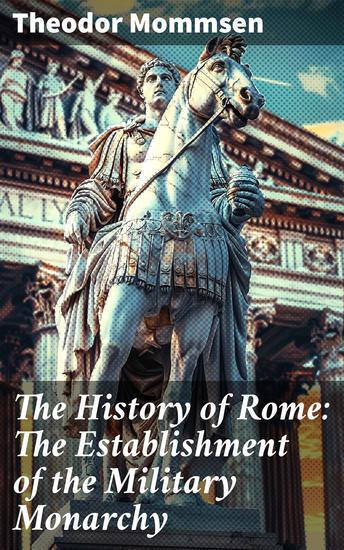
The History of Rome: The Establishment of the Military Monarchy - The Rise of Rome's Military Power - cover

The History of Rome: The Establishment of the Military Monarchy - The Rise of Rome's Military Power

Theodor Mommsen

Traducteur William P. Dickson

Maison d'édition: Good Press

  • 0
  • 0
  • 0

Synopsis

In "The History of Rome: The Establishment of the Military Monarchy," Theodor Mommsen delivers a meticulous examination of the transformation of Rome from a Republic to an autocratic regime. Through a blend of narrative history and critical analysis, Mommsen provides a vivid portrayal of the socio-political upheaval, highlighting key figures and events that shaped this pivotal moment in Roman history. The work exemplifies 19th-century historiography, characterized by comprehensive research and eloquent prose, which serves both to inform and engage the reader in a rich literary experience. Mommsen's distinctive blend of the analytical and the narrative allows readers to grasp the complexities of power dynamics, military influence, and public sentiment in the late Roman Republic. Theodor Mommsen (1817-1903), a German historian, was equally a lawyer and a politician, passionately devoted to the study of ancient Rome. His scholarly pursuits were fueled by a desire to understand the foundations of modern civilization, and this work reflects his broader philosophical views on governance and the nature of power. Notably, Mommsen was awarded the Nobel Prize in Literature in 1902, highlighting his formidable contribution to historical writing and his influence on future generations of historians. This book is highly recommended for readers interested in Roman history, political science, and historiography. Mommsen's authoritative voice and engaging narrative style make complex historical developments accessible, ensuring that both scholars and general readers can appreciate the profound implications of Rome's shift to military monarchy. It is an essential read for anyone seeking to understand the foundations of governance that continue to resonate in contemporary political discourse.
Disponible depuis: 12/08/2023.
Longueur d'impression: 687 pages.

D'autres livres qui pourraient vous intéresser

  • Awakening the Spirit of America - FDR's War of Words With Charles Lindbergh – and the Battle to Save Democracy - cover

    Awakening the Spirit of America...

    Paul M. Sparrow

    • 0
    • 0
    • 0
    Franklin Roosevelt awoke on September 1, 1939 to the news that Germany invaded Poland, signaling the start of World War II. The president warned for years that Hitler's fascist regime posed an existential threat to democracy, but the American public remained stubbornly isolationist as fascist sympathizing groups, egged on by right wing media stars promoting anti-Semitic conspiracy theories, plotted to overthrow the president. 


    The situation was dire, and Roosevelt found himself facing an unexpected adversary: Charles Lindbergh. Wildly popular, the famed aviator's youthful charm, plainspoken rhetoric, and media magnetism earned him a massive following as he led an attack on FDR's policies. The German government provided secret funds to Lindbergh's Nazi followers as he led the radical America First Committee in an effort to prevent Roosevelt from aiding England's survival—and the world's. 


    Awakening the Spirit of America shows how Roosevelt overcame the forces aligned against him in a war against fascism. Paul Sparrow, former director of the FDR Presidential Library, reveals how FDR's triumph of leadership was by no means a foregone conclusion. Awakening the Spirit of America provides a riveting account of FDR's ultimate victory over pro-Nazi isolationists and provides vital insight into American history and an iconic president.
    Voir livre
  • Sources of the River - Tracking David Thompson Across Western North America - cover

    Sources of the River - Tracking...

    Jack Nisbet

    • 0
    • 0
    • 0
    The awe-inspiring story of explorer David Thompson, whose expeditions helped shape western North America 


    In this true story of adventure, author Jack Nisbet recreates the life and times of David Thompson—fur trader, explorer, surveyor, and mapmaker. From 1784 to 1812, Thompson explored western North America, and his field journals provide the earliest written accounts of the natural history and indigenous cultures of the what is now British Columbia, Alberta, Montana, Idaho, Washington, and Oregon. Thompson was the first person to chart the entire route of the Columbia river, and his wilderness expeditions have become the stuff of legend. 


    Jack Nisbet tracks the explorer across the continent, interweaving his own observations with Thompson's historical writings. The result is a fascinating story of two men discovering the Northwest territory almost two hundred years apart.
    Voir livre
  • Justinian I - Biography of the Byzantine Emperor Justinian the Great - cover

    Justinian I - Biography of the...

    Kelly Mass

    • 0
    • 0
    • 0
    Justinian I, known to history as Justinian the Great, ruled as the Byzantine emperor from 527 until his death in 565. His reign is marked by a series of ambitious efforts to revive the grandeur of the Roman Empire, although many of these goals were only partially realized. This vision, known as the renovatio imperii or "reinstatement of the Empire," encapsulated his drive to restore Roman territories lost to barbarian invasions and to reassert imperial authority across the Mediterranean world. 
    One of the most prominent aspects of Justinian's renovatio imperii was the partial reconquest of the western provinces of the fallen Roman Empire. His military campaigns, led by the brilliant general Belisarius, achieved remarkable successes. Belisarius swiftly captured the Vandal Kingdom in North Africa, establishing Byzantine control over the region. Shortly thereafter, he, along with other generals like Narses, waged a series of successful campaigns against the Ostrogoths in Italy, eventually reclaiming key territories such as Dalmatia, Sicily, Rome, and much of Italy. This marked the end of the Ostrogothic Kingdom, which had ruled for over fifty years. Additionally, under the leadership of the praetorian prefect Liberius, the Byzantines reasserted control over the Iberian Peninsula, establishing the province of Spania. These victories re-established Roman dominance in the western Mediterranean and brought in substantial annual revenues, estimated at over a million solidi.
    Voir livre
  • The Eurasian Century - Hot Wars Cold Wars and the Making of the Modern Century - cover

    The Eurasian Century - Hot Wars...

    Hal Brands

    • 0
    • 0
    • 0
    We often think of the modern era as the age of American power. In reality, we're living in a long, violent Eurasian century. That giant, resource-rich landmass possesses the bulk of the global population, industrial might, and potential military power. Eurasia is a strategic prize without equal—which is why the world has been roiled, reshaped, and nearly destroyed by clashes over the supercontinent. 


    Since the early twentieth century, autocratic powers have aspired for dominance by seizing commanding positions in the world's strategic heartland. Offshore sea powers, namely the United Kingdom and America, have sought to make the world safe for democracy by keeping Eurasia in balance. America's rivalries with China, Russia, and Iran are the next round in this geopolitical game. If this new authoritarian axis succeeds in enacting a radically revised international order, America and other democracies will be vulnerable and insecure. 


    Hal Brands argues that a better understanding of Eurasia's strategic geography can illuminate the contours of rivalry and conflict in today's world. The Eurasian Century explains how revolutions in technology and warfare, and the rise of toxic ideologies of conquest, made Eurasia the center of twentieth-century geopolitics—with pressing implications for the struggles that will define the twenty-first.
    Voir livre
  • Phenomenology - Philosophy and the Structure of Consciousness - cover

    Phenomenology - Philosophy and...

    Hector Davidson

    • 0
    • 0
    • 0
    Phenomenology is a branch of philosophy that seeks to explore and describe the structures of experience as they present themselves to consciousness. Rooted in the Greek words phainomenon (meaning "that which appears") and logos (meaning "study" or "discourse"), phenomenology is concerned with the direct investigation and description of phenomena as consciously experienced, without recourse to theories about their causal explanation or objective reality. It aims to understand the essence of experiences, focusing on how things are perceived, rather than on external facts or empirical data. 
    Edmund Husserl, often regarded as the father of phenomenology, established the discipline in the early 20th century. His groundbreaking work sought to return philosophy to the "things themselves," emphasizing the need to examine experiences without preconceived notions or biases. Husserl introduced the concept of intentionality, the idea that consciousness is always directed toward something—it is always consciousness of something. This fundamental notion shifted the focus from the contents of the mind to the ways in which objects are experienced, highlighting the inseparable relationship between the subject and the object in acts of consciousness. 
    Phenomenology differs from other philosophical approaches in that it does not seek to explain experiences through causal or scientific means. Instead, it adopts a descriptive method, aiming to reveal the underlying structures that make experience possible. Through techniques such as epoché (the suspension of judgment about the external world) and phenomenological reduction (focusing solely on the contents of consciousness), phenomenologists attempt to uncover the pure essence of experiences, free from external assumptions.
    Voir livre
  • The Allies - cover

    The Allies

    Jaroslaw Abramow-Newerly,...

    • 0
    • 0
    • 0
    This book lay almost half a century at the bottom of an old computer before it was published. At the time, it was considered politically ‘inappropriate’ because it was too ‘anti-Russian.’ It was written in America by two political émigrés, refugees from the communist part of the world, who knew Russia as it really is and always has been, even during World War II, when it pretended to be a faithful ally of the United States.
     
    American pilots, crew members of a B 29 bomber, are hit by anti-aircraft fire during a reconnaissance flight over Japan. They make an emergency landing in USSR territory. It would seem that they are safe on the lands of an ally, but the reality turned out to be frighteningly different.
     
    Although this book is historical fiction and its characters are invented, they are woven into real historical events related to the Manhattan Project infiltrated from within by Soviet spies. During Gorbachev’s ‘thaw,’ Stalin was forgotten, and Russia was to be ‘an example and model of 
    democracy’ from then on. Even then, this book was supposed to be a warning; now it is allmost a wake-up call. Today’s Russia, waging a criminal, aggressive war against Ukraine, Russia of Vladimir Putin, with its troll farms, armed green men, murdering disobedient citizens in labor camps, poses an even greater threat to the entire free world.
    Voir livre