Begleiten Sie uns auf eine literarische Weltreise!
Buch zum Bücherregal hinzufügen
Grey
Einen neuen Kommentar schreiben Default profile 50px
Grey
Jetzt das ganze Buch im Abo oder die ersten Seiten gratis lesen!
All characters reduced
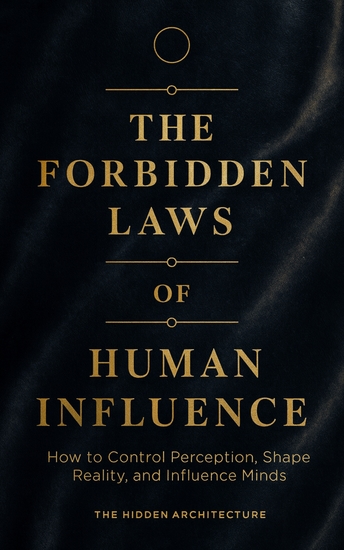
The Forbidden Laws of Human Influence - How to Control Perception Shape Reality and Influence Minds - cover

The Forbidden Laws of Human Influence - How to Control Perception Shape Reality and Influence Minds

The Hidden Architecture

Verlag: Staten House

  • 0
  • 0
  • 0

Beschreibung

You’ve seen them. The ones who never try hard, but always seem to win.This isn’t magic. It’s mastery. And you’re about to learn the rules they play by.
 
It’s a hidden system of influence they’ve tapped into, whether they realize it or not.And this book is your blueprint to do the same.
 
These are the forbidden psychological laws that silently shape perception, drive decisions, and control outcomes. Use them to make your presence shift a room, make your words stick in someone's mind for days, and make decisions feel like someone else's idea, even when they were yours.
 
Most people have been programmed to obey them.You are about to learn how to use them.
 
What You’ll Unlock Inside:
 
✅ The hidden psychological patterns that make people say “yes” without realizing why
 
✅ How to become the frame — the one who sets the tone, controls the energy, and defines reality
 
✅ The subtle mechanisms that escalate compliance and build invisible psychological contracts
 
✅ How to create the illusion of choice while guiding the result
 
✅ How to anchor identity, rewrite internal code, and make others follow your lead
 
✅ A complete breakdown of how influence works in business, relationships, and everyday life
 
This isn’t a surface-level book on persuasion tricks.It’s a forbidden manual for those ready to stop reacting and start engineering outcomes.
 
If you’ve ever felt overlooked, underestimated, or one step behind...It’s because no one taught you how the game really works.
 
Now, you’ll know.Read the book. Apply it.And never be the invisible one in the room again.
Verfügbar seit: 21.08.2025.
Drucklänge: 163 Seiten.

Weitere Bücher, die Sie mögen werden

  • Julio-Claudian Dynasty The: The History and Legacy of the First Family to Rule the Ancient Roman Empire - cover

    Julio-Claudian Dynasty The: The...

    Editors Charles River

    • 0
    • 0
    • 0
    The importance of Gaius Julius Caesar Augustus (or as he was known from birth, Gaius Octavius “Octavian” Thurinus) to the course of Western history is hard to overstate. His life, his rise to power, his political, and his social and military achievements all laid the foundations for the creation of an empire which would endure for almost five centuries, and whose traditions, laws, architecture and art continue to influence much of Europe and the world today. Octavian was the first true Roman Emperor, and the first man since the Etruscan Tarquins five centuries earlier to establish a successful hereditary ruling dynasty in what had been a proud Republic for over half a millennium.  
    Tiberius’s life soon became caught up with Augustus’s as the emperor worked to found and establish a dynasty, but it is unclear if Tiberius ever really wanted to be part of Augustus’s plans or inherit imperial power - Tiberius was known as a man who schemed and planned, but he was also a scholar and showed a marked desire throughout his life to retreat and escape the demands of power.  
    All of Rome’s poor rulers pale in comparison to Gaius Julius Caesar Augustus Germanicus, a young man remembered by posterity as Caligula. Given how bad some of Rome’s emperors were, it’s a testament to just how insane and reviled Caligula was that he is still remembered nearly 2,000 years later as the epitome of everything that could be wrong with a tyrant.  
    What makes Claudius such a surprisingly effective emperor, aside from his strange route to power, was that he was considered physically and mentally incompetent for political life. At the same time, Claudius managed to take the throne against the will of the Senate thanks to the support of the Praetorian Guard. 
    Claudius’s successor, Nero, ranks among the very worst of the Caesars, alongside the likes of mad Caligula, slothful Commodus, and paranoid Domitian.
    Zum Buch
  • San Francisco's Forgotten Cemeteries - A Buried History - cover

    San Francisco's Forgotten...

    Beth Winegarner

    • 0
    • 0
    • 0
    Digging into a forgotten past - and the dead left behind.  San Francisco is famous for not having any cemeteries, but the claim isn't exactly what it seems. In the early 20th Century, the city relocated more than 150,000 graves to the nearby town of Colma to make way for a rapidly growing population. But an estimated fifty to sixty thousand burials were quietly built over and forgotten, only to resurface every time a new building project began. The dead still lie beneath some of the city's most cherished destinations, including the Legion of Honor, United Nations Plaza, the Asian Art Museum and the University of San Francisco.  Join author Beth Winegarner as she maps the city's early burial grounds and brings back to life the dead who've been erased.
    Zum Buch
  • Countdown 1960: Book Summary & Analysis - cover

    Countdown 1960: Book Summary &...

    Briefly Summaries

    • 0
    • 0
    • 0
    This is a concise summary and analysis of Countdown 1960, by Chris Wallace.
     
    It is not the original book and is not affiliated with or endorsed by Chris Wallace.
     
    Ideal those seeking a quick and insightful overview.
    Countdown 1960 takes readers behind the scenes of one of the most pivotal years in American history. Set against the backdrop of the Cold War, civil rights struggles, and the space race, this gripping narrative delves into the high-stakes moments leading up to the 1960 U.S. presidential election. With unprecedented access to key figures and historical insights, the book offers a detailed exploration of how John F. Kennedy, Richard Nixon, and other influential leaders shaped the future of the nation during this defining year.
    Zum Buch
  • The Egyptian Wisdom in Other Jewish Writings - Ancient Egypt the Light of the World Book 8 - cover

    The Egyptian Wisdom in Other...

    Gerald Massey

    • 0
    • 0
    • 0
    When the word Sheol in the Old Testament is rendered in English by “the grave,” it is inadequate times out of number. The Hebrew writers were not always speaking or thinking of the grave when they wrote of Sheol, which has to be bottomed in Amenta, the divine nether-earth, not simply in the tomb. The grave is not identical with hell, nor the pit-hole with the bottomless pit. The pangs and sorrows of Sheol, like the purging pangs of the Romish purgatory, have to be studied in the Egyptian Ritual. –from “Egyptian Wisdom in other Jewish Writings” It goes unappreciated by modern Egyptologists, but it is embraced by those who savor the concept of a “hidden history” of humanity, and those who approach all human knowledge from the perspective of the esoteric. Gerard Massey’s massive Ancient Egypt: The Light of the World–first published in 1907 and the crowning achievement of the self-taught scholar–redefines the roots of Christianity via Egypt, proposing that Egyptian mythology was the basis for Jewish and Christian beliefs. Here, Cosimo proudly presents Book 8 of Ancient Egypt, in which Massey connects the stories of the Egyptians with the tales and lessons of the Hebrew prophets, likening David to Osiris and the “King of Glory” and “Lord of Hosts”–that is, Yahweh–to the sun-god of astronomical mythology. With similar symbology of flocks and shepherds, light and darkness, and immortality in an afterlife, it is impossible, Massey argues, not to see deep connections to and influences of Egyptian wisdom in that of the Hebrews. Peculiar and profound, this work will intrigue and delight readers of history, religion, and mythology. British author GERALD MASSEY (1828-1907) published works of poetry, spiritualism, Shakespearean criticism, and theology, but his best-known works are in the realm of Egyptology, including A Book of the Beginnings and The Natural Genesis.
    Zum Buch
  • The Psychology of Peak Performance Secrets - "Unlock your potential! Dive into transformative audio lessons that elevate your performance to new heights" - cover

    The Psychology of Peak...

    Ashton Ravenscroft

    • 0
    • 0
    • 0
    The Psychology of Peak Performance Secrets 
    ⭐⭐ A Simplified Guide with Insights Included ⭐⭐ 
    Are you eager to elevate your career and deepen your understanding of performance psychology? 
    Searching for a thorough guide that encompasses everything you need to unlock your best self through understanding performance psychology? 
    Your quest ends here! 
    This guide is your ultimate companion for enhancing your knowledge, applying your skills effectively, and engaging in practical exercises. With this resource, you're on the path to achieving your goals. 
    Updated to align with the latest insights in performance psychology. 
    Key features of this enriched guide: 
    - In-depth understanding of performance psychology principles 
    - Clarification of essential concepts related to personal growth 
    - Effective strategies for mastering the psychology of peak performance 
    Our guide stands out due to its comprehensive approach, which is crucial for your success. We dive deep into concepts rather than merely skimming the surface. 
    Please note that this guide is an independent resource and is not associated with any official entities. 
    Crafted with a clear layout and accessible language, our guide ensures seamless navigation between topics. Bid farewell to complicated jargon and embrace straightforward, accurate, and insightful content. 
    So, why wait? Click the BUY NOW button, secure your guide, and embark on your journey to excellence in performance psychology! 
    Take the leap toward unlocking your best self today!
    Zum Buch
  • Ending the World Wars: The History of the Events and Battles that Finished World War I and World War II - cover

    Ending the World Wars: The...

    Charles River Editors

    • 0
    • 0
    • 0
    For much of 1917, things went the Germans’ way. With the Bolshevik Revolution underway, the Germans were able to move soldiers to the Western front as the Russians quit the war. Moreover, the Allied powers had failed badly in its Nivelle Offensive in May 1917 and suffered a defeat in November against at the Battle of Caporetto in Slovenia. Unbelievably, the French and British had not bothered to coordinate their commands until after those defeats: they finally formed a Supreme Council to coordinate their armies’ movements and strategies. However, the Allied Powers began a counteroffensive known as the Hundred Days Offensive in August 1918 that was highly successful in pushing the Germans backward. In September, Bulgaria reached a separate armistice with the Allied powers, ceding control of the Balkans and cutting off German supplies. The defeated Ottoman Empire surrendered in late October. As the fortunes of the Central Powers waned, several lands in Austria-Hungary’s empire began declaring independence. Finally, in November, Germany’s Kaiser Wilhelm II was forced into exile, and the Germans reached an armistice with the Allied powers at 11:00 a.m. on November 11, 1918. World War I had finally ended. 
    	After the successful amphibious invasion on D-Day in June 1944, the Allies began racing east toward Germany and liberating France along the way. The Allies had landed along a 50 mile stretch of French coast, and despite suffering 8,000 casualties on D-Day, over 100,000 still began the march across the western portion of the continent. By the end of August 1944, the German Army in France was shattered, with 200,000 killed or wounded and a further 200,000 captured. However, Adolf Hitler reacted to the news of invasion with glee, figuring it would give the Germans a chance to destroy the Allied armies that had water to their backs.
    Zum Buch