Begleiten Sie uns auf eine literarische Weltreise!
Buch zum Bücherregal hinzufügen
Grey
Einen neuen Kommentar schreiben Default profile 50px
Grey
Jetzt das ganze Buch im Abo oder die ersten Seiten gratis lesen!
All characters reduced
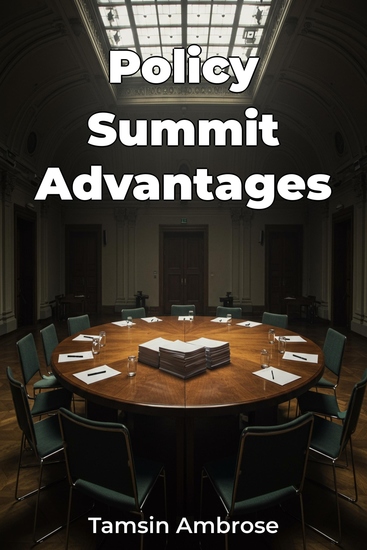
Policy Summit Advantages - cover

Policy Summit Advantages

Tamsin Ambrose

Übersetzer A AI

Verlag: Publifye

  • 0
  • 0
  • 0

Beschreibung

Policy Summit Advantages explores how international security conferences subtly yet significantly mold global geopolitics. These summits serve as critical, often overlooked, arenas where nations negotiate norms, solidify alliances, and engage in delicate diplomatic maneuvers.

 
 The book argues that these gatherings are not mere symbolic events, but influential platforms where agreements and partnerships shape international law and military cooperation. For example, agreements made can influence military spending and defense strategies.

 
 This study delves into international law by examining how summit agreements generate "soft law" and impact formal legal frameworks. It further investigates diplomatic relations cultivated during summits, demonstrating how sideline meetings can alter international negotiations. Understanding these dynamics is crucial in the context of evolving global governance and security policy.

 
 The book progresses from theoretical frameworks to case studies of major security conferences like the Munich Security Conference and NATO summits. By analyzing policy papers, agreements, and shifts in international law, it offers a tangible, evidence-based assessment of these gatherings' impacts. It provides a new model for assessing security conferences' role in global governance and international peace and offers practical insights for policymakers, diplomats, and anyone interested in international relations.
Verfügbar seit: 17.02.2025.
Drucklänge: 77 Seiten.


Weitere Bücher, die Sie mögen werden

  • Egyptian Trade and Diplomacy - Relations with Neighboring Civilizations - cover

    Egyptian Trade and Diplomacy -...

    Omar Khalil

    • 0
    • 0
    • 0
    Ancient Egypt’s prosperity and cultural richness were significantly shaped by its early trade networks and exchanges with neighboring regions. From the very beginnings of Egyptian civilization, trade played a crucial role in building economic strength and fostering diplomatic relationships. The development of trade networks allowed Egypt not only to obtain essential resources but also to influence and be influenced by surrounding cultures. 
    The origins of Egyptian trade practices can be traced back to the Predynastic period, when local communities exchanged goods such as pottery, beads, and tools. As Egyptian society evolved and centralized under powerful pharaohs, trade became more organized, enabling long-distance interactions. By the time of the Old Kingdom, Egypt had established a network of trade routes that stretched beyond its borders, connecting it to various civilizations across the ancient world. 
    One of the earliest and most vital trade routes was the Nile River, serving as a natural highway that facilitated the movement of goods and people. The Nile connected southern and northern Egypt while also linking the civilization to Nubia and further into sub-Saharan Africa. This route allowed the exchange of gold, ivory, ebony, and exotic animal products, which were crucial to the Egyptian economy and the creation of luxury goods. Additionally, maritime trade across the Red Sea connected Egypt to the Arabian Peninsula and even the distant lands of Punt, where incense, spices, and other valuable commodities were sourced.
    Zum Buch
  • Mission Iran - Special Forces Berlin & Operation Eagle Claw JTF 1-79 - cover

    Mission Iran - Special Forces...

    James Stejskal

    • 0
    • 0
    • 0
    On November 4, 1979, "student" supporters of the Ayatollah seized the U.S. Embassy with over sixty hostages. Although the Cold War was in full swing, the Iran hostage crisis was a watershed for the United States. 


    Detachment A had been established in Berlin early in the Cold War to harass and delay any Soviet military advance west. This Special unit trained relentlessly for every aspect of unconventional warfare, and was later assigned a second mission of counterterrorism. 


    The plan for Operation Eagle Claw, as it became known, was extremely complex. The first stage was intelligence gathering—no mean feat as most of the CIA's capabilities in the country had been eliminated. With operatives trained in intelligence work, fluent in many languages, and adept at blending in, Det A took on the advanced recon of the targets. Then, when Delta Force admitted that it could only manage the assault of the Embassy, Det A volunteered to rescue the three Americans at the Foreign Ministry. 


    Veteran and historian James Stejskal details Det A's unique and integral role in Operation Eagle Claw, based upon firsthand accounts of the operatives involved.
    Zum Buch
  • On the Nature of Things - cover

    On the Nature of Things

    Lucretius

    • 0
    • 0
    • 0
    "On the Nature of Things" by Lucretius is a profound exploration of Epicurean philosophy, blending poetry and science to explain the universe. Lucretius argues that everything is composed of atoms, governed by natural laws rather than divine intervention. He explores themes of existence, free will, and the pursuit of happiness, advocating for a life free from fear of death and superstition. Through vivid imagery and logical reasoning, he dismantles myths, emphasizing the importance of reason and sensory experience. This seminal work critiques materialism and highlights the beauty of the natural world. A cornerstone of classical thought, it invites readers to embrace a rational, tranquil existence rooted in understanding the cosmos and humanity's place within it.
    Zum Buch
  • Adoption Unfiltered - Revelations from Adoptees Birth Parents Adoptive Parents and Allies - cover

    Adoption Unfiltered -...

    Sara Easterly, Lori Holden,...

    • 0
    • 0
    • 0
    Adoption Unfiltered authors Sara Easterly (adoptee), Kelsey Vander Vliet Ranyard (birth parent), and Lori Holden (adoptive parent) interview dozens of adoptees, birth parents, adoptive parents, social workers, therapists, and other allies—all sharing candidly about the challenges in adoption. While finding common ground in the sometimes-contentious space of adoption may seem like a lofty goal, it reveals the authors' optimistic aim: working together with truth and transparency to move toward healing. 


    Healing isn't possible, though, without first uncovering the hurts—starting with adoption's central players: adoptees, who are so often in pain, suffering from what the latest brain science validates as the long-term emotional effects of separation trauma. By encouraging others to vulnerably share their stories, the authors discover that adoptees aren't the only ones in the adoption constellation who are hurting. Birth parents regularly shut down after being shut out by adoptive parents. Adoptive parents often struggle with unique parenting challenges and hidden insecurity, feeling the need to hide the fact that they are not the Super Parents they led the agency to believe they would be. Across the industry as a whole, misinformed and unethical practices abound. This book models the importance of adults in adoption working together in the spirit of empathy.
    Zum Buch
  • Vrnda Devi's Kitchen Religion The Yoga Of Non-Violent Living - Adventures In Ethical Vegetarianism - cover

    Vrnda Devi's Kitchen Religion...

    Sripad Jagannatha Dasa

    • 0
    • 0
    • 0
    THE ANCIENT YOGIC SCIENCE OF NON-VIOLENT SPIRITUAL EATINGVrnda Devi's Kitchen Religion introduces the art andscience of conscious eating. Listeners willleam of the 5,000-year-old Vedic approach todiet with a respectful nod to modern nutritionalscience. Yoga sages speak of the threemodes of material nature, goodness, passion,and ignorance, and the foods whichdefine each. Those in the modes of passionand ignorance dull themselves with lifeless,processed fare which overwhelms the senses-like meat, fish, eggs, strong spices, and alcohol.Those who seek entry into the mode ofgoodness, however, understand the value of.consuming organic vegetables, fresh fruits,whole grains, nuts, and, pure, whole non-violentstrictly nonfactory farming milk.Vmda examines the negative effects of meat-based fare outlines the benefits of a vegetarian diet and explains how such a diet can help heal, strengthen, and purify the body. Here is everything you need to know about life-giving of simple living and high thinking from one of the world's most celebrated animal rights angels.Vrnda Devi, was a successful vegetarianrestauranteur and host of televisioncooking shows "Vrnda's Kitchen." Her celebratedspiritual master was A.C. Bhaktivedanta SwamiPrabhupada. Devi was a dedicated animal-rightsactivist and managed a ten-acre cowprotection facility (Goshalla) in New York. SripadJagannatha Dasa is her husband.
    Zum Buch
  • Ancestral Puebloans - The Cliff Dwellers of Mesa Verde and the Architects of the Southwest - cover

    Ancestral Puebloans - The Cliff...

    Rolf Hedger

    • 0
    • 0
    • 0
    The Ancestral Puebloans, once known as the Anasazi, were among the earliest inhabitants of the American Southwest, establishing complex societies that thrived in the arid landscapes of present-day Colorado, New Mexico, Arizona, and Utah. Their origins trace back thousands of years to nomadic hunter-gatherers who gradually transitioned into settled agricultural communities. Archaeological evidence suggests that the ancestors of the Pueblo people descended from early groups who migrated into the region over 10,000 years ago, following game and adapting to the changing environment. 
    As these early populations settled, they developed strategies to cope with the harsh desert conditions. By around 2000 BCE, they had begun cultivating maize, a crop introduced from Mesoamerica, which allowed for more stable food sources and led to the formation of permanent villages. The adoption of agriculture marked a significant shift in their way of life, as they built storage pits for surplus grain and started domesticating turkeys for additional sustenance. Over time, these settlements expanded, and small familial clusters evolved into larger communities. 
    The Basketmaker period, beginning around 1200 BCE, represents a crucial stage in Ancestral Puebloan development. During this era, people lived in semi-subterranean pit houses, circular structures dug into the earth and covered with wooden frames and mud plaster. These early homes provided insulation against the region’s extreme temperatures. The Basketmakers were also known for their exceptional weaving and basketry skills, crafting intricate containers and sandals from yucca fibers and other natural materials. Pottery, which became a defining feature of Puebloan culture, gradually emerged during the later stages of this period, allowing for improved food storage and cooking techniques.
    Zum Buch