Begleiten Sie uns auf eine literarische Weltreise!
Buch zum Bücherregal hinzufügen
Grey
Einen neuen Kommentar schreiben Default profile 50px
Grey
Jetzt das ganze Buch im Abo oder die ersten Seiten gratis lesen!
All characters reduced
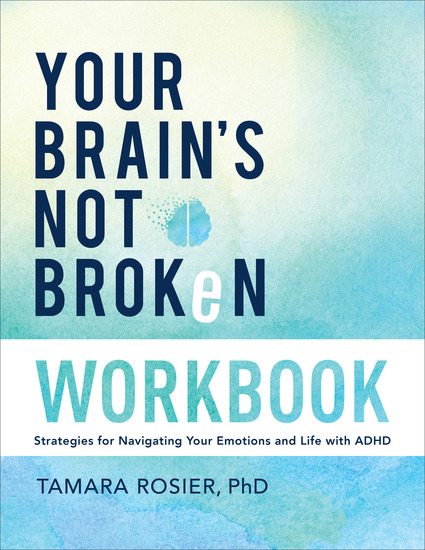
Your Brain's Not Broken Workbook - Strategies for Navigating Your Emotions and Life with ADHD - cover

Your Brain's Not Broken Workbook - Strategies for Navigating Your Emotions and Life with ADHD

Tamara Rosier

Verlag: Revell

  • 0
  • 0
  • 0

Beschreibung

Lose the shame, love your brain, and live better with ADHD 
 
In her popular book Your Brain's Not Broken, Dr. Tamara Rosier applied her years of coaching others to explain how ADHD affects every aspect of your life so that you could understand why you think, feel, and act the way you do. The result? A book chock-full of practical tools with the power to dramatically improve your life. 
 
Now this interactive companion workbook helps you personalize all those tools to fit your particular challenges. Designed specifically to work with the way your amazing brain is wired, the workbook includes  
 
● guided reflections of each chapter's content 
● space to write out your ADHD story 
● questions and exercises to apply the information from the book 
● prompts to help you work through problems 
● visual summaries of key concepts, including the Solve-It Grid 
 
The minute you start using this practical workbook, you are one step closer to losing the shame, loving your brain, and living better with ADHD.
Verfügbar seit: 14.01.2025.
Drucklänge: 180 Seiten.
Weitere Bücher, die Sie mögen werden

  • Earth Shapers - How We Mapped and Mastered the World from the Panama Canal to the Baltic Way - cover

    Earth Shapers - How We Mapped...

    Maxim Samson

    • 0
    • 0
    • 0
    The globetrotting story of how humans have harnessed the geographical landscape and written ourselves onto our surroundings.Mountains, meridians, rivers, and borders—these are some of the features that divide the world on our maps and in our minds. But geography is far less set in stone than we might believe, and, as Maxim Samson’s Earth Shapers contends, in our relatively short time on this planet, humans have become experts at fundamentally reshaping our surroundings.From the Qhapaq Ñan, the Inca’s “great road,” and Mozambique’s colonial railways to a Saudi Arabian smart city, and from Korea’s sacred Baekdu-daegan mountain range and the Great Green Wall in Africa to the streets of Chicago, Samson explores how we mold the world around us. And how, as we etch our needs onto the natural landscape, we alter the course of history. These fascinating stories of connectivity show that in our desire to make geographical connections, humans have broken through boundaries of all kinds, conquered treacherous terrain, and carved up landscapes. We crave linkages, and though we do not always pay attention to the in-between, these pathways—these ways of “earth shaping,” in Samson’s words—are key to understanding our relationship with the planet we call home.An immense work of cultural geography touching on ecology, sociology, history, and politics, Earth Shapers argues that, far from being constrained by geography, we are instead its creators.
    Zum Buch
  • Ottoman Empire’s Most Important Battles The: The History and Legacy of the Ottomans’ Biggest Victories and Defeats - cover

    Ottoman Empire’s Most Important...

    Editors Charles River

    • 0
    • 0
    • 0
    In terms of geopolitics, perhaps the most seminal event of the Middle Ages was the successful Ottoman siege of Constantinople in 1453. The city had been an imperial capital as far back as the 4th century, when Constantine the Great shifted the power center of the Roman Empire there, effectively establishing two almost equally powerful halves of antiquity’s greatest empire. Constantinople would continue to serve as the capital of the Byzantine Empire even after the Western half of the Roman Empire collapsed in the late 5th century. Naturally, the Ottoman Empire would also use Constantinople as the capital of its empire after their conquest effectively ended the Byzantine Empire, and thanks to its strategic location, it has been a trading center for years and remains one today under the Turkish name of Istanbul.  
    The end of the Byzantine Empire had a profound effect not only on the Middle East but Europe as well. Constantinople had played a crucial part in the Crusades, and the fall of the Byzantines meant that the Ottomans now shared a border with Europe. Indeed, the Ottomans would clash with Russians, Austrians, Venetians, Polish, and more before collapsing as a result of World War I, when they were part of the Central powers.  
    In the wake of taking Constantinople, the Ottoman Empire would spend the next few centuries expanding its size, power, and influence, bumping up against Eastern Europe and becoming one of the world’s most important geopolitical players. It was a rise that would not truly start to wane until the 19th century. Preserving its mixed heritage, coming from both its geographic position rising above the ashes of the Byzantine Empire and the tradition inherited from the Muslim Conquests, the Ottoman Empire lasted more than six centuries.
    Zum Buch
  • Dark Psychology - Secret Art of Reading People and Analyzing Human Psychology - cover

    Dark Psychology - Secret Art of...

    Valerie Glossner

    • 0
    • 0
    • 0
    Learning to understand ourselves, the dark and the light, the kind and the cruel, that exists within each one of us, has been a driving factor in psychological studies. This book will show you various aspects of dark psychology and teach you how to comprehend your own dark side. Learn how, and why, your conscience affects your moral decisions. Find out the truth when it comes to the facts and myths of self-sabotage. 
    Machiavellianism in psychology refers to a personality trait which sees a person so focused on their own interests they will manipulate, deceive, and exploit others to achieve their goals. This book will dive deeper into this topic along with related factors, such as how they control and manipulate others and the consequences that come with it. This book will shed some light on how to spot a manipulator and how to outwit one. Hear about various blackmail tactics and how to spot and avoid some of the most common scams on the internet. 
    In this book you can also hear about some of history’s most psychopathic killers of all time, as well as tactics used by human traffickers. Buy this book and begin to hear about the darkness.
    Zum Buch
  • Imperialism - cover

    Imperialism

    Vladimir Lenin

    • 0
    • 0
    • 0
    Written in 1916 against the backdrop of the First World War, Imperialism: The Highest Stage of Capitalism explains the flaws and power of capitalism, which inevitably lead to monopolies, imperialism and colonialism. Lenin develops Marx’s theories of political economy, which had been put forward 50 years earlier in Das Kapital. He goes on to argue that imperialism is the most advanced state of capitalism, characterised by the domination of monopolies on an international scale, with the export of capital leading to the big imperialist powers carving up the world.More than a century later, Imperialism remains highly relevant in understanding the historical background to the strategies of many of today’s major nations.
    Zum Buch
  • The Rise of Social Media - How Digital Platforms Transformed Communication and Society - cover

    The Rise of Social Media - How...

    Fredrich Hazelton

    • 0
    • 0
    • 0
    The rise of social media has reshaped the way people connect, communicate, and consume information. Over the past two decades, digital platforms have evolved from niche online communities to global networks that influence nearly every aspect of modern life. Social media is no longer just a tool for staying in touch with friends and family—it has become a powerful force in politics, business, entertainment, and culture. As the world becomes increasingly interconnected, understanding the impact of these platforms is essential.  
      
    Social media's rapid development can be traced back to the early days of the internet, when online forums and chat rooms allowed people to engage with others beyond geographical boundaries. The introduction of platforms like MySpace, Facebook, and Twitter in the early 2000s marked the beginning of a new era of digital interaction. These sites enabled users to create personal profiles, share updates, and engage in real-time conversations, setting the stage for the social media boom that followed. Today, platforms like Instagram, YouTube, TikTok, and LinkedIn serve diverse purposes, from entertainment and networking to news dissemination and activism.  
      
    The influence of social media extends far beyond personal connections. Businesses have embraced these platforms to market products, engage with customers, and build brand identities. Political campaigns rely on social media to reach voters and shape public opinion. Activists use digital platforms to mobilize communities and raise awareness about pressing social issues. At the same time, the widespread use of social media has introduced challenges, including concerns about data privacy, misinformation, cyberbullying, and the mental health effects of constant digital engagement. 
    Zum Buch
  • Mexico - From the Olmecs to the Aztecs: Eighth Edition - cover

    Mexico - From the Olmecs to the...

    Michael D. Coe, Javier Urcid,...

    • 0
    • 0
    • 0
    An extensive update to the authoritative introduction to Mexico's ancient civilizations. 


    Mexico arrives in its eighth edition with a new look and the most recent discoveries. This is the story of the pre-Spanish people of Mexico, who, with their neighbors the Maya, formed some of the most complex societies north of the Andes. Revised and expanded, the book is updated with the latest developments and findings in the field and current terminology. 


    The new edition includes expanded coverage of Oaxaca, particularly Monte Alba´n, one of the earliest cities in Mesoamerica and the center of the Zapotec civilization. Recent research on the Olmecs and the legacy of the Maya offer a wider and more cohesive narrative of Mexico's history. And a fully revised epilogue discusses the survival of indigenous populations in Mexico from the arrival of the Spanish through to the present day. 


    Mexico has long been recognized as the most readable and authoritative introduction to the region's ancient civilizations. Featuring up-to-date research, this book brings to life the vibrant ancient art and architecture of Mesoamerica.
    Zum Buch