Rejoignez-nous pour un voyage dans le monde des livres!
Ajouter ce livre à l'électronique
Grey
Ecrivez un nouveau commentaire Default profile 50px
Grey
Abonnez-vous pour lire le livre complet ou lisez les premières pages gratuitement!
All characters reduced
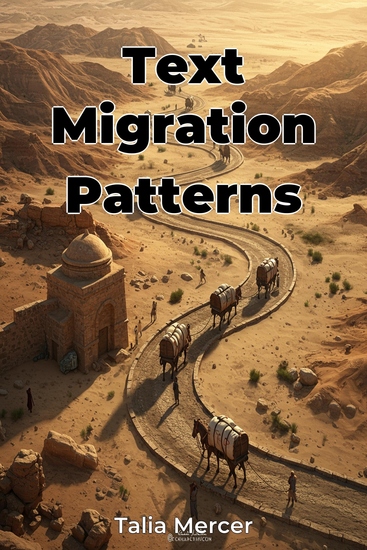
Text Migration Patterns - cover

Text Migration Patterns

Talia Mercer

Traducteur A AI

Maison d'édition: Publifye

  • 0
  • 0
  • 0

Synopsis

Text Migration Patterns explores how texts have traversed geographical and cultural boundaries, profoundly influencing societies throughout history. It examines the dynamic journey of texts via migration, education, and trade, highlighting their role as agents of change. Did you know that migrations, both voluntary and forced, have carried texts across borders, transmitting ideas and religious beliefs? Education systems, from ancient scribal schools to modern universities, have also codified and spread textual knowledge, creating standardized knowledge bases.

 
The book uniquely combines historical analysis with contemporary theories of globalization, focusing on the mechanisms through which texts travel and transform societies. It argues that the global circulation of texts actively shapes cultural identities and social structures.

 
Beginning with a theoretical framework, the book progresses through case studies that illustrate the impact of migration, education, and trade, examining historical examples from various regions and eras to reveal the complex dynamics of cultural interaction and intellectual development across the globe.
Disponible depuis: 06/05/2025.
Longueur d'impression: 63 pages.

D'autres livres qui pourraient vous intéresser

  • Battlefields of The Future: The Evolution of the Technology of War 2025-2125 - cover

    Battlefields of The Future: The...

    Dr. Nick Coman, I. A.I.

    • 0
    • 0
    • 0
    A 36‑lecture audio course on how wars are actually fought in the machine age—from seabed cables and city power grids to low‑Earth orbit, cislunar space, and the neural loop between a human and a weapon. We break the kill chain open: sensing and space‑based cueing; edge compute and target fusion; communications that survive jamming; and the things that do damage—mines, missiles, loitering munitions, directed energy, electromagnetic pulse, and code. 
    We make the stack legible for operators and serious thinkers alike: synthetic aperture radar becomes SAR; high‑altitude long endurance becomes HALE; link budgets and laser crosslinks stop being magic and start being math you can reason about in words. You will see how orbital “stalkers” shadow satellites, why stratospheric platforms matter when air defenses make manned ISR bleed, how decoys and digital camouflage fracture an adversary’s picture, and where the automation boundary really sits when AI runs parts of the kill web with a human on the loop. 
    Engineering reality, not brochure fog, sets the pace. We trace power budgets, attrition math, and reconstitution timelines; map chokepoints in chips, propellants, optics, batteries, and shipyards; and follow sanctions, export controls, and standards as operational constraints, not afterthoughts. 
    The glidepath is explicit. 2025 to 2035: proliferated space, cheap autonomy, hard lessons from electronic warfare. 2035 to 2050: directed‑energy baselines, resilient meshes, smarter decoys. 2050 to 2075 and beyond: cislunar logistics with teeth, human performance management that is governed not ghoulish, brain–computer interfaces that shorten loops without erasing judgment. 
    Rigorous, unsentimental, and built for the intellectually ambitious, this course is an operator’s guide to modern combat systems—how they are built, how they break, and how they win.
    Voir livre
  • Handsome Lake: The Life and Legacy of the Iroquois Prophet - cover

    Handsome Lake: The Life and...

    Editors Charles River

    • 0
    • 0
    • 0
    The name "Iroquois", like many Native American tribal names, is not a name the people knew themselves by, but a word applied to them by their enemies the Huron, who called them “Iroquo” (rattlesnake) as an insult. The French later added the suffix “ois.” Moreover, the Iroquois are not even a single tribe but a confederation of several different tribal nations that include the Seneca, Oneida, Onondaga, Mohawk, Cayuga and the Tuscarora, who didn’t become part of the union until the early 1700’s. The name Haudenosaunee (pronounced “ho-den-oh-SHO-nee”) is the name the people use for themselves, which translates as “the People of the Longhouse.” They are also commonly known as the Six Nations. 
    	Despite their own cultural differences, the nations that comprised the Iroquois Confederacy established their political dominance across much of America’s East Coast and Midwest through conquest, and it is that aspect which has perhaps best endured among Americans in terms of the Iroquois’ legacy. European settlers who came into contact with the Mohawks in the Northeast certainly learned to respect their combat skills, to the point that there were literally bounties on the Mohawks’ heads, with scalps fetching money for colonists who succeeded in slaying them and carrying away the “battle prize”. 
    	Handsome Lake (1735-1815) lived through the confederacy’s most turbulent time. His long life started when the Iroquois were powerful and widely feared and respected by all the tribal peoples in the region, and also by the French and the British. He lived through wars, some victories and some defeats, as well as the disunity and the collapse of traditional ways. Handsome Lake experienced his visions late in his life, at a time when the Six Nations, and his own life, were at their nadir.
    Voir livre
  • Cosmos and Republic - Arendtian Explorations of the Loss and Recovery of Politics - cover

    Cosmos and Republic - Arendtian...

    Wolfgang R. Heuer

    • 0
    • 0
    • 0
    In 20 essays inspired by Hannah Arendt's analysis of crisis-ridden modernity, Wolfgang R. Heuer addresses aspects of depoliticization and the loss of politics, and thus of freedom. The wide-ranging essays are grouped in five sections: When Politics Vanishes, The Call of Responsibility, Images and Emotions, Federations, and From Plurality to Cosmos. They lead to the insight that the crises of our time require a common change of perspective towards ecological and political sustainability, the unity of »Cosmos and Republic«.
    Voir livre
  • Sludge - What Stops Us from Getting Things Done and What to Do about It - cover

    Sludge - What Stops Us from...

    Cass R. Sunstein

    • 0
    • 0
    • 0
    How we became so burdened by red tape and unnecessary paperwork, and why we must do better. 


    We've all had to fight our way through administrative sludge—filling out complicated online forms, mailing in paperwork, standing in line at the motor vehicle registry. This kind of red tape is a nuisance, but, as Cass Sunstein shows in Sludge, it can also also impair health, reduce growth, entrench poverty, and exacerbate inequality. Confronted by sludge, people just give up—and lose a promised outcome: a visa, a job, a permit, an educational opportunity, necessary medical help. In this lively and entertaining look at the terribleness of sludge, Sunstein explains what we can do to reduce it. 


    Because of sludge, Sunstein, explains, too many people don't receive benefits to which they are entitled. Sludge even prevents many people from exercising their constitutional rights—when, for example, barriers to voting in an election are too high. Sunstein takes listeners on a tour of the not-so-wonderful world of sludge, describes justifications for certain kinds of sludge, and proposes "Sludge Audits" as a way to measure the effects of sludge. On balance, Sunstein argues, sludge infringes on human dignity, making people feel that their time and even their lives don't matter. We must do better.
    Voir livre
  • More Than IQ - cover

    More Than IQ

    Don Lawler

    • 0
    • 0
    • 0
    More Than IQ: Learn about EQ Edge and How Emotional Intelligence Can Have a Big Impact on Your Professional SuccessIntelligence quotient, or IQ, has long been considered a measure of a person's cognitive abilities and potential for success. However, in recent years, there has been a growing recognition that another form of intelligence, emotional intelligence, or EQ, is just as important, if not more so, in predicting success in life. In the workplace, individuals with high EQ tend to be more successful in their careers because they are able to effectively navigate social situations, form strong relationships with colleagues, and handle challenging emotions in a healthy and productive manner.In this audiobook, you will learn about emotional intelligence and all its impact to your professional success. We will explore the different facets of emotional intelligence and how they can help you excel in your career. You will learn how to build strong relationships, resolve conflicts, and make difficult decisions with confidence and grace.This audiobook will discuss the following topics:- Emotional Intelligence Basics- Elements of Emotional Intelligence- Emotional Intelligence and Traditional Intelligence- Emotional Intelligence Strong and Weak Competencies- Cognitive Intelligence and Emotional Intelligence in Organizational Behavior- Emotional Intelligence as a Factor of Professional Success- Emotional Intelligence, Burnout, and Job Insecurity- How Can Managers Use Emotional Intelligence- Emotional Intelligence in Groups- And many more!You can have the tools and strategies you need to harness the power of your emotions and achieve the professional success you deserve by downloading this audiobook. So scroll up and click “add to cart” now!
    Voir livre
  • Tech Literacy - Building Skills for the Digital Age - cover

    Tech Literacy - Building Skills...

    Craig Dames

    • 0
    • 0
    • 0
    Tech literacy is more than just knowing how to use a smartphone or browse the internet—it’s about understanding the digital world and navigating it confidently and responsibly. In a time when technology influences nearly every part of our lives, being tech literate is as fundamental as reading and writing. Whether you're managing personal tasks, handling work responsibilities, or simply trying to stay connected, having a strong foundation in tech literacy is essential. 
    At its core, tech literacy involves the ability to effectively use digital tools, think critically about technology, and understand how digital systems operate. It also includes knowing how to stay safe online, protect your privacy, and make informed decisions about the tech you use. Unlike digital fluency, which refers to mastering complex tools or coding, tech literacy focuses on building practical, everyday skills that help you adapt to new technology as it evolves. 
    The importance of tech literacy has grown rapidly over the last few decades. From the rise of the internet to the development of smartphones and smart devices, the digital landscape has changed how we work, learn, communicate, and socialize. Schools now integrate digital tools into the classroom, many jobs require at least basic tech proficiency, and everyday activities—like banking, shopping, or scheduling appointments—often happen online. Without tech literacy, individuals may struggle to access important resources, opportunities, and information.
    Voir livre