Rejoignez-nous pour un voyage dans le monde des livres!
Ajouter ce livre à l'électronique
Grey
Ecrivez un nouveau commentaire Default profile 50px
Grey
Abonnez-vous pour lire le livre complet ou lisez les premières pages gratuitement!
All characters reduced
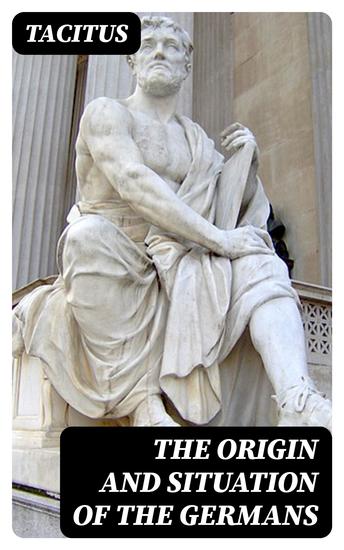
The Origin and Situation of the Germans - cover

The Origin and Situation of the Germans

Tacitus Tacitus

Traducteur Alfred John Church, William Jackson Brodribb

Maison d'édition: DigiCat

  • 0
  • 0
  • 0

Synopsis

In "The Origin and Situation of the Germans," Tacitus presents a meticulously detailed ethnographic study of the Germanic tribes, juxtaposing their customs, governance, and societal structures against the backdrop of Roman imperialism. The text is characterized by its succinct prose and keen observational style, seamlessly weaving historical analysis with vivid descriptions. Tacitus, through an impartial lens, critiques Roman civilization while illuminating the complexities of Germanic life, effectively capturing the ideological clash between the two cultures during the first century AD. His work serves not only as a valuable historical document but also as a reflection of Roman perceptions of the 'barbarian' other. Tacitus, a prominent Roman historian, was born around 56 AD and lived through a tumultuous period marked by political upheaval and moral decay within the Empire. His personal experiences, coupled with his interests in governance and ethical philosophy, likely influenced his exploration of Germanic societies. The disenchantment with contemporary Rome and a fascination with the perceived simplicity and virtue of the Germans manifest throughout Tacitus's writings, offering keen insights into his worldview. Readers intrigued by the intersection of history, culture, and identity will find Tacitus's work to be both enlightening and provocative. "The Origin and Situation of the Germans" not only serves as a foundational text for understanding Germanic heritage but also offers timeless reflections on the nature of civilization itself, making it essential reading for anyone interested in historical anthropology and classical studies.
Disponible depuis: 10/08/2022.
Longueur d'impression: 25 pages.

D'autres livres qui pourraient vous intéresser

  • The Illuminati - cover

    The Illuminati

    Phil G

    • 0
    • 0
    • 0
    There is an elite group that control the world. They run governments, companies and religions. They have done so for a very long time. Their names have changed, their faces altered but their bloodlines remain the same. We see glimpses of their power. We see the outcomes of their plots and schemes. We see revolutions and war. We succumb to their propaganda and manipulation again and again. Most have no idea that they are under the spell. 
     
    In the 18th century they emerged briefly into the spotlight to bring about world-wide cataclysmic change and they called themselves the Illuminati. Quickly they spread and embedded themselves and their ideals within other secret societies. The French had a bloody revolution. America turned the tide against a royal regime. Russia, Spain and more, all fell to the zeal of a new world order. 
     
    This is the story of the world's most powerful secret and sacred order.
    Voir livre
  • Shopping All the Way to the Woods - How the Outdoor Industry Sold Nature to America - cover

    Shopping All the Way to the...

    Rachel S. Gross

    • 0
    • 0
    • 0
    A fascinating history of the profitable paradox of the American outdoor experience: visiting nature first requires shopping 


    No escape to nature is complete without a trip to an outdoor recreational store or a browse through online offerings. This is the irony of the American outdoor experience: visiting wild spaces supposedly untouched by capitalism first requires shopping. With consumers spending billions of dollars on clothing and equipment each year as they seek out nature, the American outdoor sector grew over the past 150 years from a small collection of outfitters to an industry contributing more than 2 percent of the nation's economic output. 


    Rachel S. Gross argues that this success was predicated not just on creating functional equipment but also on selling an authentic, anticommercial outdoor identity. In other words, shopping for the woods was also about being—or becoming—the right kind of person. Demonstrating that outdoor culture is commercial culture, Gross examines Americans' journey toward outdoor expertise by tracing the development of the nascent outdoor goods industry, the influence of World War II on its growth, and the boom years of outdoor businesses.
    Voir livre
  • Stretched and Plowed by the Firefighter - First Time Gay - cover

    Stretched and Plowed by the...

    Karl Cumin

    • 0
    • 1
    • 0
    A new job in a small town fire department sees Jacob on nightshift with his new commander on the very first week. The attraction between them is already there, and there’s no fighting it off. It ends with Jacob giving in to feelings he’s been suppressing, as he lets the commander take charge to show him just how good it is to be with a man. 
    Voir livre
  • Prince The (Fingerprint Classics) - cover

    Prince The (Fingerprint Classics)

    Niccolo Machiavelli

    • 0
    • 0
    • 0
    The Prince by Niccolò Machiavelli is a timeless political treatise that explores the dynamics of power, leadership, and statecraft. Written in the early 16th century, this concise yet provocative work offers pragmatic advice to rulers on how to gain, maintain, and consolidate authority, often advocating for realism over idealism. Machiavelli examines historical examples and human behavior to present strategies that prioritize effectiveness over morality, making the book both influential and controversial. Its insights into political maneuvering and the nature of authority have cemented it as a foundational text in political philosophy and realpolitik.
    Voir livre
  • Why Science Does Not Disprove God - cover

    Why Science Does Not Disprove God

    Anonyme

    • 0
    • 0
    • 0
    The renowned science writer, mathematician, and bestselling author of Fermat's Last Theorem masterfully refutes the overreaching claims the "New Atheists," providing millions of educated believers with a clear, engaging explanation of what science really says, how there's still much space for the Divine in the universe, and why faith in both God and empirical science are not mutually exclusive. 
    A highly publicized coterie of scientists and thinkers, including Richard Dawkins, the late Christopher Hitchens, and Lawrence Krauss, have vehemently contended that breakthroughs in modern science have disproven the existence of God, asserting that we must accept that the creation of the universe came out of nothing, that religion is evil, that evolution fully explains the dazzling complexity of life, and more. In this much-needed book, science journalist Amir Aczel profoundly disagrees and conclusively demonstrates that science has not, as yet, provided any definitive proof refuting the existence of God. 
    Why Science Does Not Disprove God is his brilliant and incisive analyses of the theories and findings of such titans as Albert Einstein, Roger Penrose, Alan Guth, and Charles Darwin, all of whose major breakthroughs leave open the possibility— and even the strong likelihood—of a Creator. Bolstering his argument, Aczel lucidly discourses on arcane aspects of physics to reveal how quantum theory, the anthropic principle, the fine-tuned dance of protons and quarks, the existence of anti-matter and the theory of parallel universes, also fail to disprove God.
    Voir livre
  • Circassians The: The Turbulent History of the Ethnic Group in the North Caucasus - cover

    Circassians The: The Turbulent...

    Editors Charles River

    • 0
    • 0
    • 0
     Circassia could be broadly split into a western and eastern region. Eastern Circassia was inhabited by Kabardians who mainly spoke Kabardian while Western Circassia was made up of Adyghe, who spoke the eponymously-named Adyghe. As a result, discussions about the Circassians tend to split the geography of Circassia into two portions: Eastern Circassia, or Kabardia, and Western Circassia, or Adyghe. Geographically, Kabardia was situated in the middle segment of the Caucasian peninsula, with steppes to the north, and higher mountains to the south. The two key rivers in the Circassia region are the Kuban River, originating near Mount Elbrus in the Caucasus Mountains and flowing from south to north into the Sea of Azov, and the Terek River, originating in the Mtskheta-Mtianeti region of Georgia and flowing from west to east into the Caspian Sea. The Sunzha is another of the major rivers that dissects the region and acts as a tributary of the Terek. These waterways would provide strategic points in the long Russo-Circassian wars. The Caucasus region itself contains a repository of raw materials important in history (and today), including petroleum, natural gas, copper, manganese and tungsten. It also has fertile soil capable of growing wheat, barley, corn, sunflower, and many fruits and vegetables. It is unsurprising, therefore, that outsiders have coveted the region. 
    	 The Circassian people were never united as a single political bloc, which provided a core problem for their survival as larger powers, outsiders and invaders were able to exploit differences. They were invaded on many occasions during their history in the pre-modern period, including by the Mongols and the Khazars.
    Voir livre