Begleiten Sie uns auf eine literarische Weltreise!
Buch zum Bücherregal hinzufügen
Grey
Einen neuen Kommentar schreiben Default profile 50px
Grey
Jetzt das ganze Buch im Abo oder die ersten Seiten gratis lesen!
All characters reduced
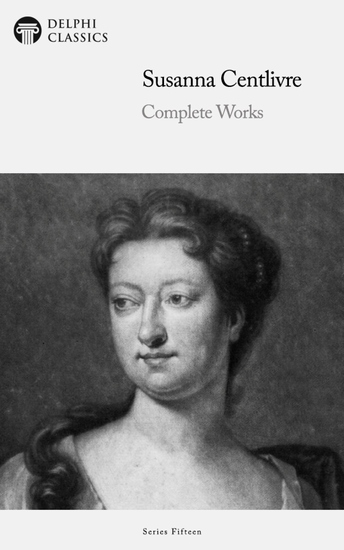
Delphi Complete Works of Susanna Centlivre Illustrated - cover

Delphi Complete Works of Susanna Centlivre Illustrated

Susanna Centlivre

Verlag: Delphi Publishing Ltd

  • 0
  • 0
  • 0

Beschreibung

The most successful female playwright of the eighteenth century,Susanna Centlivre enjoyed a long career at the Theatre Royal, Drury Lane, where she became known as the second woman of the English stage, after Aphra Behn. She penned entertaining dramas that avoided rough satiric material, poking fun instead at general human nature. She adopted many of the comic types of the Restoration stage, treating them with a tolerance uncharacteristic of her times. For the first time in publishing history, this eBook presents Centlivre’s complete works, with numerous illustrations, rare texts, informative introductions and the usual Delphi bonus material. (Version 1)
 
* Beautifully illustrated with images relating to Centlivre’s life and works* Concise introductions to the major texts* All 19 plays, with individual contents tables* Features rare dramas appearing for the first time in digital publishing* Images of how the plays were first published, giving your eReader a taste of the original texts* Includes Centlivre’s complete poetry – available here for the first time in publishing history* Also includes Centlivre’s epistles – available in no other collection* Features a bonus biography – discover Centlivre’s theatrical life* Ordering of texts into chronological order and genres
 
CONTENTS:
 
The PlaysThe Perjur’d Husband (1700)The Beau’s Duel (1702)The Stolen Heiress (1702)Love’s Contrivance (1703)The Gamester (1705)The Basset Table (1705)Love at a Venture (1706)The Platonick Lady (1706)The Busie Body (1709)The Man’s Bewitched (1709)A Bickerstaff’s Burying (1710)Marplot (1710)The Perplex’d Lovers (1712)The Wonder (1714)A Gotham Election (1715)A Wife Well Managed (1715)The Cruel Gift (1716)A Bold Stroke for a Wife (1718)The Artifice (1722)
 
The PoetryThe Poetry of Susanna Centlivre
 
The LettersFamiliar and Courtly Letters (1700)The Second Volume of Familiar Letters as Astraea (1701)Letters of Wit, Politicks and Morality as Astraea (1701)
 
The BiographySusannah Centlivre (1900) by John Joseph Knight
Verfügbar seit: 14.04.2025.
Drucklänge: 2378 Seiten.

Weitere Bücher, die Sie mögen werden

  • Didicoy - cover

    Didicoy

    Karen Downs-Barton

    • 0
    • 0
    • 0
    Didicoy offers a window into the colourful, precarious world of a multiracial Romany family, and focuses on characters at the often-untold margins of society. Blending lyricism with formal experimentation, these poems explore what it is to belong. Clear-eyed and outspoken, Didicoy has something of the impact of a contemporary Cathy Come Home.
    The collection is wonderfully peopled, with an unforgettable portrait of a mother and a powerful and important depiction of life in a children's home. Writing like this, which combines real expressive skill with material which must be expressed, really reminds us what poetry is for. – Jonathan Edwards, winner of the Costa Poetry Award
    Zum Buch
  • A Rhyme A Dozen ― Fruit - 12 Poets 12 Poems 1 Topic - cover

    A Rhyme A Dozen ― Fruit - 12...

    Elinor Wylie, Mirabai, D H...

    • 0
    • 0
    • 0
    ‘A dime a dozen’ as known in America, is perhaps equal to the English ‘cheap as chips’ but whatever the lingua franca of your choice in this series we hereby submit ‘A Rhyme a Dozen’ as 12 poems on many given subjects that are a well-rounded gathering, maybe even an essential guide, from the knowing pens of classic poets and their beautifully spoken verse to the comfort of your ears. 
    1 - A Rhyme a Dozen - 12 Poets, 12 Poems, 1 Topic.  Fruit - An Introduction 
    2 - Epigram on Fruit by Diodorus 
    3 - Wild Peaches by Elinor Wylie 
    4 - Moonlit Apples by John Drinkwater 
    5 - The Pomegranate by Alice Corbin 
    6 - Oranges and Lemons from Sicily by Abd-al-Rahman 
    7 - The Plums Tasted by Mirabai 
    8 - Sonnet 13 -  Summer Fruit by Rainer Maria Rilke 
    9 - This Is Just to Say by William Carlos Williams 
    10 - Apples by Jonathan Swift 
    11 - Cherry Ripe by Robert Herrick 
    12 - Figs by D H Lawrence 
    13 - Quince by Shafer Ben Utman Al-Mushafi
    Zum Buch
  • The Top 10 Poets – The English - Five poems each from some of the best English poets ever - cover

    The Top 10 Poets – The English -...

    Alfred Lord Tennyson, Christina...

    • 0
    • 0
    • 0
    The language of Poetry is an art that most of us attempt at some point in our lives.  Although its commonplace exposure has been somewhat marginalised in today’s often fast-paced lives we all recognise good verse that can empathise with our thoughts or open us up to experience new things in new ways, to better understand and to enjoy the many strands of our lives. 
     
    But finding a starting point can be overwhelming, even off-putting, so in this series we offer up our Top 10 classic poets, who brim with talent and verse, on a range of subjects and themes that we can all enjoy. 
     
    In this volume the English language reveals itself in a scale and depth that few others can compare with.  It seems to be an advantage to be able to choose from over a million words and yet, it is not the words but the way in which they are used that resonate with us all.  Is there some bond between the English and writing poetry?  Maybe, maybe not, but let us celebrate these poems down the ages, not as one nation’s hoard but humanity’s gift.
    Zum Buch
  • Everything We've Done: Female Poets of WW1 - cover

    Everything We've Done: Female...

    Charlotte Mew, May Sinclair,...

    • 0
    • 0
    • 0
    The horror of the male experience during World War One was well documented in poetry, memoir, and fiction throughout the 20th century. Women's voices of despair, endurance and anger, however, have often been forgotten. These poems of political fury, widowed brides, industry undertaken, and sons and friends loved and lost, give a heartbreaking insight into the experience of women throughout World War One.
    The full list of poems included in this collection are:
    
    
    - Joining the Colours, by Katharine Tynan
    - War Girls, by Jessie Pope
    - August 1914, by May Wedderburn Cannan
    - Rouen, by May Wedderburn Cannan
    - Dedication 8 March, by May Sinclair
    - Belgium, by Edith Wharton
    - Lament, by Katharine Tynan
    - Spring in War-Time, by Sara Teasdale
    - The Falling Leaves, by Margaret Postgate Cole
    - 'I know the truth! Renounce all others!', by Marina Tsvetaeva
    - Lamplight, by May Wedderburn Cannan
    - In a Soldier's Hospital 1: Pluck, by Eva Dobell
    - Perhaps 1916, by Vera Brittain
    - Field Ambulance in Retreat, by May Sinclair
    - At the Movies, by Florence Ripley Mastin
    - Reported Missing, by Anna Gordon Keown
    - from At the Somme: The Song of the Mud, by Mary Borden
    - from The Work, by Gertrude Stein
    - After the War, by May Wedderburn Cannan
    - The Veteran, by Margaret Postgate Cole
    - Epitaph On My Days in Hospital, by Vera Mary Brittain
    - Roundel, by Vera Mary Brittain
    - War Mothers, by Ella Wheeler Wilcox
    - The Lament of the Demobilized, by Vera Brittain
    - The Cenotaph, by Charlotte Mew
    - A War Bride, by Jessie St. John
    - Screens (In a Hospital), by Winifred Letts
    - The Deserter, by Winifred Letts
    - The Spires of Oxford, by Winifred Letts
    - Night Duty, by Eva DobellThis audiobook is fully indexed. Once downloaded, each book and chapter will be listed so you can easily navigate to the individual section.
    Zum Buch
  • Mother Daughter Augur - cover

    Mother Daughter Augur

    Mary Simmons

    • 0
    • 0
    • 0
    Mary Simmons’s debut is a world unto itself: a dark storybook realm, lush and full of eerie possibility, a place outside of time where women move in different forms and pass on warnings and wisdom. In the spirit of a Victorian naturalist’s collection, this book brings together found elements from nature, folklore, mythology, ballet, and oral tradition, crafting a strange, kaleidoscopic beauty and complicating inherited definitions of femininity. As these poems blur dichotomies—maiden and witch, mother and daughter, friend and lover—they reach for a new vision of womanhood beyond the bounds of roles and expectations, one that is mystical, ethereal, a little dangerous, and inherently queer. In the process, they tap into deep currents of yearning, grapple with corporeality, raise larger questions about love and what lasts, and find meaning in the uncanny and the macabre. In these pages are insects and omens, wolves and birds and weird apparitions, Odile and Ophelia, even a seventeenth-century professional poisoner. Original, atmospheric, and immersive, this is a work like no other: a tour through an enchanted forest, a darkness that’s illuminating.
    Zum Buch
  • Octaves - Poem from a Pulitzer prize winner - cover

    Octaves - Poem from a Pulitzer...

    Edward Arlington Robinson

    • 0
    • 0
    • 0
    Edwin Arlington Robinson was born on the 22nd December 1869 in Tide in Lincoln County, Maine.  
    His childhood was described by him as ‘stark and unhappy’.  His name was drawn out of a hat from a fellow vacationer from Arlington Massachusetts when fellow holiday makers decided that his parents had waited long enough at 6 months to name him.  It was a name he despised and reflects the station to which his parents had placed him; their great hope at his birth were that he was a girl to complement their two sons. 
    His pessimistic mood carried him to adulthood and a doomed encounter with Emma Loehen Shepherd who constantly encouraged his poetry.  Edwin was thought too young to be her companion and so his elder, middle brother, Herman was assigned to her.  It was a great blow to Edwin and during their marriage on February 12th, 1890, he stayed home and wrote ‘Cortege’ 
    In the fall of 1891 Edwin entered Harvard, taking classes in English, French and Shakespeare.  He felt at ease with the Ivy League and made great efforts to be published in one of the Harvard literary journals.  Indeed, the Harvard Advocate published ‘Ballade of a Ship’ but then his career appeared to stall.  His father died and although he returned to Harvard for a second year it was to be his last but also the start of some life-long friendships. 
    In 1893 he returned to Gardiner Maine as the man of the household.  Herman by this time had become an alcoholic, having suffered business failures, and was now to become estranged from Emma. 
    Edwin began farming whilst he wrote and quickly developed a close relationship with Emma who had now moved back to Gardiner after Herman’s death with her children. 
    Although he proposed twice, he was rejected and in consequence moved to New York to start afresh. 
    But it was a salutary experience. Although surrounded by artists he had little money and life was difficult. 
    In 1896 he published his own book, ‘The Torrent and the Night Before’, paying 100 dollars for 500 copies.  Edwin wanted it to be a surprise for his Mother, but days before its arrival she died of diphtheria. 
    His second volume, ‘The Children of the Night’, had a wider circulation.  At the behest of President Roosevelt, whose son was an avid admirer, he was given a job in 1905 at the New York Customs Office although it appears his real job was “to help American letters”. 
    Either way his success began to widen and his influence proper.  During the 1920s he won the Pulitzer Prize for Poetry on three separate occasions. In 1922 for ‘Collected Poems’ again in 1925 for ‘The Man Who Died Twice’ and finally in 1928 for ‘Tristram’. 
    During the last twenty years of his life he became a regular summer resident at the MacDowell Colony in New Hampshire, where he became the object of fascination by several women.  But he never married. 
    Edwin Arlington Robinson died of cancer on the 6th April 1935 in the New York Hospital in New York. He was 65.
    Zum Buch