Begleiten Sie uns auf eine literarische Weltreise!
Buch zum Bücherregal hinzufügen
Grey
Einen neuen Kommentar schreiben Default profile 50px
Grey
Jetzt das ganze Buch im Abo oder die ersten Seiten gratis lesen!
All characters reduced
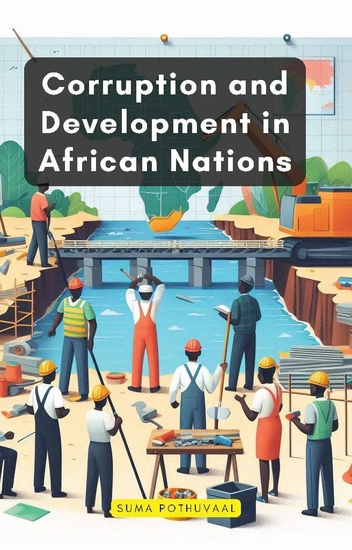
Corruption and Development in African Nations - cover

Corruption and Development in African Nations

Suma Pothuvaal

Verlag: Educohack Press

  • 0
  • 0
  • 0

Beschreibung

"Corruption and Development in African Nations" explores the deep-rooted causes of corruption in Africa, going beyond the typical portrayal of African countries as corrupt. We delve into the African political economy to uncover the severity of governance issues and their impact on the domestic economy and the region's role in the international economic order.
Our book combines economic analysis and political theory to provide a comprehensive understanding of political and economic corruption in Sub-Saharan Africa. Instead of merely focusing on increasing vigilance, coercion, and democratic processes, we offer insightful analysis to grasp the foundational issues contributing to corruption.
This book is essential for anyone seeking to understand the complexities of governance and corruption in African nations, providing a nuanced perspective on the challenges and potential solutions for development.
Verfügbar seit: 03.01.2025.
Drucklänge: 270 Seiten.

Weitere Bücher, die Sie mögen werden

  • Undercover Angels - Virginia Hall And The Spy Women Who Fought The Nazis During World War II - cover

    Undercover Angels - Virginia...

    Davis Truman

    • 0
    • 0
    • 0
    Step into the covert world of World War II's untold heroes, the female agents of the Special Operations Executive (SOE). While history often overlooks their pivotal roles, these daring women defied societal norms and infiltrated enemy lines, rewriting the rules of warfare. 
    "Undercover Angels: Virginia Hall And The Spy Women Who Fought The Nazis During World War II" uncovers their remarkable journey, from recruitment to undercover operations and imprisonment. Drawing from classified documents and personal accounts, this gripping tale reveals their dual identity as combatants and strategic spies, leveraging femininity as a formidable weapon. 
    Explore how these extraordinary women challenged perceptions of wartime roles, leaving a legacy that continues to captivate the world's imagination, morphing from combatants into the enigmatic realm of espionage.
    Zum Buch
  • 20 First Legislative Acts of the Russian Bolshevik Revolution - cover

    20 First Legislative Acts of the...

    Vladimir Lenin

    • 0
    • 0
    • 0
    Decrees were legislative acts of the highest Soviet institutions, primarily of the Council of People's Commissars (the highest executive body — Sovnarkom) and of VTsIK (the highest legislative body between sessions of the Congress of Soviets).
    The Bolshevik Initial Decrees were announced as soon as the Bolsheviks declared their success in the October Revolution (October 26, 1917). The Decrees seemed to conform to the popular Bolshevik slogan "Peace, Land and Bread". The slogan succinctly articulated the grievances of the Russian peasantry, armed forces and proletariat.
    The Bolsheviks were not opportunists but benevolent idealists; the point of the Decrees was to bring about a better quality of life for the Russian people. Regardless of which view is the more accurate account, it is clear from these opposing perspectives that the history of the Initial Decrees is a politically charged issue. This is perhaps because historians use the Decrees to try to discern whether the implementation of Marxist thought has totalitarian tendencies.
    Zum Buch
  • What's So Great about America - cover

    What's So Great about America

    Dinesh D'Souza

    • 0
    • 0
    • 0
    What's So Great About America isn't a question—it's a statement. From the unique perspective that perhaps only an immigrant can have, Dinesh D'Souza says that America is a land of opportunity and freedom. A leading conservative thinker, D'Souza trumpets the science, democracy, and capitalism that he believes have led the West to global supremacy. Along the way, he spares no opportunity to bash those who he thinks have "denigrated" America and trivialized its freedom: multiculturalists, feminists, hippies, and vegetarians. As an "outsider" from India who has had amazing success in the United States, D'Souza defends not an idealized America, but America as it really is.
    Zum Buch
  • The War on Critical Race Theory - Or The Remaking of Racism - cover

    The War on Critical Race Theory...

    David Theo Goldberg

    • 0
    • 0
    • 0
    "Critical Race Theory" is consuming conservative America. The mounting attacks on a once-obscure legal theory are upending public schooling, legislating censorship, driving elections, and cleaving communities. 


    In this much-needed response, renowned scholar David Theo Goldberg cuts to the heart of the claims expressed in these attacks. He punctures the demonization of Critical Race Theory, uncovering who is orchestrating it, funding the assault, and eagerly distributing the message. The book richly illustrates the enduring nature of structural racism, even as a conservative insistence on colorblindness serves to silence the possibility of doing anything about it. Crucially, Goldberg exposes the political aims and effects of the vitriolic attacks. The upshot of CRT's targeting, he argues, has been to unleash racisms anew and to stymie any attempt to fight them, all with the aim of protecting white minority rule.
    Zum Buch
  • Citizen of the World: Soon-Young and the UN - cover

    Citizen of the World: Soon-Young...

    Soon-Young Yoon

    • 0
    • 0
    • 0
    From North Korean Refugee to the United Nations: A Courageous and Compassionate Memoir 
    Soon-Young Yoon understood from an early age that people's destinies are connected to international events. This book is a collection of her reflections as a women's human rights advocate speaking up to end violence against women and change the world to ensure gender equality, sustainable development, and peace. 
    Yoon has seen the struggle for human rights in all corners of the world, meeting with people in urban slums and the offices of the United Nations. She urges us to look at the world through women's eyes to understand why gender equality and women's empowerment, particularly for the poorest and most vulnerable populations, is essential to our collective good. 
    In Citizen of the World, you'll be inspired by Yoon's stories on 
    Ending violence against women and girls 
    Finding the Earth's balance 
    Claiming the right to social and economic development 
    Portraits of great women leaders 
    Collective voices that are changing the world 
    Challenges working as a feminist anthropologist inside and outside the United Nations 
    Written through the lens of an anthropologist, these essays reflect her belief that one needs to understand a wide range of issues to shape our common future. 
    Students, academics, and activists in the fields of women's studies, international relations, anthropology, and social justice will find Citizen of the World both unique and eye-opening—and filled with hope for a better future for us all.
    Zum Buch
  • What Is Property? - An Inquiry into the Principle of Right and of Government - cover

    What Is Property? - An Inquiry...

    Pierre-Joseph Proudhon

    • 0
    • 0
    • 0
    ‘Property is Theft’, a phrase which has passed into common parlance, was the rallying call of Pierre-Joseph Proudhon’s political treatise What Is Property? Proudhon (1809-1865) was both admired and excoriated. A political theorist of the first order, he was vilified in his native France by the Communists and the Monarchists alike, though admired by Karl Marx as well as many in the nation’s academia and judiciary who valued the clarity of his thought and analytical method.  
     
    He criticised both Right and Left (the very definition of French political thinking), describing them as two sides of the same coin. Their solutions to society’s ills, he said, were like Thesis and Antithesis, based on a common error and both inadequate to the task of healing society. He offered, instead, a third way, which he called his Synthesis. Regarded as the founder of modern Anarchism, his aim was not to engender chaos, as the word anarchy often connotes, but to suggest a workable, political, and economic foundation for society which would promote order and equity for all under the most unfettered conditions of individual liberty.  
     
    Proudhon grew up in poverty, and was home schooled as a child, but received a bursary in his youth sufficient to allow him to attend the City College in his home town (though not sufficient, it seems, to buy him shoes). There, he discovered the library which introduced him to a world, classical and contemporary, previously denied him. Lacking wealth or contacts, he worked variously as a printer, a compositor and proof-reader by day and an essayist by night, learning Latin along the way to assist in his work. In 1830, a friend, a scholar, invited Proudhon to join him in Paris to pursue his philosophical writings full time. When a cholera outbreak forced his return home, Proudhon spent the next few years juggling his two careers. In 1839, he applied for a pension (bursary) at the Academy of Besançon which obliged him to write works on its behalf.  
     
    What Is Property?, published in France in 1840, was his first. It was so controversial that little else followed. However, it established his reputation, and he was eventually able to pursue his philosophical work full time. What Is Property? (First Memoir) attempts to uncover the roots of poverty and associated social ills and examines different attitudes to poverty and wealth from the Greeks to the present day. Proudhon quickly identifies a common thread, property, which he distinguishes from possession, and argues that only a fundamental, though gradual, abandonment of property (as an asset) and all that flows from it, can rescue society from its current conflicts. The memoir seeks to illuminate the underlying causes of war, poverty, slavery, and oppression and points the way to a solution. In effect, it is a practical manual for the survival of mankind. The Second Memoir (1841), included on this recording, is Proudhon’s response to the criticisms of the First Memoir, initially uncomprehending and then self-assured by turns. What Is Property? is Proudhon’s masterwork. It divides opinion, but no one who hears it can come away with their view of their own world unchanged.  
     
    Translation: Benjamin R. Tucker.
    Zum Buch