Rejoignez-nous pour un voyage dans le monde des livres!
Ajouter ce livre à l'électronique
Grey
Ecrivez un nouveau commentaire Default profile 50px
Grey
Abonnez-vous pour lire le livre complet ou lisez les premières pages gratuitement!
All characters reduced
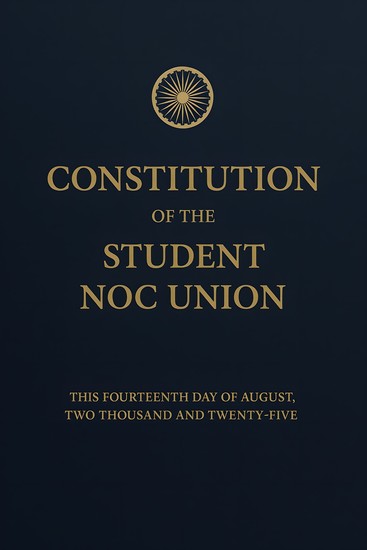
Constitution of Student Noc Union - Guiding Principles and Laws of the Student NOC Union - cover

Constitution of Student Noc Union - Guiding Principles and Laws of the Student NOC Union

Sukhraj Singh PF

Maison d'édition: Publishdrive

  • 0
  • 0
  • 0

Synopsis

The Constitution of the Student NOC Union, adopted on the 14th of August 2025, stands as the foundational charter of a student-led organisation committed to unity, welfare, and progress. Crafted with vision and foresight, this Constitution defines the Union’s structure, objectives, membership rights, leadership succession, and guiding principles.
 
It serves as a beacon of equality, fraternity, and mutual assistance, ensuring that every student above the age of fourteen may find a place of belonging, support, and growth within its framework. From academic guidance and skill development to mental well-being and social cooperation, the Union seeks to empower its members in every dimension of student life.
 
With well-defined codes of conduct, transparent disciplinary measures, and a strong emphasis on integrity, this Constitution safeguards the dignity of its members while protecting the Union’s spirit of service. It entrusts leadership to the President, beginning with its First President, Sukhraj Singh, while establishing a system of succession and continuity.
 
More than a governing document, this Constitution is a living symbol of collective aspiration — a pledge that students, bound by shared values and respect, can create an enduring community of learning, leadership, and brotherhood.
Disponible depuis: 26/08/2025.
Longueur d'impression: 14 pages.

D'autres livres qui pourraient vous intéresser

  • Mastering Control: A Man's Journey Beyond Anger - Practical Steps to Regain Inner Peace - cover

    Mastering Control: A Man's...

    James Donovan

    • 0
    • 0
    • 0
    Learn how to turn anger from a destructive force into a potent tool for personal development in "Mastering Control: A Man's Journey Beyond Anger: Practical Steps to Regain Inner Peace." For guys who want to learn how to understand and regulate their anger, this book gives them the tools they need to take back emotional control and find long-lasting inner peace. 
    Anger may easily become a roadblock to living a happy life, impacting relationships, work, and general health. This book takes readers on a journey to discover hidden triggers, deal with unresolved emotional anguish, and investigate the causes of their anger. By employing a blend of introspection and tried-and-true methods, readers will discover how to see wrath before it festers, create more constructive reactions, and transform angry times into learning experiences. 
    The book is divided into five in-depth parts, each of which offers practical advice on how men might develop emotional resilience. The art of letting go of old grudges, breathing exercises, and mindfulness will all become skills that readers will acquire. They will acquire the skills necessary to form virtuous habits and maintain emotional control over time. 
    "Mastering Control" is a road map to personal empowerment and a life characterized by composure, self-control, and patience rather than just a manual for managing rage. This is where the path to enduring peace starts.
    Voir livre
  • Pragmatism - Philosophy and Truth in Action - cover

    Pragmatism - Philosophy and...

    Hector Davidson

    • 0
    • 0
    • 0
    Pragmatism is a philosophy that emphasizes the practical application of ideas by focusing on their consequences and real-world outcomes. Rooted in the belief that thought should be guided by experience, pragmatism challenges the notion of abstract, detached theorizing. Rather than searching for eternal truths or fixed principles, pragmatists argue that the value of ideas is measured by their usefulness in addressing human needs and solving practical problems. This approach seeks to bridge the gap between philosophy and everyday life, transforming ideas into action. 
    At the heart of pragmatism lies the concept of truth, which is not seen as an abstract, objective reality but as something that emerges through interaction with the world. For pragmatists like Charles Peirce and William James, truth is dynamic and evolves based on what works in practice. Ideas and beliefs are continuously tested, refined, and adjusted according to their ability to produce positive outcomes in human experience. Truth, then, becomes a process of inquiry, always in the making and never static. 
    The philosophy of pragmatism is also deeply concerned with the connection between thought and action. It suggests that knowledge is not just something to be passively absorbed, but a tool to be actively employed in solving problems. This perspective challenges traditional philosophies that prioritize theory over practice and encourages individuals to test their ideas in real-world contexts. Whether in science, ethics, politics, or personal life, pragmatism urges a philosophy that is not only reflective but also responsive to the ever-changing circumstances of human existence.
    Voir livre
  • The Genealogy of Morals - Understanding Ethics Power and Human Nature - cover

    The Genealogy of Morals -...

    Friedrich Nietzsche, Tim Zengerink

    • 0
    • 0
    • 0
    What defines “good” and “evil”? Where do our moral values come from? How do power and societal structures shape our view of the world? 
    The Genealogy of Morals is Nietzsche’s groundbreaking analysis of morality’s origins and evolution. This modern translation offers a clearer path to understanding his profound insights, making them more accessible for real-world application. 
    More than a critique of traditional ethics, The Genealogy of Morals explores human nature, power dynamics, and the social forces that influence our values. Nietzsche encourages us to challenge long-held assumptions and embrace intellectual courage. 
    What You’ll Discover: 
    - Origins of Morality – See how historical and cultural forces have shaped our notions of right and wrong. 
    - Power and Human Nature – Understand how power dynamics affect society and learn to navigate them personally and professionally. 
    - Question Conventional Thinking – Free yourself from restrictive norms and expand your perspective. 
    - Philosophy for Modern Challenges – Apply Nietzsche’s ideas to inform decisions, overcome obstacles, and inspire personal growth. 
    Imagine gaining the clarity to question societal expectations, the courage to challenge outdated beliefs, and the insight to discover your true self. The Genealogy of Morals has inspired generations of thinkers—now it’s your turn. 
    Begin your journey into morality, power, and freedom. Get your copy today and unlock the transformative wisdom that could forever change your perspective on the world.
    Voir livre
  • How to English: Idioms - A Practical Guide to Common Idiomatic Phrases - cover

    How to English: Idioms - A...

    David Tobin

    • 0
    • 0
    • 0
    Make your English more natural, colorful, and expressive. 
    Unlock the power of English idioms with this engaging and practical guide. How to English: Idioms offers clear explanations, real-life examples, and a wide variety of expressions to help you sound more fluent and confident. 
    Perfect for intermediate to advanced learners, educators, or anyone who wants to add personality and depth to their English, this audiobook makes idioms easy to understand—and even easier to use. 
    Whether you're learning for fun, study, or everyday conversation, this guide brings English to life, one idiom at a time.
    Voir livre
  • Navalny - Putin's Nemesis Russia's Future? - cover

    Navalny - Putin's Nemesis...

    Jan Matti Dollbaum, Ben Noble,...

    • 0
    • 0
    • 0
    A fascinating account of Russia's famous dissident and the politics he embodies. 


    Who is Alexei Navalny? Poisoned in August 2020 and transported to Germany for treatment, the politician returned to Russia in January 2021 in the full glare of the world media. His immediate detention at passport control set the stage for an explosive showdown with Vladimir Putin. 


    But Navalny means very different things to different people. To some, he is a democratic hero. To others, he is betraying the Motherland. To others still, he is a dangerous nationalist. Navalny explores the many dimensions of his political life, from his pioneering anti-corruption investigations to his ideas and leadership of a political movement. It also looks at how his activities and the Kremlin's strategies have shaped one another. 


    Navalny makes sense of this divisive character, revealing the contradictions of a man who is the second most important political figure in Russia—even when behind bars. In order to understand modern Russia, you need to understand Alexei Navalny.
    Voir livre
  • The Legends of King Arthur - Chivalry Magic and Myth in Medieval Britain - cover

    The Legends of King Arthur -...

    Odessa Nightshade

    • 0
    • 0
    • 0
    The legend of King Arthur is one of the most enduring and captivating myths in Western history. For centuries, stories of the noble king, his valiant knights, and the magical forces surrounding them have fascinated people across generations. Arthurian legends have been retold through medieval manuscripts, romantic poetry, and modern films, each version reshaping the myth to fit its time. But who was King Arthur? Was he a real historical figure, or merely a creation of folklore? The answer remains elusive, yet the legend continues to hold a profound place in literature and culture.  
      
    The origins of the Arthurian legend are shrouded in mystery. Early references to Arthur can be traced back to medieval Welsh poetry and the historical writings of figures like Geoffrey of Monmouth, who played a crucial role in shaping Arthur’s story. Some believe Arthur was inspired by a real warrior who fought against invading Saxons in the early Middle Ages. Others argue that Arthur was never a historical figure at all but rather a symbol of ideal kingship, created to embody the virtues of courage, wisdom, and justice. Regardless of his origins, the myth of Arthur evolved over time, blending history with fantasy.  
      
    One of the defining elements of the Arthurian legend is the concept of chivalry. The stories of Arthur and his Knights of the Round Table emphasize honor, loyalty, and the pursuit of noble causes. These ideals were deeply rooted in the medieval code of conduct, influencing literature and knightly behavior for centuries. The knights’ quests, whether for justice or for the Holy Grail, reflect themes of personal growth, sacrifice, and moral integrity. The concept of Camelot, a utopian kingdom where justice prevails and the weak are protected, continues to inspire stories of heroism and idealism. 
    Voir livre