Begleiten Sie uns auf eine literarische Weltreise!
Buch zum Bücherregal hinzufügen
Grey
Einen neuen Kommentar schreiben Default profile 50px
Grey
Jetzt das ganze Buch im Abo oder die ersten Seiten gratis lesen!
All characters reduced
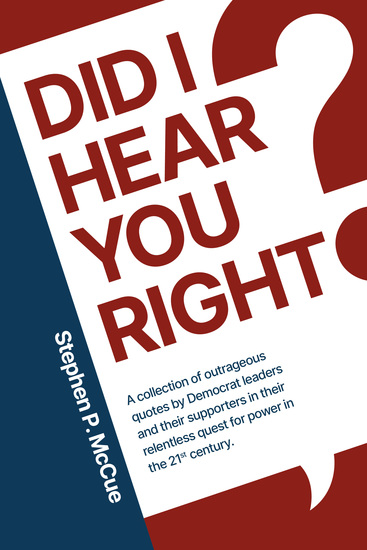
Did I Hear You Right? - A Collection of Outrageous Quotes by Democrat Leaders and Their Supporters in Their Relentless Quest for Power in the 21st Century - cover

Did I Hear You Right? - A Collection of Outrageous Quotes by Democrat Leaders and Their Supporters in Their Relentless Quest for Power in the 21st Century

Stephen P. McCue

Verlag: Defiance Press and Publishing

  • 0
  • 0
  • 0

Beschreibung

In "Did I Hear You Right?", Stephen P. McCue delivers a biting compilation of jaw-dropping quotes from Democratic leaders and their supporters that reveals their true agenda. From Barack Obama's declaration about "fundamentally transforming" America to Joe Biden's string of gaffes and fabrications, this meticulously researched collection exposes the disconnect between what Democrats say and what they actually believe.
 
McCue organizes these revealing statements by political office, from Presidents and Vice Presidents to members of Congress and local officials, creating a comprehensive record of Democratic hypocrisy, double standards, and extremism. Each quote is presented with important context and insightful commentary that helps readers understand not just what was said, but why it matters.
 
Whether it's Nancy Pelosi's infamous "We have to pass the bill so that you can find out what is in it" or Kamala Harris's nonsensical word salads, this book chronicles the outrageous statements that mainstream media often ignores or downplays. McCue demonstrates how Democratic leaders have embraced increasingly radical positions on issues ranging from immigration and crime to gender ideology and education.
 
This is more than just a collection of political gaffes—it's a sobering look at how far the Democratic Party has strayed from American values and common sense. Entertaining yet enlightening, this book serves as both a reference guide for political discussions and a warning about the direction in which Democrats are taking the country.
 
If you enjoyed "The Authoritarian Moment," "Liberal Fascism," or "Unfreedom of the Press," you'll love "Did I Hear You Right?"
Verfügbar seit: 13.03.2025.
Drucklänge: 346 Seiten.

Weitere Bücher, die Sie mögen werden

  • Life As Dance: The Lost Wisdom of Ralph Waldo Emerson - cover

    Life As Dance: The Lost Wisdom...

    Ralph Waldo Emerson

    • 0
    • 0
    • 0
    Ralph Waldo Emerson was an American essayist, lecturer, philosopher, abolitionist, and poet who led the transcendentalist movement of the mid19th century. He was seen as a champion of individualism and a prescient critic of the countervailing pressures of society, and his ideology was disseminated through dozens of published essays and more than 1,500 public lectures across the United States. 
      
    Emerson gradually moved away from the religious and social beliefs of his contemporaries, formulating and expressing the philosophy of transcendentalism in his 1836 essay "Nature". Following this work, he gave a speech entitled "The American Scholar" in 1837, which Oliver Wendell Holmes Sr. considered to be America's "intellectual Declaration of Independence." 
      
    Emerson wrote most of his important essays as lectures first and then revised them for print. His first two collections of essays, Essays: First Series and Essays: Second Series, represent the core of his thinking. They include the well-known essays "SelfReliance", "The OverSoul", "Circles", "The Poet", and "Experience." Together with "Nature", these essays made the decade from the mid1830s to the mid1840s Emerson's most fertile period. Emerson wrote on a number of subjects, never espousing fixed philosophical tenets, but developing certain ideas such as individuality, freedom, the ability for mankind to realize almost anything, and the relationship between the soul and the surrounding world. Emerson's "nature" was more philosophical than naturalistic: "Philosophically considered, the universe is composed of Nature and the Soul." Emerson is one of several figures who "took a more pantheist approach by rejecting views of God as separate from the world."
    Zum Buch
  • Los animales en la granja Animals on the Farm - cover

    Los animales en la granja...

    Kim Mitzo Thompson, Karen Mitzo...

    • 0
    • 0
    • 0
    Kids will love this playful story in both Spanish and English. This dual language reader will encourage children to learn farm animal names and phrases. Simple sentence structures and repetitive words will have young readers learning a new language in no time. Kids will enjoy following along word-for-word with the recorded story that features sound effects and professional voices to teach correct pronunciation in both Spanish and English. This reader features adorable art showing diversity to help children form a sense of acceptance and understanding of different races and individual differences.
    Zum Buch
  • Xhosa Folk-Lore - South African Folk Tales Vol II - cover

    Xhosa Folk-Lore - South African...

    George McCall Theal

    • 0
    • 0
    • 0
    Tales from the Eastern Cape, gathered in 1886.
    Zum Buch
  • Modern History - Insights from the Gilded Age and the Dutch East India Company - cover

    Modern History - Insights from...

    Kelly Mass

    • 0
    • 0
    • 0
    This special deal includes 2 titles, which are: 
    Gilded Age: The Gilded Age was a period in American history that covered the late 19th century, from the 1870s till around 1900. The Gilded Age was a period of great financial development in the United States, specifically in the North and West. The time saw an increase of countless European immigrants, as American incomes were considerably higher than those in Europe, specifically for experienced workers, while industrialization demanded an ever-increasing common labor force. 
    Between 1860 and 1890, the quick growth of market led to a 60 percent boost in real salaries, which was dispersed over an ever-increasing manpower. The typical annual wage for a commercial worker (consisting of men, women, and kids) increased by 48 percent from $380 in 1880 to $564 in 1890. On the other hand, the Gilded Age was also a time of severe poverty and inequality, as countless immigrants—many from poor parts—gathered to the United States, bringing with them a high concentration of wealth that ended up being more obvious and controversial. 
    Dutch East India Trading Company: Did you know that the Dutch were some of the first who came up with stocks? They were also known for their gigantic fleet, their ships, their colonies, and so much more. The 17th century was a golden age, a golden century for the Dutch, who discovered how to go to the new world in Asia, America, and other continents to transport spices, minerals, and other materials. 
    The Dutch East India Company, officially the United East India Company (Dutch: Vereenigde Oost Indische Compagnie; VOC), was a mega corporation created in the early 17th century by a government-directed merger of many competing Dutch trade services.
    Zum Buch
  • Game Over - Understanding Internet Gaming Disorder Its Effects on Mental Health And How to Get Out of It - cover

    Game Over - Understanding...

    Brian Gibson

    • 0
    • 0
    • 0
    This audiobook is narrated by an AI Voice.   
    In an era where digital connectivity is omnipresent, gaming has evolved from a casual pastime into a global phenomenon. However, with this rise, a darker aspect has emerged: Internet Gaming Disorder (IGD). *Game Over* delves deeply into this modern affliction, examining its complexities and the impact on mental health. 
    Authored by experts in psychology and behavioral sciences, this comprehensive guide demystifies IGD, examining the fine line between recreational gaming and addiction. Through rigorous research and real-life case studies, the book uncovers how excessive gaming can lead to severe psychological and social consequences, including anxiety, depression, and deteriorating relationships. 
    Beyond merely identifying the problem, *Game Over* is a beacon of hope for those affected by IGD. It provides practical strategies and therapeutic approaches for overcoming addiction. Readers will find actionable advice on setting boundaries, seeking professional help, and building a balanced life away from the screen. 
    Whether you are a concerned parent, a mental health professional, or someone struggling with gaming addiction, *Game Over* offers the knowledge and tools necessary to reclaim control and foster healthier habits. This essential read sheds light on the growing issue of IGD and empowers readers to take meaningful steps toward recovery and mental well-being.
    Zum Buch
  • The Siege of Stalingrad - The Turning Point in the War on the Eastern Front - cover

    The Siege of Stalingrad - The...

    Sage Winters

    • 0
    • 0
    • 0
    The Battle of Stalingrad stands as one of the most defining events of the 20th century, a turning point that shifted the trajectory of World War II. Situated along the banks of the Volga River, Stalingrad was not only a city of industrial and strategic importance but also a symbolic prize for both Adolf Hitler and Joseph Stalin. The ferocity and scale of the battle transformed it into a microcosm of the broader conflict between Nazi Germany and the Soviet Union.  
      
    When Germany launched Operation Barbarossa in June 1941, the Wehrmacht seemed unstoppable as it swept across the Soviet Union. Hitler’s ambitions of seizing Soviet territories were fueled by his vision of Lebensraum and the destruction of Bolshevism. By the summer of 1942, German forces were pressing deeper into the southern front, aiming to capture the oil fields of the Caucasus and secure Stalingrad as a vital stepping stone. For Hitler, Stalingrad held immense propaganda value, carrying the name of his adversary, Stalin. Its fall would signify not just a military triumph but a psychological blow to the Soviet people.  
      
    For the Soviet Union, the defense of Stalingrad became a matter of national survival and pride. Stalin’s orders to defend the city at all costs rallied both soldiers and civilians. The infamous directive “Not a step back!” underscored the desperation and determination of the Soviet war effort. As the battle unfolded, Stalingrad was transformed into a hellish landscape of rubble, where every building and street became a battlefield. 
    Zum Buch