Rejoignez-nous pour un voyage dans le monde des livres!
Ajouter ce livre à l'électronique
Grey
Ecrivez un nouveau commentaire Default profile 50px
Grey
Abonnez-vous pour lire le livre complet ou lisez les premières pages gratuitement!
All characters reduced
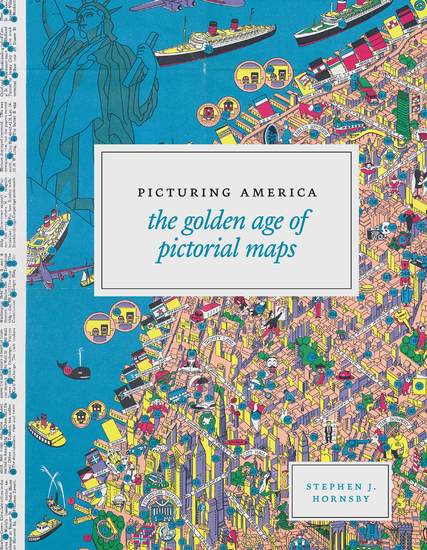
Picturing America - The Golden Age of Pictorial Maps - cover

Picturing America - The Golden Age of Pictorial Maps

Stephen J. Hornsby

Maison d'édition: The University of Chicago Press

  • 0
  • 0
  • 0

Synopsis

Instructive, amusing, colorful—pictorial maps have been used and admired since the first medieval cartographer put pen to paper depicting mountains and trees across countries, people and objects around margins, and sea monsters in oceans. More recent generations of pictorial map artists have continued that traditional mixture of whimsy and fact, combining cartographic elements with text and images and featuring bold and arresting designs, bright and cheerful colors, and lively detail. In the United States, the art form flourished from the 1920s through the 1970s, when thousands of innovative maps were mass-produced for use as advertisements and decorative objects—the golden age of American pictorial maps.  Picturing America is the first book to showcase this vivid and popular genre of maps. Geographer Stephen J. Hornsby gathers together 158 delightful pictorial jewels, most drawn from the extensive collections of the Library of Congress. In his informative introduction, Hornsby outlines the development of the cartographic form, identifies several representative artists, describes the process of creating a pictorial map, and considers the significance of the form in the history of Western cartography. Organized into six thematic sections, Picturing America covers a vast swath of the pictorial map tradition during its golden age, ranging from “Maps to Amuse” to “Maps for War.” Hornsby has unearthed the most fascinating and visually striking maps the United States has to offer: Disney cartoon maps, college campus maps, kooky state tourism ads, World War II promotional posters, and many more. This remarkable, charming volume’s glorious full­-color pictorial maps will be irresistible to any map lover or armchair traveler.
Disponible depuis: 23/03/2017.
Longueur d'impression: 304 pages.

D'autres livres qui pourraient vous intéresser

  • Combat Narratives: The Aleutians Campaign - June 1942 - August 1943 - cover

    Combat Narratives: The Aleutians...

    United States Navy, Office of...

    • 0
    • 0
    • 0
    "Combat Narratives: The Aleutians Campaign June 1942 - August 1943" by the Office of Naval Intelligence provides a detailed and firsthand account of the military operations in the Aleutian Islands during World War II. The book covers the period from June 1942 to August 1943, offering a comprehensive narrative of the strategic importance of the Aleutian Islands and the challenges faced by the U.S. Navy in countering Japanese forces. The narrative delves into the planning, execution, and outcomes of various naval battles and amphibious operations in the harsh and challenging Aleutian environment. It aims to provide readers with an in-depth understanding of the military strategies employed, the logistical challenges faced by both sides, and the overall significance of the Aleutians Campaign in the broader context of the Pacific Theater.
    Voir livre
  • Stones Still Speak - How Biblical Archaeology Illuminates the Stories You Thought You Knew - cover

    Stones Still Speak - How...

    Amanda Hope Haley

    • 0
    • 0
    • 0
    When we first encounter the Bible, we are taught its stories—Adam and Eve, Moses and the Red Sea, David and Goliath, Jonah and the whale, and more. When a story lacks the details we crave, we fill in the blanks—with what we've seen in movies, read in books, and been told by our Sunday school teachers. But there's a better way to encounter the whole story of Scripture: uncovering and understanding the ancient world and the people who experienced biblical events. 


    In Stones Still Speak, Harvard-trained archaeologist and theologian Amanda Hope Haley scrapes back 2,000 years of misguided cultural interpretations to reveal God's Word in its historical, archaeological, and literary contexts. Far from a dry academic exercise, this process explains how our misunderstandings developed and revitalizes the Scripture you thought you knew, with the greater purpose of encouraging a more intentional, rigorous study of the Bible in your daily life.
    Voir livre
  • The First 8 Verses of the Book of Joel - cover

    The First 8 Verses of the Book...

    Pastor Philip

    • 0
    • 0
    • 0
    Let us pray;Heavenly Father, you are the source of all knowledge. Give us understanding, knowledge, and revelation about the first 8 verses of the Book of Joel.In Jesus name. AmenThe tune "Wonderful Grace (Instrumental)" from Divine Sounds, at the end of the sermon, gives the listener an opportunity to reflect on the sermon.
    Voir livre
  • Basic Income - A Short Guide - cover

    Basic Income - A Short Guide

    Anne Miller

    • 0
    • 0
    • 0
    This innovative book provides a new perspective on Basic Income - a regular, unconditional payment to every citizen of the country. This comprehensive book has been rigorously researched and thus will appeal to academics, policy-makers, and the general reader concerned about the current state of social security in the UK. Basic Income in practice, A Basic Income includes details of real Basic Income Schemes.
    Voir livre
  • How to Lose Yourself - An Ancient Guide to Letting Go - cover

    How to Lose Yourself - An...

    The Buddha and His Followers

    • 0
    • 0
    • 0
    Inviting new translations of classical Buddhist texts about why the self is an illusion—and why giving it up can free us from suffering 


    From self-realization and self-promotion to self-help and the selfie, the modern world encourages us to be self-obsessed. We are even told that finding ourselves is the key to happiness. Better to lose yourself! More than 2,500 years ago, the Buddha argued that the self is an illusion—and that our belief in it is the cause of most, if not all, of our suffering. How to Lose Yourself presents lively, accessible, and expert new translations of ancient Buddhist writings about the central, unique, and powerful Buddhist teaching of "no-self." 


    Drawn from three important Buddhist traditions, these essential Indian, Tibetan, and Chinese writings provide a rich sampling of the ways Buddhist philosophers have understood the idea that we are selfless persons—and why this insight is so therapeutic. When we let go of the self, we are awakened to the presence of all things as they truly are, and we let go of the anxiety, fear, greed, and hatred that are the source of all suffering.
    Voir livre
  • Unmasking Fear - How Fears Are Our Gateways to Freedom - cover

    Unmasking Fear - How Fears Are...

    Guryan Tighe

    • 0
    • 0
    • 0
    Imagine the possibilities if instead of avoiding the things you feared, you approached them with courage and curiosity. 
      
    When we are in the grip of fear, our world can get very small and for many of us, the number of choices shrink to just four basic reactions: fight, flight, freeze, or fawn. That’s not a lot of options. On a collective level, elements of our society like governments, religions, and businesses sometimes instill fear to divide and control—to keep us feeling dependent on them instead of ourselves. On an individual level, fear can be the reason we’re living a life that’s not reflective of our truth or potential. It’s what keeps us feeling stuck and holds us back. What most of us don’t realize is that fear has much to teach us. 
      
    “Fear Technician” Guryan Tighe reframes the way we approach fear from the goal of conquering it to a goal of learning from it by providing readers three gateways to look at fear in a way that frees us: curiosity, gratitude, and purpose. She shows us how to interrupt our initial reaction, pause, check in with ourselves, and rewrite the patterns we use to respond to that which we fear. With this shift in thinking and how to engage it, readers will find new pathways forward as they shift from unintentional reactions to intentional responses. 
      
    When we change our relationship to fear, we gain valuable insights that inform our growth and development, connecting us more deeply to our truth. This different approach to fear doesn’t just transform our relationship with ourselves but can also unite us with others through empathy and shared purpose. What has the power to separate us from ourselves and each other—fear—also has the power to unite us. Unmasking Fear shows us that fear is courage unrealized and understanding our fears frees us to pursue the life we want. 
      
    “For anyone in the grip of fear, or longing for deeper connection to themselves and others, this book will propel you towards greater clarity, confidence and peace.”—Randy Taran, author of Emotional Advantage and founder/CEO of Project Happiness.org
    Voir livre