




ÉCOUTER EXTRAIT

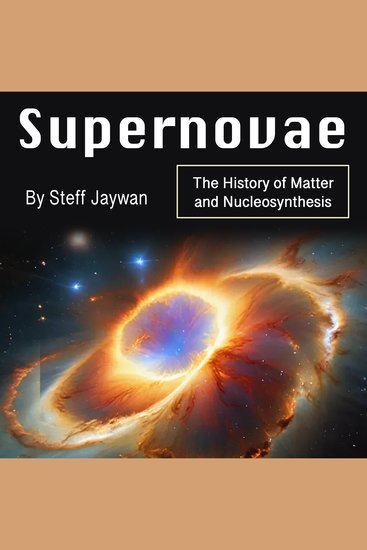
Supernovae - The History of Matter and Nucleosynthesis
Steff Jaywan
Narrateur Sky Uniford
Maison d'édition: Dedona Publishing
Synopsis
Supernovae are incredibly powerful explosions that occur at the end of a star's life cycle, during which the star undergoes a dramatic increase in brightness, often outshining an entire galaxy for a brief period. They can occur through various mechanisms, such as the collapse of massive stars or the thermonuclear explosions of white dwarfs in binary systems. Supernovae play a crucial role in the evolution of galaxies, as they distribute heavy elements and trigger the formation of new stars and planetary systems.
Supernovae are pivotal events in astrophysics, influencing our understanding of the universe in multifaceted ways. Firstly, they are factories for heavy elements such as iron and gold, synthesizing and dispersing these crucial building blocks of planets and life itself into the interstellar medium. This process, known as nucleosynthesis, is integral to cosmic chemical enrichment, shaping the composition of subsequent generations of stars and galaxies.

Beyond their role in elemental production, supernovae release immense amounts of energy, profoundly impacting their surroundings. This energy input drives processes like star formation and galactic winds, influencing the overall dynamics and evolution of galaxies. Moreover, supernovae, particularly Type Ia, serve as standard candles for measuring cosmic distances, pivotal in our understanding of the universe's expansion and the discovery of dark energy.
Durée: 41 minutes (00:40:32)
Date de publication: 16/08/2024; Unabridged; Copyright Year: — Copyright Statment: —




