Rejoignez-nous pour un voyage dans le monde des livres!
Ajouter ce livre à l'électronique
Grey
Ecrivez un nouveau commentaire Default profile 50px
Grey
Abonnez-vous pour lire le livre complet ou lisez les premières pages gratuitement!
All characters reduced
The Invisible Collection - cover

Nous sommes désolés! L'éditeur ou l'auteur a retiré ce livre de notre catalogue. Mais ne vous inquiétez pas, vous pouvez toujours choisir les livres que vous souhaitez parmi plus de 500 000 titres!

The Invisible Collection

Stefan Zweig

Traducteur Anthea Bell

Maison d'édition: ERIS

  • 0
  • 0
  • 0

Synopsis

"I found it terrible, yet at the same time touching, for in all the years of the war I had not seen so perfect and pure an expression of bliss on any German face."
An ostensibly whimsical story about the adventures of a Berlin art dealer, Stefan Zweig's The Invisible Collection is a powerful evocation of the condition of Germany between the wars. When Zweig's anonymous narrator sets off to the provinces in search of a lucrative bargain, he finds himself caught up in the slow unfolding of a family tragedy—and is confronted with a unique reminder of the power of art…
Disponible depuis: 30/06/2023.
Longueur d'impression: 36 pages.

D'autres livres qui pourraient vous intéresser

  • Roads of Destiny - cover

    Roads of Destiny

    O. Henry

    • 0
    • 0
    • 0
    "Roads of Destiny" by O. Henry navigates through the crossroads of fate, where characters confront life-altering choices and unforeseen consequences. With his signature blend of humor and poignancy, O. Henry weaves tales of love, betrayal, and redemption, painting vivid portraits of individuals grappling with destiny's whims. Through twists of fate, the stories explore the human condition with insight and compassion, revealing the interconnectedness of lives bound by the roads they travel.
    Voir livre
  • A Legend of Old Egypt - From their pens to your ears genius in every story - cover

    A Legend of Old Egypt - From...

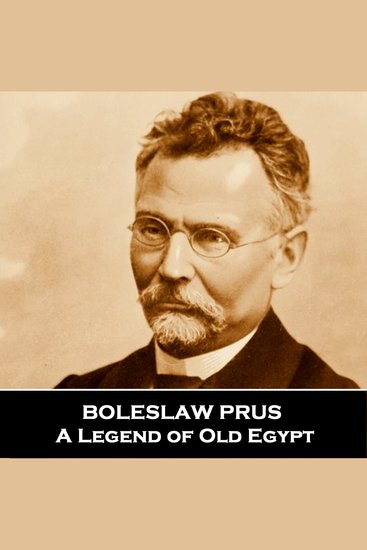
    Boleslaw Prus

    • 0
    • 0
    • 0
    Aleksander Głowacki who wrote under the nom de plume Boleslaw Prus was born on 20th August 1847 at Hrubieszów in the Kingdom of Poland, at that time, controlled by the Russian Empire. 
    At three his mother died and then at nine his father.  Female relatives helped raise him but at 15 he joined the Polish uprising against the might of Imperial Russia.  Wounded on the battlefield, arrested and imprisoned, he was later released into the care of a relative and resumed secondary school and then Warsaw University but poverty forced him to leave after two years.  At some point he developed agoraphobia which often caused problems. 
    In 1869, he enrolled in the Forestry Department at Puławy but was soon sacked and so he began a system of self-education that led to work as a newspaper columnist on a wide-ranging series of topics that eventually became the ‘Weekly Chronicles’ and spanned 40 years. 
    With his finances now stabilized he married and then adopted his late brother-in-law’s son.  
    It seems he had doubts as to the scale of his talents and early on adopted the name ‘Boleslaw Prus’ for both his journalistic and literary offerings. 
    His work as a short-story writer met with much acclaim. He wrote several dozen of them, originally published in newspapers and ranging in length from micro-story to novella. His keen observation of everyday life and sense of humor are evident in them.  
    During his career he also wrote novels. After ‘Pharoah’, in 1895, he embarked on a four-month journey taking in Berlin, Dresden, Nuremberg, Rapperswil in Switzerland, where he stayed for two months, and his final destination, Paris.  Here his agoraphobia was so bad he couldn’t cross the Seine.  
    However, his writing continued and in 1911 his novel ‘Changes’, though uncompleted, began to be serialised.  It was never finished. 
    Boleslaw Prus died on 19th May 1912, at his Warsaw apartment.  He was 64.  A National Hero, thousands attended both his funeral service and interment.
    Voir livre
  • Les Misérables - Volume 2: Cosette (Unabridged) - cover

    Les Misérables - Volume 2:...

    Victor Hugo

    • 0
    • 0
    • 0
    Victor-Marie Hugo (26 February 1802 - 22 May 1885) was a French poet, novelist, essayist, playwright, and dramatist of the Romantic movement. During a literary career that spanned more than sixty years, he wrote abundantly in an exceptional variety of genres: lyrics, satires, epics, philosophical poems, epigrams, novels, history, critical essays, political speeches, funeral orations, diaries, and letters public and private, as well as dramas in verse and prose.
    VOLUME 2: COSETTE: Last year (1861), on a beautiful May morning, a traveller, the person who is telling this story, was coming from Nivelles, and directing his course towards La Hulpe. He was on foot. He was pursuing a broad paved road, which undulated between two rows of trees, over the hills which succeed each other, raise the road and let it fall again, and produce something in the nature of enormous waves.
    Voir livre
  • Dethroned - Ukranian born Potapenko offers us a marvelous social commentary short story on class jealousy and status - cover

    Dethroned - Ukranian born...

    I N Potapenko

    • 0
    • 0
    • 0
    Ignaty Nikolayevich Potapenko was born on 30th December 1856 in the village of Fyodorovka in the Kherson Governorate of what was then the Russian Empire. 
     
    After an education that included studying at the Odessa University and the St Petersburg Conservatory Potapenko began his literary career, at first in tales detailing the lives of those Ukrainians all around him. 
     
    His undoubted talent soon took his canon beyond short stories to include both novels and plays.  
     
    I N Potapenko died on 17th May 1929 in Leningrad.  He was 72.
    Voir livre
  • The Cask of Amontillado - cover

    The Cask of Amontillado

    SAMPI Books, Edgar Allan Poe

    • 0
    • 0
    • 0
    Edgar Allan Poe's "The Cask of Amontillado" is a short story that explores themes of revenge and deceit. The story follows Montresor, who is deeply offended by Fortunato. Montresor devises a meticulous plan under the guise of cordiality, promising Fortunato a taste of a rare wine, Amontillado, during the carnival. The story unfolds in a tense and mysterious atmosphere.
    Voir livre
  • Dickon the Devil - From their pens to your ears genius in every story - cover

    Dickon the Devil - From their...

    Sheridan Le Fanu

    • 0
    • 0
    • 0
    Joseph Sheridan Le Fanu was born on 28th August 1814 in Dublin into a literary family with Huguenot, Irish and English roots.   
    For a time he and his siblings were tutored but Le Fanu would often immerse himself in the books of his father’s library. 
    In 1833 Le Fanu began his Law studies at Trinity College, Dublin and graduated in 1839. Although called to the bar he instead began a career in journalism.   
    He was also writing. His first fiction story ‘The Ghost and the Bonesetter’ was published in 1838.  In 1843 came the novella ‘Spalatro: From the Notes of Fra Giacomo’, a hero with a particular necrophiliac passion for an undead blood-drinking beauty, a forerunner to his later female vampire ‘Carmilla’.  
    In 1844 Le Fanu married Susanna Bennett with whom he had 4 children. The following year his first novel ‘The C'ock and Anchor’ was published. Works now flowed from his pen and with a rapid increase in family finances they moved, in 1851, to Merrion Square, Dublin, where he remained until his death.  
    In 1858 Susanna died and Le Fanu became reclusive. It was during this period that he produced some of his best work.  Working only by candlelight he wrote through the night, burnishing his reputation as a major figure of 19th Century supernaturalism with many classics including; ‘Green Tea’, ‘Mr Justice Harbottle’, and ‘In a Glass Darkly’.  
    Joseph Thomas Sheridan Le Fanu died in Merrion Square in his native Dublin on February 7th, 1873, at the age of 58.
    Voir livre