Begleiten Sie uns auf eine literarische Weltreise!
Buch zum Bücherregal hinzufügen
Grey
Einen neuen Kommentar schreiben Default profile 50px
Grey
Jetzt das ganze Buch im Abo oder die ersten Seiten gratis lesen!
All characters reduced
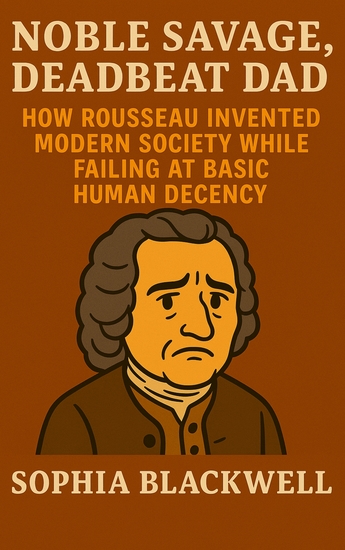
Noble Savage Deadbeat Dad - How Rousseau Invented Modern Society While Failing at Basic Human Decency - cover

Noble Savage Deadbeat Dad - How Rousseau Invented Modern Society While Failing at Basic Human Decency

Sophia Blackwell

Verlag: Cogito Ergo Nope

  • 0
  • 0
  • 0

Beschreibung

In this mercilessly funny takedown, Jean-Jacques Rousseau—history's most insufferable philosopher—gets the roasting he so richly deserves. "Noble Savage, Deadbeat Dad" exposes the spectacular hypocrisy of a man who abandoned five children at orphanages while writing the definitive guide to education, preached natural virtue while exposing himself to strangers, and railed against wealth while living off rich patrons.
 
Laugh out loud as we dissect Rousseau's greatest contradictions: his fetishization of indigenous cultures (without meeting any actual indigenous people), his belief that society corrupts natural goodness (while engaging in deeply unnatural bedroom activities), and his conviction that he alone understood true freedom (while being pathologically dependent on others for basic survival).
 
This savagely irreverent guide reveals how a paranoid, chronically constipated Swiss misanthrope somehow managed to inspire both democracy AND totalitarianism between bouts of accusing everyone he met of conspiring against him. With brutal honesty and razor-sharp wit, we explore how Rousseau's complete disaster of a personal life somehow produced philosophical insights that still haunt us today—especially when we complain about technology ruining society while scrolling through social media.
 
Perfect for philosophy students in desperate need of comic relief, or anyone who enjoys watching narcissistic geniuses get thoroughly eviscerated. Warning: Reading this book in public may cause uncontrollable laughter and concerned looks from serious academics.
Verfügbar seit: 16.04.2025.
Drucklänge: 47 Seiten.
Weitere Bücher, die Sie mögen werden

  • Byzantine Empire - cover

    Byzantine Empire

    Santiago Machain

    • 0
    • 0
    • 0
    Byzantine Empire traces the dramatic transformation of the Roman Empire’s eastern half into a distinct Byzantine civilization, charting its arc from the founding of Constantinople in 330 to the empire’s high-water mark under the Macedonian dynasty around 1025. Beginning with Constantine’s 'New Rome,' the book explores how geography, law, and faith fused to create a durable imperial culture. It follows the legalization and institutionalization of Christianity, the political theology that bound church and state, and the cultural splendors that culminated in Hagia Sophia’s luminous dome. 
    Through narrative chapters, readers encounter Justinian’s daring—his legal codification, the reconquest of lost provinces, the trauma of plague, and the brilliance of Hagia Sophia—before pivoting to the Arab conquests that reshaped frontiers and identities. The emergence of the theme system, the icon debates that tested the soul of Byzantine devotion, and the everyday economy of farms, markets, and guilds reveal an empire constantly reinventing itself. The story crescendos with the Macedonian Renaissance: a disciplined revival of letters, law, art, and arms that reconquered lands, codified governance in Greek, choreographed courtly ceremony, and exported Byzantine culture through missions to the Slavs and Rus’. 
    Written for general readers, this volume blends political narrative with human-scale vignettes—scribes and soldiers, merchants and monks—showing how resilience, administration, and a theology of beauty created a civilization at once traditional and experimental. It sets the stage for the empire’s later crises and transformations, while celebrating the ingenuity that made Byzantium the City of the World’s Desire.
    Zum Buch
  • Escaping the Timeline - Poems on Family Karma and Boundaries - cover

    Escaping the Timeline - Poems on...

    Rebecca Trowbridge

    • 0
    • 0
    • 0
    If you intend on a new start, avoiding the fractal vise of old entanglements, Escaping the Timeline is a restorative collection of poetry exploring the path between doing no harm and taking no crap. 
    Table of Contents: 
    Chapter 1: Family SnapshotCompassSpiny Leaf InsectRoyal PainMy Daughter, the InsurrectionistGetting Along with In-LawsPost-Exorcism Damage ControlInsomnia AnywayThe Smell of BreadNeuralgia11 PM 
    Chapter 2: Growing Up for the ChildrenFirst Time CookA Dream Where I Meet Repressed RageFirst to OutgrowLiterary SceneRetreatWelcome to your beautiful streamInternal CrisisDon't Rescue. The Desert is Infinite Potential EnergyCthuluRope Fell Out of the Sewing BoxFour Seasons Toward Self-LoveHoodoo RocksRi(f)tObligations and Torture at ChristmasEmotion-dumpers and Energy-feedersNot Smothering to Bother WithEscaping the Timeline 
    Chapter 3: Finding the Grace in EverythingSi(gh)tProtecting the BlessingsLearning IntegrityLoose endsBlue handsSuspendedViewing Drinkwater's Ocean Face BronzeViewing Ronald Ong's HeightsMarble CavesNudibranchsG-force NineLiftDracaena CinnabariLighting Incense to AncestorsThe Beaches Parkrun, Australia, December
    Zum Buch
  • Ethereum And Smart Contracts: A Guide For Investors - cover

    Ethereum And Smart Contracts: A...

    AHMED MUSA

    • 0
    • 0
    • 0
    "Ethereum and Smart Contracts: A Guide for Investors" is an in-depth exploration of Ethereum's groundbreaking technology and its transformative impact on the world of blockchain and cryptocurrency. This book serves as a comprehensive resource for investors seeking to understand Ethereum’s potential, its core concepts, and the powerful capabilities of smart contracts. 
    From its origins and unique design philosophy to its applications in a wide range of industries, this guide provides clear insights into the world of decentralized applications, blockchain, and consensus mechanisms. With a focus on the investor perspective, it covers the practical implications of Ethereum’s smart contract technology, highlighting its advantages, real-world use cases, challenges, and future potential. 
    Readers will gain a thorough understanding of how smart contracts are reshaping sectors like finance, real estate, insurance, and more. Through detailed explanations, this book also addresses legal, regulatory, and security issues, offering a roadmap for navigating the complexities of this rapidly evolving space. 
    Whether you're new to Ethereum or a seasoned investor looking to deepen your knowledge, this book is your essential guide to understanding and capitalizing on the opportunities Ethereum and smart contracts present in the digital economy.
    Zum Buch
  • The Short Story - A Very Short Introduction - cover

    The Short Story - A Very Short...

    Andrew Kahn

    • 0
    • 0
    • 0
    What defines a modern short story is much more than a question of length. Despite the efforts of early pioneers like Edgar Allan Poe, the genre was originally synonymous with the anecdote or tale and seen more as entertainment than art. However it has become far more than that, and this Very Short Introduction considers afresh the form's ongoing innovations in plot construction, capacity for psychological insight, and ability to offer intensely concentrated perceptions. 


    This book charts the rise of the short story from its original appearance in magazines and newspapers. For much of the nineteenth century, tales were written for the press, and the form's history is marked by engagement with popular fiction. From the later nineteenth century, the short story earned a reputation for its skillful use of plot design and character study. After the First World War it found outlets in high-brow publications, and single-author collections, as well as anthologies. 


    Exploring the form's techniques and themes, Andrew Kahn considers the continuity and variation in key structures and techniques such as the beginning, the creation of voice, the ironic turn or plot twist, and how writers manage endings. Throughout he draws on examples from an international and flourishing corpus of work, with close analysis of classic and lesser-known stories.
    Zum Buch
  • Brainjacking - The Science of Influence and Manipulation - cover

    Brainjacking - The Science of...

    Brian Clegg

    • 0
    • 0
    • 0
    Brainjacking takes us on a journey through advertising and marketing's attempts to understand and influence our thoughts and desires, from the earliest billboards to the technologies of the future. To discover how science intersects with our desires and decisions, the book pulls together three strands that have a huge impact on our lives: advertising, how much privacy we can and should have in the new electronic world, and how to draw the line been information and influence. 
     
    With Brian Clegg as your guide, this is a book that will help you unpick the insidious world of brainjacking. Expertly pulling together different strands on disparate topics including AI, Big Data, subliminal advertising and more, this essential investigation shows how new and old technology and science can be combined to influence human behaviour and beliefs.
    Zum Buch
  • Age of Emergency - Living with Violence at the End of the British Empire - cover

    Age of Emergency - Living with...

    Erik Linstrum

    • 0
    • 0
    • 0
    When uprisings against colonial rule broke out across the world after 1945, Britain responded with overwhelming and brutal force. Although this period has conventionally been dubbed "postwar," it was punctuated by a succession of hard-fought, long-running conflicts that were geographically diffuse, morally ambiguous, and impervious to neat endings or declarations of victory. 


    Age of Emergency traces facts and feelings about violence as torture, summary executions, collective punishments, and other ruthless methods were employed in "states of emergency." It examines how Britons at home learned to live with colonial warfare by examining activist campaigns, soldiers' letters, missionary networks, newspaper stories, television dramas, sermons, novels, and plays. Some contemporaries cast doubt on facts about violence. Still others aestheticized violence by celebrating visions of racial struggle or dramatizing the grim fatalism of dirty wars. Through their voices, Erik Linstrum narrates what violence looked, heard, and felt like as an empire ended, a history with unsettling echoes in our own time. 


    Vividly analyzing how far-off atrocities became domestic problems, Age of Emergency shows that the compromising entanglements of war extended far beyond the conflict zones of empire.
    Zum Buch