¡Acompáñanos a viajar por el mundo de los libros!
Añadir este libro a la estantería
Grey
Escribe un nuevo comentario Default profile 50px
Grey
Suscríbete para leer el libro completo o lee las primeras páginas gratis.
All characters reduced
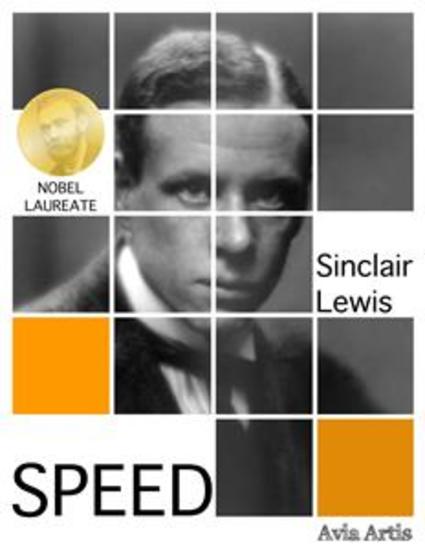
Speed - cover

Speed

Sinclair Lewis

Editorial: Avia Artis

  • 0
  • 0
  • 0

Sinopsis

“Speed” is a book by Sinclair Lewis an American writer. In 1930, he became the first writer from the United States to receive the Nobel Prize in Literature.
“Speed” is a short story by Sinclair Lewis. 
“Out in the road were two new automobile tires, and cans of gasoline, oil, water. The hose of a pressure air-pump stretched across the cement sidewalk, and beside it was an air-gauge in a new chamois case. Across the street a restaurant was glaring with unshaded electric lights; and a fluffy-haired, pert-nose girl alternately ran to the window and returned to look after the food she was keeping warm. The president of the local motor club, who was also owner of the chief garage, kept stuttering to a young man in brown union overalls, “Now be all ready — for land’s sake, be ready. Remember, gotta change those casings in three minutes.” They were awaiting a romantic event — the smashing of the cross-continent road-record by a Mallard car driven by J. T. Buffum.”
Preview.
 
Disponible desde: 22/03/2022.

Otros libros que te pueden interesar

  • Araby - From their pens to your ears genius in every story - cover

    Araby - From their pens to your...

    James Joyce

    • 0
    • 0
    • 0
    James Augustine Aloysius Joyce was born on the 2nd February 1882 in Dublin into a middle-class family, and the eldest of ten surviving siblings 
    Admired as a brilliant student he briefly attended the Christian Brothers-run O'Connell School before excelling at the Jesuit schools of Clongowes and Belvedere.  From there he went on to attend University College Dublin from 1898, studying English, French and Italian 
    In 1902, Joyce was now in his early twenties, and went to Paris to study Medicine but soon abandoned his teachings.  Back in Dublin to attend to his dying Mother he met Nora Barnacle. They bonded immediately into a life-long match. Together they decided to emigrate to Europe.  The couple lived in Trieste, Rome, Paris, and finally Zürich where Joyce pursued a variety of jobs and ventures to supplement his literary pursuits but none of these paid off.  
    After publishing a poetry volume, ‘Chamber Music’, in 1907, his short story collection ‘The Dubliners’, in 1914, helped establish his talent in the rapidly changing world.  
    Although far from home Joyce’s literary heart and works were set in his recollections of Dublin.  Characters are close resemblances of family and friends and indeed enemies.  His landmark work ‘Ulysses’, published in 1922, is set in the streets and alleyways of the city as it parallels Homer’s Odyssey in a variety of styles including its famed stream of consciousness. 
    His pen continued to produce classics of the order of ‘A Portrait of the Artist as A Young Man’ and ‘Finnegan’s Wake’ together with several volumes of poetry and a play ‘The Exiles, in 1918.   
    On the 11th January 1941, Joyce underwent surgery in Zürich for a perforated duodenal ulcer. The next day he fell into a coma. On the 13th after a brief period of lucidity in which he called for his wife and son he passed.  He was 58.
    Ver libro
  • Cursed Curiosities Volume 2 - 10 More Relics That Shouldn’t Exist - cover

    Cursed Curiosities Volume 2 - 10...

    H. T. W. Bousfield, C. P....

    • 0
    • 0
    • 0
    A second collection of classic works concerning items that harbour sinister secrets and unusual powers. 
    Contents: 
    "The Uncommon Prayer-Book" by M. R. James (London Mercury 1925) 
    Eight unusual copies of the Book of Common Prayer. 
    "The Green Flame" by Donald Wandrei (Weird Tales 1930) 
    The tale of a strange jewel. 
    "The Disinterment of Venus" by Clark Ashton Smith (Weird Tales 1934) 
    A curious statue unearthed in the grounds of a monastery. 
    "The Man Who Made Faces" by C. P. Howard (HorrorBabble 2024) 
    The tale of a man haunted by a past mistake. 
    "The God with Four Arms" by H. T. W. Bousfield (1939) 
    A man takes his frustrations out on a rare bronze idol. 
    "The Ebony Frame" by Edith Nesbit (Longman's 1891) 
    A beautiful and curiously carved picture frame. 
    "The Meerschaum Pipe" by L. A. Lewis (Tales of the Grotesque 1934) 
    A series of strange dreams and mysterious murders. 
    "The Black Stone Statue" by M. E. Counselman (Weird Tales 1937) 
    The story of a weird deception practised on the world by an obscure artist. 
    "Out of the Aeons" by H. P. Lovecraft (Weird Tales 1935) 
    A Boston museum that displays an ancient mummy recovered from a sunken island. 
    "The Mezzotint" by M. R. James (Ghost-Stories of an Antiquary 1904) 
    A strange engraving, with even stranger properties.
    Ver libro
  • A Resurrection - From their pens to your ears genius in every story - cover

    A Resurrection - From their pens...

    H B Marriott Watson

    • 0
    • 0
    • 0
    The bookshelves of British literature are incredible collections that have gathered together centuries of very talented authors.  From these Isles their fame spread and whilst among their number many are now forgotten or neglected their talents endure.  Among them is H B Marriott Watson.
    Ver libro
  • Shadow The - Story Time Episode 76 (Unabridged) - cover

    Shadow The - Story Time Episode...

    Hans Christian Andersen

    • 0
    • 0
    • 0
    "The Shadow" (Danish: Skyggen) is a fairy tale by Danish poet and author Hans Christian Andersen. The tale was first published in 1847. Once a learned man from the northern regions of Europe went on a voyage south. One night, he sat on his terrace, while the fire behind him cast his shadow on the opposite balcony. As he was sitting there, resting, the man was amused to observe how the shadow followed his every movement, as if he really did sit upon the opposing balcony. When he finally grew tired and went to sleep, he imagined the shadow would likewise retire in the house across the street. The next morning however, the man found to his surprise that he in fact had lost his shadow overnight. As a new shadow slowly grew back from the tip of his toes, the man did not give the incident another thought, returned to northern Europe, and took up writing again. Several years passed by until one night there was a knock at his door. To his surprise, it was his shadow, the one he lost years before in Africa, and now stood upon his doorstep, almost completely human in appearance. Astonished by his sudden reappearance, the learned man invited him into his house, and soon the two sat by the fireplace, as the shadow related how he had come to be man...
    Ver libro
  • Lady Susan - cover

    Lady Susan

    Jane Austen

    • 0
    • 0
    • 0
    Delve into the cunning world of "Lady Susan" by Jane Austen, a captivating novella told through a series of letters. The charming yet unscrupulous Lady Susan Vernon weaves a web of flirtation and manipulation, seeking advantageous matches for herself and her daughter. As her scheming unfolds, the characters around her must navigate the fallout of her deceptive games. Austen's sharp wit and incisive social commentary shine through in this enthralling tale of ambition, romance, and intrigue, showcasing the complexities of human relationships and moral ambiguity.
    Ver libro
  • North and South - cover

    North and South

    Elizabeth Gaskell

    • 0
    • 0
    • 0
    "North and South" is a social novel by English writer Elizabeth Gaskell, published in 1855. The story is set in the fictional industrial town of Milton in the North of England and contrasts the way of life in the industrial North with that in the rural South. The novel follows Margaret Hale, a young woman from rural southern England, who moves to the northern industrial town and encounters the stark realities of industrialization, class conflict, and social upheaval. The novel explores themes of industrialization, class differences, gender roles, and societal change. Margaret’s evolving relationships, particularly with the mill owner John Thornton, form the crux of the narrative
    Ver libro