Join us on a literary world trip!
Add this book to bookshelf
Grey
Write a new comment Default profile 50px
Grey
Subscribe to read the full book or read the first pages for free!
All characters reduced
Main Street - cover

Main Street

Sinclair Lewis

Publisher: Classica Libris

  • 0
  • 0
  • 0

Summary

This classic by Sinclair Lewis shattered the sentimental American myth of happy small-town life with its satire. “Main Street” attacks the conformity and dullness of early 20th century midwestern village life in the story of Carol Milford, the city girl who marries the town doctor. Her efforts to bring culture to the prairie village are met by a wall of gossip, greed, and petty small-minded bigotry. Lewis’s complex and compelling work established him as an important character in American literature.
Available since: 05/21/2022.
Other books that might interest you

  • The Diary of a Madman - cover

    The Diary of a Madman

    Guy De Maupassant

    • 0
    • 0
    • 0
    The public mourns when a beloved magistrate dies, a man of upstanding character who had a reputation for bringing criminals to justice. Yet when our tale’s narrator stumbles upon the man’s diary, he discovers another side to this public servant. One entry reads: “It must be a pleasure, unique and full of zest, to kill.” Find out why Guy de Maupassant is considered a master of the short story when you dive into this haunting tale of man’s hidden wickedness.  
    Show book
  • Anna Karenina (Part 8) - cover

    Anna Karenina (Part 8)

    Leo Tolstoy

    • 0
    • 0
    • 0
    Part 8: Sergei Ivanovich's (Kostya's brother) latest book is ignored by readers and critics and he participates in the Russian commitment to Pan-Slavism. Stiva gets the post he desired so much, and Karenin takes custody of Vronsky and Anna's baby, Annie. A group of Russian volunteers, including the suicidal Vronsky, depart from Russia to fight in the Orthodox Serbian revolt that has broken out against the Turks, more broadly identified as the Russo-Turkish War (1877–1878). - A lightning storm occurs at Kostya's estate while his wife and newborn son are outdoors and, in his fear for their safety, Kostya realizes that he does indeed love his son as much as he loves Kitty. Kitty's family is concerned that a man as altruistic as her husband does not consider himself to be a Christian.
    Anna Karenina is a novel by the Russian author Leo Tolstoy, first published in book form in 1878. Many writers consider Anna Karenina the greatest work of literature ever, and Tolstoy himself called it his first true novel. It was initially released in serial installments from 1873 to 1877 in the periodical The Russian Messenger.
    Show book
  • The voyage out - cover

    The voyage out

    Virginia Woolf

    • 0
    • 0
    • 0
    "The Voyage Out" is the first novel written by Virginia Woolf. It was published in 1915 and is considered a significant work in the modernist literary movement. The novel follows the journey of Rachel Vinrace, a young woman, as she embarks on a sea voyage from England to South America. "The Voyage Out" explores themes of self-discovery, societal conventions, and the limitations imposed on women in the early 20th century. Woolf weaves a narrative that delves into the complexities of human relationships and the impact of cultural norms on individual lives. The novel is known for its introspective and psychological depth, laying the groundwork for Woolf's later, more experimental works.
    Show book
  • Summary of F Scott Fitzgerald’s The Great Gatsby - cover

    Summary of F Scott Fitzgerald’s...

    Falcon Press

    • 0
    • 0
    • 0
    Summary of F. Scott Fitzgerald’s The Great Gatsby is an acclaimed novel about the glamour and moral bankruptcy of the Jazz Age. The title refers to Jay Gatsby, a mysterious millionaire who is the talk of his ritzy Long Island community…
    Show book
  • The Fall of the House of Usher - cover

    The Fall of the House of Usher

    Edgar Allan Poe

    • 0
    • 0
    • 0
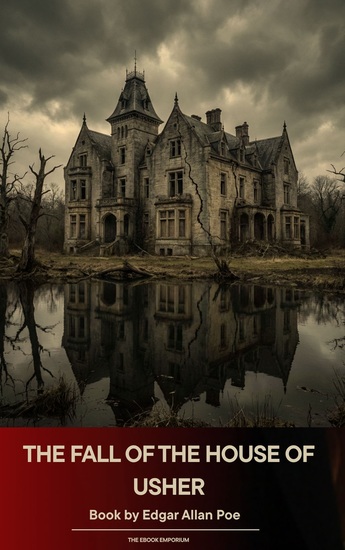
    "A dull, dark, and soundless day... where the clouds hung oppressively low."
    
    When an unnamed narrator arrives at the ancestral estate of his childhood friend, Roderick Usher, he finds a house that seems to possess a life of its own. Roderick, suffering from a hypersensitivity of the senses and a profound "mental disorder," lives in a state of perpetual terror alongside his dying twin sister, Madeline. As the physical structure of the mansion mirrors the crumbling sanity of its inhabitants, the narrator is drawn into a nightmare of subterranean vaults, haunting melodies, and a family secret that refuses to stay buried. This is Poe at the height of his powers, weaving a story where every shadow, every sound, and every stone contributes to a singular effect of overwhelming gloom.
    
    One of the most chilling elements of the story is Roderick's belief that the very stones of his house are sentient. Poe uses this to create a "Gothic atmosphere" where the environment itself is a character, conspiring against the Ushers to bring about their total annihilation.
    
    From the "barely perceptible fissure" zig-zagging down the front of the mansion to the storm that rages during the climax, Poe uses the physical world to represent the internal collapse of the human mind. The "Fall" of the title refers simultaneously to the destruction of the building, the death of the family line, and the descent into madness.
    
    The Fall of the House of Usher established the tropes that would define horror for nearly two centuries. It is a psychological puzzle that invites endless interpretation—is it a ghost story, a study of incestuous decay, or a journey into a dying mind? Poe's rhythmic, hypnotic prose ensures that once you enter the House of Usher, you never truly leave.
    
    Enter the mansion of madness. Purchase "The Fall of the House of Usher" today.
    Show book
  • At the Villa Rose - cover

    At the Villa Rose

    A. E. W. Mason

    • 0
    • 0
    • 0
    Harry Wethermill, the brilliant young scientist, a graduate of Oxford and Munich, has made a fortune from his inventions, and is taking a vacation at Aix-les-Bains. There he meets, and immediately falls in love with, the young and beautiful Celia Harland, who serves as companion to the aging but warm-hearted Madam Dauvray of Paris. All this is observed by Julius Ricardo, a retired financier from the City of London, who spends every August at Aix, expecting there to find a pleasant and peaceful life. Imagine his consternation when he learns that Mme. Dauvray has been brutally murdered, and imagine Harry Wethermill's consternation when he learns that every finger of suspicion is pointed at the now vanished Celia Harland. 
    Implored to do so by Wethermill, Ricardo asks his friend Inspector Hanaud, the great detective of the Paris Sûreté (who is also vacationing in Aix) to involve himself in the case so that the truth may come out. Hanaud agrees to do so (with the permission of the Aix police, of course), and goes to work. Will he be up to the job? And will Harry Wethermill ultimately be glad that he called in the great man? We can only wait to find out. But surely Hanaud will exercise his powerful little grey cells – one of several characteristics he shares with a famous Belgian detective of later decades, and indeed some scholars of mystery stories suggest that Agatha Christie, in her invention of Hercule Poirot, owes a debt to Mason and his invention of Inspector Hanaud. And indeed Julius Ricardo has than a passing resemblance to Arthur Hastings, Poirot's sidekick, who is invariably a few confused steps behind the detective
    Show book