Rejoignez-nous pour un voyage dans le monde des livres!
Ajouter ce livre à l'électronique
Grey
Ecrivez un nouveau commentaire Default profile 50px
Grey
Abonnez-vous pour lire le livre complet ou lisez les premières pages gratuitement!
All characters reduced
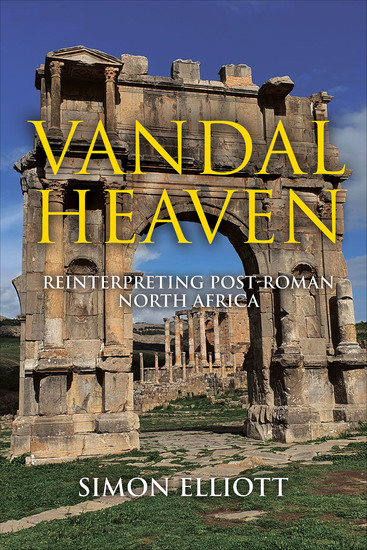
Vandal Heaven - Reinterpreting Post-Roman North Africa - cover

Vandal Heaven - Reinterpreting Post-Roman North Africa

Simon Elliott

Maison d'édition: Casemate

  • 0
  • 0
  • 0

Synopsis

A new study that challenges previous interpretations of post-Roman North Africa.

North Africa was one of the richest parts of the Roman Empire, the agricultural powerhouse of the Mediterranean. It was also home to some of the emperor’s biggest imperial estates, and prosperous cities of all kinds. Its loss to the Vandals in the first half of the 5th century AD was the mortal blow which both precipitated the fall of the western empire, and set the eastern empire back for decades. Its reconquest then became an obsession with each new emperor in Constantinople. Time and again the eastern Romans failed in this goal, until Justinian I finally succeeded in the AD 530s. Although North Africa’s restoration to the world of Rome only lasted a short time, it has widely been regarded as a positive development.

However, new research—published here for the first time—shows that post-Roman North Africa thrived under the Vandals. To them it was Vandal heaven, a place where they found a way as the new incumbent elite to live comfortably alongside the late Roman inhabitants, despite their different interpretations of Christianity. Together, the two cultures flourished.

When the eastern Romans – now styled Byzantines – returned, they weren’t welcome. This is evidenced in the surviving built environments of this new period of North African history, namely chains of small forts along the frontier and interior, where the Byzantines used mounted troops to keep an unhappy local population under control.

Dr Elliott not only presents a brand-new interpretation of post-Roman North Africa, but makes the case that the Arab Conquest was so successful in this region because the Byzantine overlords were so unpopular. Furthermore his argument explains how the region today came to be part of the Arab world, in contrast to the regions along the northern Mediterranean freeboard, which maintain their Roman-ness to this day.
Disponible depuis: 31/03/2024.
Longueur d'impression: 240 pages.

D'autres livres qui pourraient vous intéresser

  • 25+ The Collected Works of Vladimir Lenin - The Dreamer in the Kremlin State and Revolution What Is to Be Done? Imperialism: The Final Stage of Capitalism and others - cover

    25+ The Collected Works of...

    Vladimir Lenin, H. G. Wells

    • 0
    • 0
    • 0
    Vladimir Ilyich Ulyanov, better known as Vladimir Lenin, was a Russian revolutionary, politician, and political theorist. He served as the first and founding head of government of Soviet Russia from 1917 to 1924 and of the Soviet Union from 1922 to 1924. Under his administration, Russia, and later the Soviet Union, became a one-party socialist state governed by the Communist Party. Ideologically a Marxist, his developments to the ideology are called Leninism.
    Russia in the Shadows is a book by H. G. Wells published early in 1921, which includes a series of articles previously printed in The Sunday Express in connection with Wells's second visit to Russia (after a previous trip in January 1914 to St. Petersburg and Moscow) in September and October 1920.
    During his visit to Russia he visited his old friend Maxim Gorky, whom he had first met in 1906 on a trip to the United States, and who arranged Wells's meeting with Lenin.
    In a chapter (The Dreamer in the Kremlin) devoted to an interview with Lenin at the Kremlin Wells describes the leader and founder of Russian communism. Wells portrays Lenin as a pragmatic leader who "has recently stripped off the last pretence that the Russian revolution is anything more than the inauguration of an age of limitless experiment."
     
    Vladimir Lenin:
    State and Revolution
    What Is to Be Done?
    Imperialism: The Final Stage of Capitalism
    The State and Revolution
    The Three Sources and Three Component Parts of Marxism
    To the Citizens of Russia!
    To Workers, Soldiers, and Peasants!
    Report on Peace
    Report on Land
    Decree on Abolishment of Capital Punishment
    Decree on Transfer of Power to the Soviets
    Decree on Establishment of the Workers' and Peasants' Government
    Decree on Elections for the Constituent Assembly
    Decree on Suppression of Hostile Newspapers
    Decree on Transfer of Food Control to Municipalities
    Decree on an Eight-Hour Working Day
    Decree on the Right to Issue Laws
    Resolution on the Right of Sovnarkom to Issue Decrees
    Decree on Social Insurance
    Declaration of the Rights of the People of Russia
    Decree on Organization of Volost Land Committees
    Decree on Transfer of Power and the Means of Production to the Toilers
    Decree Proclaiming Advertising a State Monopoly
    Decree Abolishing Classes and Civil Ranks
    Decree on Workers' Control
    Resolution on Relation of the Central Executive Committee to the Sovnarkom
    Decree on the Right to Call for Re-Elections
    Decree on Establishment of the Extraordinary Commission to Fight Counter-Revolution
    V. I. Lenin Note To F. E. Dzerzhinsky with a Draft of A Decree On Fighting Counter-Revolutionaries And Saboteurs
     
    H. G. Wells:
    The Dreamer in the Kremlin
    Voir livre
  • The Communist Manifesto - cover

    The Communist Manifesto

    Karl Marx, Friedrich Engels

    • 0
    • 0
    • 0
    Welcome to an unprecedented audio journey into Karl Marx and Friedrich Engels' "The Communist Manifesto" - the unabridged edition that remains unswervingly loyal to the original text. Its ground-breaking insights into class struggle, capitalism, and communism have left an indelible mark on the history of political thought.Crafted for the discerning listener, this audiobook's clear and crisp voice rendition makes the complex philosophical and political ideas accessible to all. Each sentence is meticulously delivered, making the potent theories of Marx and Engels not only more understandable but also more relatable.From your first listen, you'll find yourself captivated by the lucidity and precision of the narrator's voice as it guides you through the compelling manifesto that catalyzed a global revolution. The original text's essence is preserved with great fidelity, allowing you to grasp the theoretical underpinnings of communism as envisioned by its founders."The Communist Manifesto (Unabridged Version)" paints a vivid picture of society's class struggles - a narrative that continues to resonate today. Marx and Engels' theories are brought to life in this audiobook, making it not just a listening experience but an enlightening journey into the depths of socioeconomic discourse.Embark on this transformative journey with "The Communist Manifesto (Unabridged Version)" and uncover the powerful ideas that continue to shape our world. Immerse yourself in the clarity of thought and depth of understanding that this audiobook promises.
    Voir livre
  • The Meaning of Truth - cover

    The Meaning of Truth

    William James

    • 0
    • 0
    • 0
    The Meaning of Truth by William James is a collection of essays exploring the nature of truth through the lens of pragmatism. James argues that truth is not a fixed, abstract concept but rather a practical relationship between ideas and their consequences. He proposes that the "truth" of an idea lies in its ability to guide action and produce positive results in the world. This pragmatic approach to truth contrasts with traditional philosophical views that often emphasize the correspondence between ideas and reality.
    Voir livre
  • The Space Race - The History of the Technological Rivalry Between the Soviets and Americans during the Cold War - cover

    The Space Race - The History of...

    Charles River Editors

    • 0
    • 0
    • 0
    Today the Space Race is widely viewed poignantly and fondly as a race to the Moon that culminated with Apollo 11 “winning” the Race for the United States. In fact, it encompassed a much broader range of competition between the Soviet Union and the United States that affected everything from military technology to successfully launching satellites that could land on Mars or orbit other planets in the Solar System. Moreover, the notion that America “won” the Space Race at the end of the 1960s overlooks just how competitive the Space Race actually was in launching people into orbit, as well as the major contributions the Space Race influenced in leading to today’s International Space Station and continued space exploration.  
    	Of all the goals the Bolshevik Revolution aimed to bring about, perhaps nowhere were Russian promises delivered on more than in the success of the Soviet Space program of the 1950s and 1960s. As a result of Russian innovation and technology, but also due to incredible drive to modernize and compete with the United States for world power, Russia was finally and triumphantly modernized in the eyes of her own people and the world. Neil deGrasse Tyson recognized the Soviet legacy in space in his Space Chronicles, citing the Soviets’ “important measure[s] of space achievement: first spacewalk, longest spacewalk, first woman in space, first docking in space, first space station, longest time logged in space.”[1] 
    	In fact, the Soviet Union spent much of the 1950s leaving the United States in its dust (and rocket fuel). President Eisenhower and other Americans who could view Soviet rockets in the sky were justifiably worried that Soviet satellites in orbit could soon be spying on them, or, even worse, dropping nuclear bombs on them. Dovetailing off their success developing intercontinental ballistic missiles, the Soviets were the first to make enormous advances in actual space exploration.
    Voir livre
  • Cherokee - History and Culture of the Native American Tribes - cover

    Cherokee - History and Culture...

    Kelly Mass

    • 0
    • 0
    • 0
    The Cherokee are among the native tribes of the United States' Southeastern Woodlands. They resided in communities along river valleys in what's now southwestern North Carolina, southeastern Tennessee, the limits of western South Carolina, northern Georgia, and northeastern Alabama just before the 18th century. 
    Cherokee belongs to the Iroquoian language family. One oral legend tells of the people moving south in age-old times from the Great Lakes area, where other Iroquoian-speaking tribes were based, according to James Mooney, an early American ethnographer.
    Voir livre
  • Drive: Book Summary and Analysis - cover

    Drive: Book Summary and Analysis

    Briefly Summaries

    • 0
    • 0
    • 0
    This is a concise summary and analysis of Drive, by Daniel H. Pink. It is not the original book and is not affiliated with or endorsed by Daniel H. Pink. Ideal for those seeking a quick and insightful overview.
     
    In "Drive", the author explores motivation, focusing on intrinsic drives over extrinsic rewards. The book delves into autonomy, mastery, and purpose as key motivators, contrasting traditional carrot-and-stick approaches. It examines how autonomy fosters innovation and productivity, emphasizing mastery as a source of satisfaction and growth. Purpose emerges as a crucial driver, aligning personal values with organizational goals. Through research and anecdotes, the author challenges conventional management practices, advocating for a paradigm shift towards intrinsic motivation. This insightful exploration offers a fresh perspective on fostering engagement and fulfillment in work and life.
    Voir livre