Begleiten Sie uns auf eine literarische Weltreise!
Buch zum Bücherregal hinzufügen
Grey
Einen neuen Kommentar schreiben Default profile 50px
Grey
Jetzt das ganze Buch im Abo oder die ersten Seiten gratis lesen!
All characters reduced
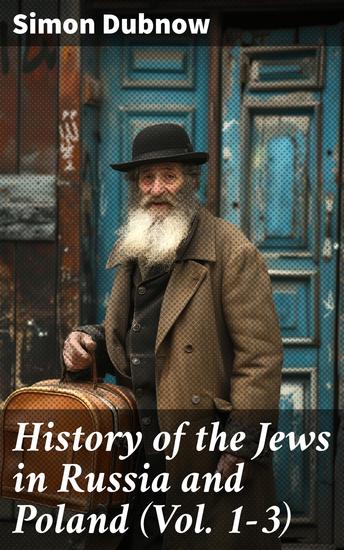
History of the Jews in Russia and Poland (Vol 1-3) - Exploring the Jewish Experience in Russia and Poland - cover

History of the Jews in Russia and Poland (Vol 1-3) - Exploring the Jewish Experience in Russia and Poland

Simon Dubnow

Übersetzer Israel Friedlaender

Verlag: Good Press

  • 0
  • 0
  • 0

Beschreibung

In "History of the Jews in Russia and Poland," Simon Dubnow presents an exhaustive and compelling narrative that spans the rich tapestry of Jewish life from the medieval period to the early 20th century. Dubnow employs a meticulous historical approach, weaving together a vast array of primary sources, social contexts, and cultural anecdotes to create a vibrant portrayal of Jewish communities in Eastern Europe. His literary style combines scholarly rigor with a keen narrative flair, making complex historical events accessible and engaging for readers. The trilogy is situated within the broader context of Jewish historiography, which often grappled with themes of identity, survival, and resilience amidst sociopolitical upheaval. Simon Dubnow, a prominent historian and advocate of Jewish nationalism, was profoundly influenced by the socio-political dynamics of his time. A witness to the rise of anti-Semitism and the complexities of Jewish identity, Dubnow's works reflect his commitment to preserving Jewish heritage in the face of adversity. His own experiences as a Jewish intellectual in the Russian Empire fueled his quest to document and analyze the multifaceted history of Jews in Eastern Europe, fostering a sense of communal belonging and awareness. This remarkable trilogy is an indispensable resource for scholars and general readers alike, offering deep insights into the sociocultural and political challenges faced by Jews in Russia and Poland. Dubnow's narrative is not merely a chronicle of events; it is a testament to the enduring spirit of a people navigating oppression and change. For anyone interested in Jewish history, this work is a must-read that invites reflection on the historical journey of the Jewish people.
Verfügbar seit: 12.12.2023.
Drucklänge: 765 Seiten.

Weitere Bücher, die Sie mögen werden

  • Maharaji Is Always With You - Neem Karoli Baba - cover

    Maharaji Is Always With You -...

    Radha Krsna Das

    • 0
    • 0
    • 0
    Neem Karoli Baba known to his followers as Maharaj-ji - was a great Hindu guru, mystic and devotee of Lord Hanuman. He is very well known outside India for being the spiritual master of a number of prominent Americans who traveled to India in the 1960s and 70s, including spiritual teachers Ram Dass, Bhagavan Das, and musicians Krishna Das and Jai Uttal. His ashrams are in Kainchi, Vrindavan, Rishikesh, Shimla, Neem Karoli village near Khimasepur in Farrukhabad, Bhumiadhar, Hanumangarhi, Delhi in India and in Taos, New Mexico. Maharaji was a lifelong adept of bhakti yoga, and encouraged service to others (seva) as the highest form of unconditional devotion to God. 
     
    There can be no biography of him. Facts are few, stories many. He seems to have been known by different names in many parts of India, appearing and disappearing through the years. His non-Indian devotees of recent years knew him as Neem Karoli Baba, but mostly as “Maharajji” – a nickname so commonplace in India that one can often hear a tea vendor addressed thus. Just as he said, he was "nobody". He gave no discourses; the briefest, simplest stories were his teachings. Usually, he sat or lay on a wooden bench wrapped in a plaid blanket while a few devotees sat around him. Visitors came and went; they were given food, a few words, a nod, a pat on the head or back, and they were sent away.
    Zum Buch
  • Subtle Abuse - Indirect Forms of Psychological Harm - cover

    Subtle Abuse - Indirect Forms of...

    Cito Harder

    • 0
    • 0
    • 0
    Subtle abuse is a form of psychological harm that often goes unnoticed, yet its effects can be just as damaging as more overt forms of mistreatment. Unlike physical abuse, which leaves visible marks, or direct verbal abuse, which is easier to identify, subtle abuse operates in the shadows, disguised as normal behavior, misunderstandings, or even acts of care. This makes it particularly dangerous because victims may not recognize it until significant emotional and psychological damage has already occurred. 
    At its core, subtle abuse is about control, manipulation, and emotional harm inflicted in ways that are difficult to detect. It can take many forms, including gaslighting, passive-aggressive behavior, emotional withholding, and undermining someone’s confidence in indirect ways. A common characteristic of subtle abuse is its plausibility—it often leaves victims doubting their own experiences and questioning whether they are simply overreacting. Because the harm is delivered in small, often deniable doses, victims may struggle to explain their distress to others, further isolating them in their experience. 
    One of the most insidious aspects of subtle abuse is its ability to erode a person’s sense of self over time. The victim may start to feel insecure, anxious, or even incapable, not realizing that their mental state has been shaped by constant, indirect put-downs or the gradual withholding of emotional support. For example, a partner who consistently dismisses concerns with phrases like “You’re too sensitive” or “I was just joking” may be engaging in subtle emotional abuse by invalidating the other person’s feelings. Similarly, a boss who subtly undermines an employee’s work without overt criticism may be manipulating them into self-doubt and compliance.
    Zum Buch
  • The Ascent of Affect - Genealogy and Critique - cover

    The Ascent of Affect - Genealogy...

    Ruth Leys

    • 0
    • 0
    • 0
    In recent years, emotions have become a major, vibrant topic of research not merely in the biological and psychological sciences but throughout a wide swath of the humanities and social sciences as well. Yet, surprisingly, there is still no consensus on their basic nature or workings.   Ruth Leys’s brilliant, much anticipated history, therefore, is a story of controversy and disagreement. The Ascent of Affect focuses on the post–World War II period, when interest in emotions as an object of study began to revive. Leys analyzes the ongoing debate over how to understand emotions, paying particular attention to the continual conflict between camps that argue for the intentionality or meaning of emotions but have trouble explaining their presence in non-human animals and those that argue for the universality of emotions but struggle when the question turns to meaning. Addressing the work of key figures from across the spectrum, considering the potentially misleading appeal of neuroscience for those working in the humanities, and bringing her story fully up to date by taking in the latest debates, Leys presents here the most thorough analysis available of how we have tried to think about how we feel.  
    Zum Buch
  • How to Have a Life - An Ancient Guide to Using Our Time Wisely - cover

    How to Have a Life - An Ancient...

    Seneca

    • 0
    • 0
    • 0
    A vibrant new translation of Seneca's "On the Shortness of Life," a pointed reminder to make the most of our time 


    Who doesn't worry sometimes that smart phones, the Internet, and TV are robbing us of time and preventing us from having a life? How can we make the most of our time on earth? In the first century AD, the Stoic philosopher Seneca the Younger offered one of the most famous answers to that question in his essay "On the Shortness of Life"—a work that has more to teach us today than ever before. In How to Have a Life, James Romm presents a vibrant new translation of Seneca's brilliant essay, plus two Senecan letters on the same theme, complete with an inviting introduction. 


    With devastating satiric wit, skillfully captured in this translation, Seneca lampoons the ways we squander our time and fail to realize how precious it is. We don't allow people to steal our money, yet we allow them to plunder our time, or else we give it away ourselves in useless, idle pursuits. Seneca also describes how we can make better use of our brief days and years. In the process, he argues, we can make our lives longer, or even everlasting, because to live a real life is to attain a kind of immortality.
    Zum Buch
  • The Kingdom of Kush - Nubian Kings and the Black Pharaohs of the Nile - cover

    The Kingdom of Kush - Nubian...

    Rolf Hedger

    • 0
    • 0
    • 0
    The Kingdom of Kush, an ancient African civilization, flourished along the Nile River in what is now modern-day Sudan. This powerful kingdom played a crucial role in the history of northeastern Africa, often interacting with its northern neighbor, Egypt. The land of Kush was known for its rich natural resources, strategic location, and unique cultural identity, which set it apart from other civilizations of the time. 
    Geographically, Kush was centered in the region known as Nubia, a stretch of land between the first and sixth cataracts of the Nile. This location provided fertile lands for agriculture, supported by the annual flooding of the river. Unlike Egypt, which relied heavily on the predictable flooding of the Nile, the Kushites also adapted to drier conditions, developing irrigation techniques to sustain their crops. The region was abundant in valuable resources such as gold, ivory, ebony, and exotic animal skins, making it an important trade hub in the ancient world. These resources attracted merchants from Egypt, the Mediterranean, and even as far as the Middle East, contributing to the kingdom's economic strength. 
    Kushite civilization was heavily influenced by its relationship with Egypt, but it also maintained distinct cultural and political traditions. Early Kushite settlements date back to around 2500 BCE, and by the time of the Egyptian Middle and New Kingdoms, Kush had grown into a formidable power. Egyptian pharaohs often sought control over Nubia due to its wealth, leading to periods of conquest and integration. However, Kush was not merely a passive recipient of Egyptian influence. It developed its own identity, blending Egyptian religious beliefs with native Nubian traditions, which would later be reflected in Kushite art, architecture, and burial practices.
    Zum Buch
  • Inca History: 500 Interesting Facts About Incas - cover

    Inca History: 500 Interesting...

    Ahoy Publications

    • 0
    • 0
    • 0
    Discover the mysteries of Inca history with 500 fascinating facts! 
    Come along with us as we explore Inca history, from the rise of the Inca civilization in the 1200s to its decline in the 1500s. 
    Discover the inner workings of their political and social structures, their spiritual beliefs, and their unique burial customs. 
    Uncover their clothing and arts that adorned their land and the laws and justice that ruled it. Learn about their medical practices, agriculture and aquaculture, architecture, technology, language, trade, and so much more! 
    500 Interesting Facts About Inca History is an all-encompassing look at a captivating civilization. Here is just a taste of what awaits inside:Emergence of the Inca civilizationGovernment and political structureReligion and spiritualityDeath and burial customs of the IncaInca festivalsFood and cuisineClothing of the IncasAnd much more! 
    Ready to open a time capsule into one of the most influential cultures in South America? Scroll up and click the “add to cart” button to begin your journey into the past!
    Zum Buch