Rejoignez-nous pour un voyage dans le monde des livres!
Ajouter ce livre à l'électronique
Grey
Ecrivez un nouveau commentaire Default profile 50px
Grey
Abonnez-vous pour lire le livre complet ou lisez les premières pages gratuitement!
All characters reduced
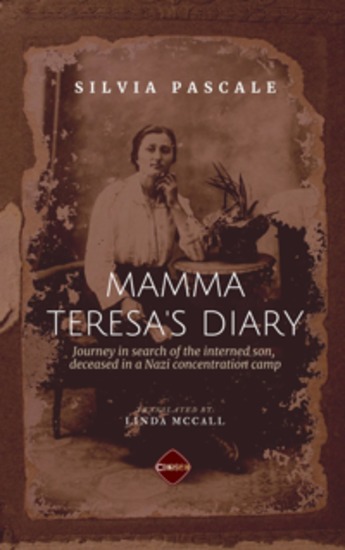
Mamma Teresa's Diary - Journey In Search Of Her Son Who Died While Interned In A Nazi Concentration Camp - cover

Mamma Teresa's Diary - Journey In Search Of Her Son Who Died While Interned In A Nazi Concentration Camp

Silvia Pascale

Maison d'édition: CIESSE Edizioni di SANTI Carlo

  • 0
  • 0
  • 0

Synopsis

Teresa’s son was one of the many Italian Military Internees (IMI), the Italian soldiers who, after the armistice of 8 September 1943, refused to side with the Republic of Salò and Hitler and were subsequently deported to the Third Reich and German-occupied territories where they were forced to work in Nazi labour camps. 
When Mamma Teresa learns of her son’s death, she is utterly grief-stricken. But her greatest suffering comes from not knowing where he was buried. It takes her five long years to obtain the necessary documents to travel abroad in search of his grave. But this is just the beginning of her ordeal. Setting off from Bova di Marrara, near Ferrara in northern Italy, she makes her way to Germany, all alone, without knowing a word of German and with very little money. The journey is long and arduous and Teresa records the experience in a diary, producing a unique and exceptional testimony. Decades later, Teresa’s relatives dig out that same diary from an attic and hand it to the author, who thus inherits her memories. 
 “A memorial to my poor son and to everything that his mamma did for him, because only a mother could do this for her son and I did it out of immense love.” 
(From the diary of Mamma Teresa Zerbini née Mascellani)
Disponible depuis: 22/07/2025.
Longueur d'impression: 1000 pages.

D'autres livres qui pourraient vous intéresser

  • Cheka The: The History of the Soviet Agency that Eventually Became the KGB - cover

    Cheka The: The History of the...

    Editors Charles River

    • 0
    • 0
    • 0
    The KGB is one of the most famous abbreviations of the 20th century, and it has become synonymous with the shadowy and often violent actions of the Soviet Union’s secret police and internal security agencies. In fact, it is often used to refer to the Soviet state security agencies throughout its history, from the inception of the inception of the Cheka (Extraordinary Commission) in 1917 to the official elimination of the KGB in 1992. Whether it’s associated with the Russian Civil War’s excesses, Stalin’s purges, and even Vladimir Putin, the KGB has long been viewed as the West’s biggest bogeyman during the second half of the 20th century. 
    	However, the KGB did not appear out of thin air. Naturally, the earliest Soviet leaders utilized intelligence agencies that collected information both abroad and within the Soviet Union, targeting foreign opponents and domestic opponents alike. Lenin did not imagine the scale of the opposition he would have to face after the revolution, and he quickly came to the conclusion that "a special system of organized violence" must be created to implement the dictatorship of the proletariat. 
    	Thus, from nearly the beginning of the Bolshevik takeover of Russia, Lenin and his successors established and relied on a particularly ruthless agency: the All-Russian Extraordinary Commission for Combating Counter-Revolution and Sabotage, later abbreviated to the Extraordinary Commission. Known colloquially as the Cheka (Extraordinary Commission), it soon became as feared by non-socialists as the Tsar’s secret police had ever been. The main means approved by the Council of People's Commissars on December 20, 1917, which the Cheka had to use to fight the counter-revolution, were "seizure of property, resettlement, deprivation of cards, publication of lists of enemies of the people, etc."
    Voir livre
  • People Skills: A Simple Guide to Reading People Mastering Small Talk and Getting People to Like You - cover

    People Skills: A Simple Guide to...

    Andy Gardner

    • 0
    • 0
    • 0
    Discover how to better your people skills and change your life forever! 
    Do you find it challenging to connect with others? 
    Do you sometimes feel like you are just going through the motions in conversations? 
    The truth is, we all have a deep need to feel understood and connected to others. And yet, most of us do not know how to create those connections. Some may have given up all hope, but it does not have to be this way! 
    This book reveals the secrets to connecting with others. You will learn the people skills you need to connect with others in almost any situation. 
    In this book, you will:Discover the truth about small talk and learn how to use it to your advantageDiscover how to read people like a pro with simple, easy-to-learn techniquesLearn how to keep the conversation going, even when you are feeling shy or tongue-tiedDevelop meaningful connections with the people you care aboutAnd much more! 
    Stop feeling awkward and start enjoying interactions with others. The joy of connecting with others is within your reach, and you can finally start living the life you were meant to live! 
    If you want to improve your life, click on the “add to cart” button now and start building the relationships you have always wanted.
    Voir livre
  • On Breathing - Understanding the Connection Between Breath and Life - cover

    On Breathing - Understanding the...

    Aristotle, Tim Zengerink

    • 0
    • 0
    • 0
    What if you could uncover the vital link between breath and the very essence of human life? 
    In this illuminating treatise, Aristotle explores the biological and philosophical significance of breathing—an act we often take for granted. Adapted for contemporary readers, this work reveals how breath not only sustains life but also shapes our well-being and consciousness—sparking insights that resonate with today’s mind-body research. 
    What You’ll Discover in This Modern Translation: 
    - The physiological role of breath in sustaining life 
    - Aristotelian perspectives on the mind-body connection 
    - How breathing influences our energy and state of mind 
    - Ancient wisdom that complements modern wellness practices 
    Imagine harnessing the simple yet powerful act of breathing to enhance physical health, mental clarity, and emotional stability. Aristotle’s investigation inspires readers to see breath as a bridge to a more vibrant, centered way of living. 
    Take a breath and dive into a deeper understanding of life’s sustaining force. Get your copy now and reconnect with the timeless wisdom of this essential act.
    Voir livre
  • Influencing Hemingway - People and Places That Shaped His Life and Work - cover

    Influencing Hemingway - People...

    Nancy W Sindelar

    • 0
    • 0
    • 0
    Ernest Hemingway embraced adventure and courted glamorous friends while writing articles, novels, and short stories that captivated the world. Hemingway’s personal relationships and experiences influenced the content of his fiction, while the progression of places where the author chose to live and work shaped his style and rituals of writing. Whether revisiting the Italian front in A Farewell to Arms, recounting a Pamplona bull run in The Sun Also Rises, or depicting a Cuban fishing village in The Old Man and the Sea, setting played an important part in Hemingway’s fiction. The author also drew on real people—parents, friends, and fellow writers, among others—to create memorable characters in his short stories and novels.   In Influencing Hemingway: The People and Places That Shaped His Life and Work Nancy W. Sindelar introduces the reader to the individuals who played significant roles in Hemingway’s development as both a man and as an artist—as well as the environments that had a profound impact on the a
    Voir livre
  • Virginia Woolf: 3 Essays on Dostoyevsky - cover

    Virginia Woolf: 3 Essays on...

    Virginia Woolf

    • 0
    • 0
    • 0
    Presented here are 3 short works by Virginia Woolf, each a unique consideration of the work of Fyodor Dostoyevsky. The essays included are:
    
    The Father: Woolf's ruminations of family and, particularly, the father within the works of Dostoyevsky.
    
    More Dostoyevsky: Further thoughts on Dostoyevsky's work, an author of whom she once wrote "It is directly obvious that he is the greatest writer ever born."
    
    In Cranford: A comedic exploration of Dostoyevsky's work where Woolf transplants the great master into English provincial life to explore the unique nature of his work and the English nature.
    Voir livre
  • The Syrian Civil War - Conflict Humanitarian Crisis and the Struggle for Power - cover

    The Syrian Civil War - Conflict...

    Fredrich Hazelton

    • 0
    • 0
    • 0
    The Syrian Civil War, which began in 2011, stands as one of the most devastating conflicts in modern history, reshaping not only Syria but the entire Middle East and the international political landscape. The war has drawn in numerous global powers, each with their own motivations, and has sparked a humanitarian crisis of unparalleled scale. This conflict is not merely a battle between the Assad regime and opposition groups but a complex web of local, regional, and international rivalries, ideologies, and geopolitical interests. As the fighting continues, the war has resulted in staggering human loss, displacement, and destruction, leaving a country in ruins and millions of people displaced across borders. 
    At the heart of the Syrian Civil War lies a struggle for power, with multiple factions vying for control over a fractured nation. The Assad regime, backed by Russia and Iran, has maintained a firm grip on large parts of the country. Meanwhile, various opposition groups, initially united by a common goal of overthrowing the regime, soon fractured into competing factions with differing ideologies, including Islamic extremists and Kurdish forces. The conflict became a battleground for regional and global powers, each seeking to shape Syria’s future in line with their own strategic interests. The United States, Turkey, and other Western powers became deeply involved, often supporting rebel groups or fighting alongside Kurdish forces in the fight against the Islamic State (ISIS), further complicating an already volatile situation. 
    The humanitarian impact of the Syrian Civil War has been catastrophic. With over half of the pre-war population displaced and millions of civilians killed, the war has created one of the largest refugee crises in history. The fighting has destroyed critical infrastructure, making it difficult to deliver aid to those in need, while the global response has often been inadequate.
    Voir livre