Begleiten Sie uns auf eine literarische Weltreise!
Buch zum Bücherregal hinzufügen
Grey
Einen neuen Kommentar schreiben Default profile 50px
Grey
Jetzt das ganze Buch im Abo oder die ersten Seiten gratis lesen!
All characters reduced
Group Psychology and the Analysis of the Ego - [Illustrated & Psychology Glossary & Index Added Inside] - cover

Group Psychology and the Analysis of the Ego - [Illustrated & Psychology Glossary & Index Added Inside]

Siegmund Freud, James Strachey

Verlag: E-Kitap Projesi & Cheapest Books

  • 0
  • 0
  • 0

Beschreibung

In Group Psychology and the Analysis of the Ego, (1922), Sigmund Freud based his preliminary description of group psychology on Le Bon's work, but went on to develop his own, original theory, related to what he had begun to elaborate in Totem and Taboo. Theodor Adorno reprised Freud's essay in 1951 with his Freudian Theory and the Pattern of Fascist Propaganda, and said that "It is not an overstatement if we say that Freud, though he was hardly interested in the political phase of the problem, clearly foresaw the rise and nature of fascist mass movements in purely psychological categories.Group Dynamics refers to a system of behaviors and psychological processes occurring within a social group (intragroup dynamics), or between social groups (intergroup dynamics). The study of group dynamics can be useful in understanding decision-making behavior, tracking the spread of diseases in society, creating effective therapy techniques, and following the emergence and popularity of new ideas and technologies. Group dynamics are at the core of understanding racism, sexism, and other forms of social prejudice and discrimination. These applications of the field are studied in psychology, sociology, anthropology, political science, epidemiology, education, social work, business, and communication studies.Within the context of psychology, Social Psychology is the scientific study of how people's thoughts, feelings, and behaviors are influenced by the actual, imagined, or implied presence of others. By this definition, scientific refers to the empirical method of investigation. The terms thoughts, feelings, and behaviors include all psychological variables that are measurable in a human being. The statement that others' presence may be imagined or implied suggests that we are prone to social influence even when no other people are present, such as when watching television, or following internalized cultural norms. Social psychologists typically explain human behavior as a result of the interaction of mental states and immediate social situations. In general, social psychologists have a preference for laboratory-based, empirical findings.Social psychology theories tend to be specific and focused, rather than global and general. Social psychologists therefore deal with the factors that lead us to behave in a given way in the presence of others, and look at the conditions under which certain behavior/actions and feelings occur. Social psychology is concerned with the way these feelings, thoughts, beliefs, intentions and goals are constructed and how such psychological factors, in turn, influence our interactions with others.Social psychology is an interdisciplinary domain that bridges the gap between psychology and sociology. During the years immediately following World War II, there was frequent collaboration between psychologists and sociologists. However, the two disciplines have become increasingly specialized and isolated from each other in recent years, with sociologists focusing on "macro variables" (e.g., social structure) to a much greater extent. Nevertheless, sociological approaches to social psychology remain an important counterpart to psychological research in this area.In addition to the split between psychology and sociology, there has been a somewhat less pronounced difference in emphasis between American social psychologists and European social psychologists. As a broad generalization, American researchers traditionally have focused more on the individual, whereas Europeans have paid more attention to group level phenomena..
Verfügbar seit: 24.01.2024.
Drucklänge: 150 Seiten.

Weitere Bücher, die Sie mögen werden

  • Qin Dynasty - The Birth of China and the Great Wall Legacy - cover

    Qin Dynasty - The Birth of China...

    Rolf Hedger

    • 0
    • 0
    • 0
    The Qin state emerged as a formidable power during the turbulent Warring States period (475–221 BCE), a time when rival kingdoms vied for dominance over China. Originally a small and relatively minor state located in the western regions, Qin gradually expanded its influence through strategic warfare, strong leadership, and administrative reforms. Unlike some of the more culturally refined states in the east, Qin was often perceived as a land of rugged warriors and strict discipline, an image that ultimately worked in its favor. 
    One of the key figures in Qin’s rise was Duke Xiao (r. 361–338 BCE), who implemented sweeping reforms with the help of his advisor Shang Yang. Shang Yang, a staunch advocate of Legalism, introduced policies that emphasized merit-based governance, agricultural development, and a powerful military structure. His reforms transformed Qin into a highly efficient and centralized state, strengthening its ability to compete with and eventually surpass its rivals. While Shang Yang's policies greatly benefited Qin, they also led to significant social hardships, as strict laws and severe punishments were imposed to maintain order. 
    Militarily, Qin adopted advanced tactics and weaponry, incorporating iron tools and crossbows that gave its armies a technological edge. The state also developed a well-organized conscription system, ensuring a steady supply of disciplined soldiers. Unlike some of the fragmented alliances among other states, Qin’s centralized command structure allowed for swift and decisive military campaigns. Under leaders such as King Huiwen and later King Zhaoxiang, Qin expanded its territory, securing vital strategic locations that set the stage for its final conquest.
    Zum Buch
  • Voices of Famous Spiritual Leaders Volume 2 - cover

    Voices of Famous Spiritual...

    William Bell Riley, Homer...

    • 0
    • 0
    • 0
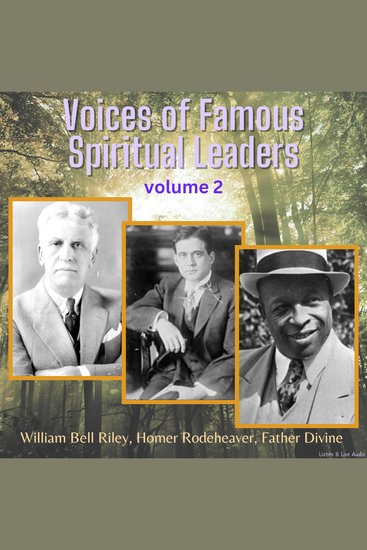
    William Bell Riley (March 22, 1861 - December 5, 1947) was known as "The Grand Old Man of Fundamentalism". Born and educated in Indiana, Riley received his teacher's certificate and, later, graduated from the Southern Baptist Theological Seminary in Louisville, KY. He served several Baptist churches in Kentucky, Indiana, and Illinois before taking the pastorate at the First Baptist Church in Minneapolis, MN, in 1897. 
    Father Divine (1876 - 1965), also known as Reverend Major Jealous Divine, was an African American spiritual leader from 1907 until his death. He founded the International Peace Mission movement, formulated its doctrine of economic independence and racial equality, and oversaw its growth from a small and predominantly black congregation into a multiracial and international church. 
    Homer Alvan Rodeheaver (October 4, 1880 - December 18, 1955) was an American evangelist, music director, music publisher, composer of gospel songs, and pioneer in the recording of sacred music. From 1910 to 1930, he served as musical director for Billy Sunday, the most popular evangelist of the period, using his baritone voice to effect as a soloist and as a participant in ensembles composed of other members of Sunday's evangelistic team. 
    ©2016 Listen & Live Audio, Inc. (P)2016 Listen & Live Audio, Inc.
    Zum Buch
  • US Presidents - Abraham Lincoln George Washington and Andrew Jackson - cover

    US Presidents - Abraham Lincoln...

    Kelly Mass

    • 0
    • 0
    • 0
    These three United States presidents will be discussed in this book combo: 
    1 - From 1861 till his assassination in 1865, Abraham Lincoln was an American legal representative and statesman who functioned as the 16th president of the United States. Lincoln led the nation through the American Civil War, preserving the Union, eliminating slavery, enhancing the federal government, and helping the economy of the United States. Lincoln grew up on the frontier, mainly in Indiana, and was born into poverty in a log cabin. He was self-taught and went on to end up being a legal representative, Whig Party leader, Illinois state lawmaker, and member of the U.S.A. Congress for Illinois. 
    2 - George Washington was an American soldier, statesman, and Founding Father who worked as the nation's first president from 1789 to 1797. Washington was called leader of the Continental Army by the Continental Congress, and he led the Patriot forces to triumph in the American Revolutionary War. He also commanded the Constitutional Convention of 1787, which developed the USA Constitution and a federal government. For his different management throughout the nation's developmental years, Washington has been called the "Father of the Nation." 
    3 - Andrew Jackson was an American attorney, soldier, and statesman who acted as the seventh president of the U.S. from 1829 to 1837. Jackson rose to prominence as a basic in the US Army and served in both homes of Congress before being chosen to the presidency. Jackson, an expansionist president, defended the rights of the "commoner" and the Union against a "corrupt upper class."
    Zum Buch
  • Nazi ufo - cover

    Nazi ufo

    Raphael Terra

    • 0
    • 0
    • 0
    This audiobook has been recorded using Text to speech (TTS). 
     
    From the onset, the Nazi party were obsessed with the world of the occult. They scoured the globe in search of the weapons that would enable them to conquer the world and build their 1000 Year Reich. 
     
    From the Holy Grail to the lance that pierced the side of Christ... From Tibet to the Antarctic... no region or mythological device was ignored. 
     
    They turned the planet inside out looking for something ancient, something the Nazi elite called "the most powerful weapon"... a weapon that would instill such awe that it would cause the entire world to surrender overnight. 
     
    And then suddenly during the Second World War and perhaps even years before, the Nazi's achieved a massive leap in technology, so great that many have questioned where this Nazi science originated.
    Zum Buch
  • American Restraint - Taming Hyper-Individualism & Hyper-Capitalism - cover

    American Restraint - Taming...

    Patrick Trepanier

    • 0
    • 0
    • 0
    AN IMPORTANT NEW BOOK ON HOW TO FIX AMERICA BY A POLITICAL OUTSIDER. 
    America is broken. America is divided. 80% of Americans believe the country is on the wrong track. And everything you need to know about the Divided States of America can be explained by two relentless forces: hyper-individualism and hyper-capitalism.  
    American Restraint explores how both hyper-individualism and hyper-capitalism are what is fundamentally ripping our country apart. Traditional solutions and status quo politicians can’t help us.  
    Patrick Trepanier is a powerful new voice addressing the real root causes and solutions for our divided country. 
    The first solution is in the Constitution…an Article V Convention of States. A Convention proposing three popular amendments: a balanced budget amendment, term limits for Congress, and limits to the power and jurisdiction of the federal government.   
    Then we need more “innovation and experimentation” by individual states to restrain the forces of hyper-individualism and hyper-capitalism. 
    American Restraint challenges decades of failed Democratic and Republican policies and calls for new pragmatic solutions that put the needs of children, families and communities first.   
    This groundbreaking new book also provides a framework to restore respect for religion, rebuild the middle class, restrain toxic consumerism, restore community trust, restrain the Wall Street Casino, restrain Big Tech’s control over our lives, reduce illegal competition for American jobs, promote resilience and service to help disadvantaged Americans. 
    American Restraint. The handbook to fix America.  
    Zum Buch
  • Pontiac's War - The 1763 Native American Rebellion against the British - cover

    Pontiac's War - The 1763 Native...

    Kelly Mass

    • 0
    • 0
    • 0
    Pontiac's War, also referred to as Pontiac's Conspiracy or Pontiac's Rebellion, was a significant conflict that emerged in the aftermath of the French and Indian War (1754–1763). In 1763, a coalition of Native American tribes, disillusioned with the increasing British presence and control in the Great Lakes region, united under the leadership of the Odawa chieftain Pontiac. These Native American forces launched an offensive aimed at driving British soldiers and settlers from the region. 
    The war began in May 1763 when Native American warriors, fearful of British General Jeffrey Amherst’s harsh policies, launched a series of attacks on British forts and settlements. These assaults led to the destruction of eight forts, the death or capture of hundreds of colonists, and the forced evacuation of many others. The intensity of the conflict shocked the British, as the attacks, though widespread, were coordinated across many tribes, reflecting a united front among the Indigenous people. Despite their efforts, the Native Americans were unable to expel the British from the region. The war finally began to subside in 1764 after British military actions prompted peace talks, which continued into 1766.
    Zum Buch