¡Acompáñanos a viajar por el mundo de los libros!
Añadir este libro a la estantería
Grey
Escribe un nuevo comentario Default profile 50px
Grey
Suscríbete para leer el libro completo o lee las primeras páginas gratis.
All characters reduced
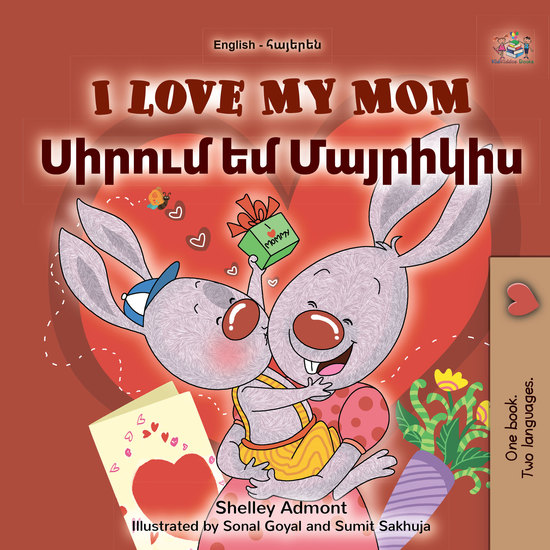
I Love My Mom Սիրում եմ Մայրիկիս - English Armenian Bilingual Book for Children - cover

I Love My Mom Սիրում եմ Մայրիկիս - English Armenian Bilingual Book for Children

Shelley Admont, KidKiddos Books

Editorial: KidKiddos Books

  • 0
  • 0
  • 0

Sinopsis

English Armenian Bilingual children's book. Perfect for kids studying English or Armenian as their second language. Everybody loves their Mom, no matter what their age. In this bedtime story, the little bunny Jimmy and his older brothers try to find a perfect present for Mom's birthday. They want to show how much they love her. What creative solution did they find to express their feelings? You will find out in this illustrated children's book. This children's book is part of a collection of short bedtime stories. This story may be ideal for reading to your kids at bedtime and enjoyable for the whole family as well!
Disponible desde: 29/05/2024.
Longitud de impresión: 34 páginas.

Otros libros que te pueden interesar

  • A Practical Guide To Modern Gamekeeping - Essential information for part-time and professional gamekeepers - cover

    A Practical Guide To Modern...

    J C eremy Hobson

    • 0
    • 0
    • 0
    I know of no gamekeepers who are not countrymen to their fingertips.  They observe, they consider, they cherish and they do more than most to look after out woodlands and hedgerows, our moorlands and fens.  Theirs is not an easy job, out in all weathers and misunderstood by many townies who are further removed from the countryside and its workings than they have ever been, thanks to increasing technology which keeps them housebound.  They need never go out if they so choose, remaining glued to the screen of a mobile phone, a computer or a television. But those who do realise that the intervention of man need not always be irresponsible and thoughtless can see just what benefits can accrue from the wise management of our natural resources, and Jeremy Hobson does much in this book to apprise us all of the modern approach to keepering, from raising birds and habitat management to choosing coats and boots and training dogs. It is all here, and a fascinating read it is; both for those in the know and those who are curious to learn all about it. 
    Alan Titchmarsh MBE, VMH, DL.
    Ver libro
  • Dog Training for Beginners - Basic Dog Training 101 - Step by Step Guide to Raise Your Puppy with Love in a Positive Way and Deal with Behavior Issues - cover

    Dog Training for Beginners -...

    Ben Monks

    • 0
    • 0
    • 0
    If you are thinking about getting a puppy or simply want to learn how to train your perfect dog in a happy, positive way, then keep reading. 
    Many people make the mistake of training their puppies the wrong way, or even don’t make a conscious effort to train them at all. After some time, they get angry and blame their dog for bad behavior. Ironically, it’s the dog owners who are responsible for these problems in most cases. But there is a way to solve them by learning how to raise your puppy properly and in a positive way. 
    It’s not your dog’s fault. If you treat the root causes of behavioral issues rather than the symptoms, you can teach your dog much faster without the use of punishment or stress.  
    In this guide you will learn:Why “getting dominance” over your dog is a bad ideaWhy a dog’s natural pack instincts are the key to a happy relationshipWhy what your dog really needs may not be what you’re giving himHow to choose a dog who’s right for you and your familyTricks you didn’t even know a dog could learnThe real difference between discipline and punishmentHow “rough and tumble primate play” can lead to trouble and how to play with your dog in ways that are fun and keep him out of troubleHow dogs reflect the personality of their owner and why most dogs want to live with benevolent leaders rather than wanna-be alphasThe importance of observing and understanding your dog’s body language and how to react appropriatelyHow to deal with common health problems and bad behavior 
    Whether you have never trained a dog or are just switching over to positive training, this guide offers a proven method of easy, fun and effective training. 
    Start enjoying a happy family life with your puppy. Scroll to the top of the page and select one of the “Buy” options.
    Ver libro
  • Infected: An AFK Book (Piggy Original Novel) - cover

    Infected: An AFK Book (Piggy...

    Terrance Crawford

    • 0
    • 1
    • 0
    Mystery, mayhem -- try to survive the terrifying world of PIGGY in this original novel based on the fan-favorite videogame!There is a mystery to be solved, keys to be found, and an evil pig to escape!When an infection threatens to turn everyone into mindless, dangerous monsters, it is up to a few desparate survivors to get survive long enough to find a cure. But can they hold on long enough to get to the bottom of this mysterious illness, or will PIGGY and her new minons find them first?Welcome to the bone chilling, pulse-pounding world of PIGGY, the survival-horror game that will keep you up at night. Explore a frightening maze full of secrets to unearth and monsters that are out for blood! Can anyone make it out alive?
    Ver libro
  • Asan Joban Rute Marna - cover

    Asan Joban Rute Marna

    Shiv Kumar Batalvi

    • 0
    • 0
    • 0
    Shiv Kumar Batalvi is known as the poet of sorrow. However, his poetry also beautifully expresses deep human emotions. His poems use unique symbols, phrases, and forgotten words from rural life. He also portrays the struggles of women with deep emotions, making his poetry heartfelt and touching.
    Ver libro
  • The Man Who Liked Lions - cover

    The Man Who Liked Lions

    John Bernard Daley

    • 0
    • 0
    • 0
    The Man Who Liked Lions by John Bernard Daley - A zoo is a place where some people make sport of lower animals. That included Kemper, but for him people were the lower animals! 
    Mr. Kemper leaned on the rail, watching the caged lions asleep in the August sun. At his side a woman lifted a whimpering little girl to her shoulder and said, "Stop that! Look at the lions!" Then she jiggled the girl up and down. The lion opened yellow eyes, lifted his head from between his paws and yawned. Immediately the girl put her fingers over her face and began to cry. "Shut up!" said the woman. "You shut up right now or I'll tell that big lion to eat you up!" Looking through her fingers the girl said, "Lions don't eat little girls." The woman shook her. "Of course they do! I said they did, didn't I?" 
    "Lions seldom eat people," said Mr. Kemper. With all of her two hundred pounds the woman turned to face him. "Well!" she said. The word hung like an icicle in the warm air, but Mr. Kemper waved it aside. "Only old lions resort to human flesh. Except for the famous incident of the Tsavo man-eaters, of course." The woman pulled her arm tighter around the girl, elbow up, as if to ward him off. "Come on, Shirl," she said. "Let's go look at the taggers." And with a warning look over her shoulder she lunged away from the rail. A big man with an unlit cigarette in his mouth took her place. 
    As her wide back swayed down the walk, Mr. Kemper wondered if she had a special intuition about him, like dogs, whose noses warned them that he was not quite the kind of man they were accustomed to. Women, particularly those with children, seemed to feel that way. He watched her leave, having decided that she was unsuited for what he had in mind. 
    The big man beside him tapped him on the shoulder and asked him for a match; at the same time Kemper saw, just beyond the retreating woman, a man in a tweed jacket and gray slacks, watching him.
    Ver libro
  • Plato - Theaetetus - cover

    Plato - Theaetetus

    Plato

    • 0
    • 0
    • 0
    The Theaetetus is one of Plato's dialogues concerning the nature of knowledge, written circa 369 BC. In this dialogue, Socrates and Theaetetus discuss three definitions of knowledge: knowledge as nothing but perception, knowledge as true judgment, and, finally, knowledge as a true judgment with an account. Each of these definitions is shown to be unsatisfactory.
    Ver libro