Begleiten Sie uns auf eine literarische Weltreise!
Buch zum Bücherregal hinzufügen
Grey
Einen neuen Kommentar schreiben Default profile 50px
Grey
Jetzt das ganze Buch im Abo oder die ersten Seiten gratis lesen!
All characters reduced
The Red Door - A dark fairy tale told in poems - cover

The Red Door - A dark fairy tale told in poems

Shawn C. Harris

Verlag: Ben Yehuda Press

  • 0
  • 0
  • 0

Beschreibung

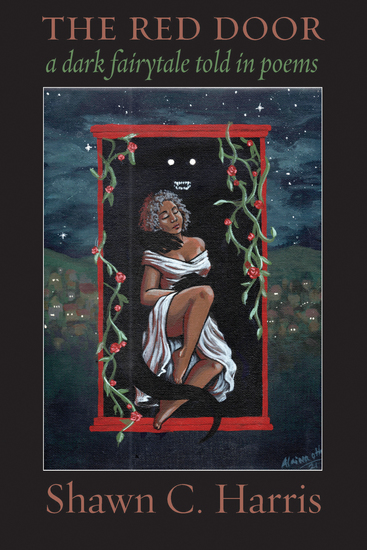
The story starts at a Jewish funeral.
 
fist after fist fills with cool damp earth
 
It travels to Israel:
 
at ben-gurion airporthere she comes hauling her baggagerendered clumsy by her burdenbeneath that smooth brown skinthat halo of thick coarse hairthe plantation and the shtetllive in blood and memory
 
her passport names hertirzah persephone horowitzafter an aunt on her dad’s sidewho died so young in the campsand her mother’s favorite greek mythbut to call her tirzah is too muchlike uncovering her nakednesslike speaking aloud the holy name
 
and the holy city of Tzfat…
 
i am a city of songplucked strings of a lyreloud brassy klezmerthrobbing techno beatsshoes clop-clopping on cobblestonetires screeching on the asphalt riverwinding round my peak
 
It features monsters…
 
terry loves monstersloved them since her first pimples and pubessneaking dracula under the coverswondering what it would be liketo feel a vampire’s fangs on her neckto taste human blood in her mouthto transform into wolf or bat or mistbut dracula always diesstaked and beheaded by good christian menbecause magic and mystery must not survive
 
And it ends…
 
No. That would be telling.
Verfügbar seit: 05.09.2022.
Drucklänge: 80 Seiten.
Weitere Bücher, die Sie mögen werden

  • Tao Te Ching - A New English Version - cover

    Tao Te Ching - A New English...

    Anonym

    • 0
    • 0
    • 0
    In 81 brief chapters, Lao-Tzu's Tao Te Ching, or Book of the Way, provides advice that imparts balance and perspective, a serene and generous spirit, and teaches us how to work for the good with the effortless skill that comes from being in accord with the Tao—the basic principle of the universe.  
    Stephen Mitchell's bestselling version has been widely acclaimed as a gift to contemporary culture.
    Zum Buch
  • The Waste Land - cover

    The Waste Land

    T. S. Eliot

    • 0
    • 0
    • 0
    In The Waste Land, T.S. Eliot presents a haunting and fragmented vision of a world in decline—a world ravaged by war, disillusionment, and spiritual desolation. Considered one of the most influential poems of the 20th century, The Waste Land is a complex mosaic of voices, mythic references, and shifting landscapes, capturing the fractured psyche of modern life.
    
    Through its five sections, Eliot explores the themes of fragmentation, despair, and the search for meaning in a society torn apart by cultural and spiritual crisis. From the bleak and desolate opening lines, the poem journeys through images of decay, lost hope, and barren landscapes, interspersed with moments of revelation and the possibility of redemption. With references to works ranging from the Bible to Dante, the Upanishads to the Grail myth, The Waste Land weaves a dense web of cultural and literary allusions, challenging readers to confront the disintegration of modern civilization.
    
    A bold exploration of the fractured nature of contemporary existence, The Waste Land is both a lament and a call to find hope amidst the ruins—an extraordinary work of literary art that continues to resonate with readers in the modern age.
    Zum Buch
  • Poets on Poetry - The most artistic and creative form of writing we have a selection of poems from those artistic and creative minds about poetry itself - cover

    Poets on Poetry - The most...

    Matthew Arnold, Sarojini Naidu,...

    • 0
    • 0
    • 0
    Who has not tried to write a poem?  The poetic form of words seems to be rather easy.  In its basic form, which we learn as children, the rhyming couplet is, in a child’s written and spoken words, pure joy - success!  In the hands of a Shakespeare it is magnificent with a reach and understanding that the rest of us enjoy but are far from even attempting.    
     
    As we listen to various poetic forms, schools and movements we can only react with wonder at how these innocent words are assembled to create symphonies of ideas, wonder and revelation.  The emotions they seek to invoke can be anything from happiness to sadness, from love to revulsion. 
     
    Arnold, Stevens, Keats, Akhmatova, Browning, Herrick, Hood, Killigrew are but a few of the roll-call of wordsmiths who with mere words create ravenous beauty that reveals tender lines and sensitive verse on how and why they are who they are. 
     
    01 - Poets on Poetry - An Introduction 
    02 - When I Write Poems by Anna Akhmatova 
    03 - Of My Poems by Thomas MacDonagh 
    04 - An Apology For Her Poetry by Duchess of Newcastle, Margaret Cavendish 
    05 - Sonnet 76 - Why is My Verse So Barren of New Pride by William Shakespeare 
    06 - The Austerity of Poetry by Matthew Arnold 
    07 - Of Modern Poetry by Wallace Stevens 
    08 - Poetry by Claude McKay 
    09 - The Poetry of Keats by George Meredith 
    10 - Future Poetry by Alice Meynell 
    11 - Sonnet 17 - Who Will Believe My Verse in Time to Come by William Shakespeare 
    12 - Poetic Eggs by Ezra Pound 
    13 - Poem by William Carlos Williams 
    14 - On the Grasshopper and Cricket by John Keats 
    15 - Ode on the Poetical Character by William Collins 
    16 - Introduction and Conclusion of a Long Poem by Alan Seeger 
    17 - A True Account of the Birth and Conception of a Late Famous Poem by Charles Sackville, Earl Of Dorset 
    18 - The Poem That Took the Place of a Mountain by Wallace Stevens 
    19 - The Poet and the Poem by Elizabeth Stuart Phelps 
    20 - Of English Verse by Edmund Waller 
    21 - Love, The Soul of Poetry by Anne Killigrew 
    22 - Why, If All Poets Crown Their Love with Verse by Emily Hickey 
    23 - Verse Making Was the Least of My Virtues by Robert Browning 
    24 - The Poet's Love-Song by Sarojini Naidu 
    25 - A Letter to a Brother of the Pen in Tribulation by Aphra Behn 
    26 - Not Every Day Fit for Verse by Robert Herrick 
    27 - On the Poetic Muse by George Moses Horton 
    28 - Sonnet - Written in Keats by Thomas Hood 
    29 - Sonnet 86 -Was It the Proud Full Sail of His Great Verse by William Shakespeare 
    30 - Song in Imitation of Shakespeare by James Beattie 
    31 - The High-toned Old Christian Woman by Wallace Stevens 
    32 - Poetry is a Destructive Force by Wallace Stevens 
    33 - To My Most Dearly Loved Friend Henry Reynolds Esquire of Poets and Poesie by Michael Drayton 
    34 - His Poetry His Pillar by Robert Herrick 
    35 - To Live Merrily and to Trust to Good Verses by Robert Herrick 
    36 - Poem for the End by Ivor Gurney
    Zum Buch
  • The Book of Hours - a new poetic translation for devotional use - cover

    The Book of Hours - a new poetic...

    Rainer Maria Rilke, Brett Alan...

    • 0
    • 0
    • 0
    Written at the turn of the twentieth century, The Book of Hours is one of the most significant works of modern German poetry. There has never been an English translation that preserved the tight poeticism and Christian mysticism of the original until now. In this long poem, the narrator-poet is a monk and icon painter desperately trying to see God in a way that his art can’t capture. Over three sections (The Book of Monkish Life, The Book of Pilgrimage, and The Book of Poverty & Death), Rilke takes the narrator on a journey from the pastoral lands of his monastery to the bustling and inhuman cities of the world on a quest to make sense of God's central mystery. A variety of images recur: building, trees (roots and fruits), ripening, ore, and what Rilke simply calls "the things". Through these motifs, the narrator seeks to understand God by exploring imagery that is the inverse of the usual Biblical symbols. What can we learn by thinking of God as darkness, as son, as poor neighbor, or as the rock that runs through the earth...? And, ultimately, what truly are poverty and death to the holy pilgrim?
    Zum Buch
  • Ages of Man - cover

    Ages of Man

    William Shakespeare

    • 0
    • 0
    • 0
    Here are some of Shakespeare's finest speeches performed by one of the greatest Shakespearean actors of this century. It ranges from the youth of Jaques' introduction to life, 'All the world's a stage!' in ""As You Like It"" to the aged Prospero's goodbye to Ariel and Shakespeare's own farewell to his muse in ""The Tempest"": 'Now my charms are all o'erthrown!' Sir John's masterful reading brings delight to the ear and joy to the heart.
    Zum Buch
  • Love's Labour's Lost - cover

    Love's Labour's Lost

    William Shakespeare

    • 0
    • 0
    • 0
    King Ferdinand and his three friends, Biron, Longaville, and Dumain, plan to study philosophy for the next three years. During their academic pursuits, they must vow to sleep only three hours a night and not let any woman within a mile of court. These strict rules will prevent any distractions from their work - but their promises are soon put to the test when a princess and her three companions arrive for a state visit.
    Zum Buch