Rejoignez-nous pour un voyage dans le monde des livres!
Ajouter ce livre à l'électronique
Grey
Ecrivez un nouveau commentaire Default profile 50px
Grey
Abonnez-vous pour lire le livre complet ou lisez les premières pages gratuitement!
All characters reduced
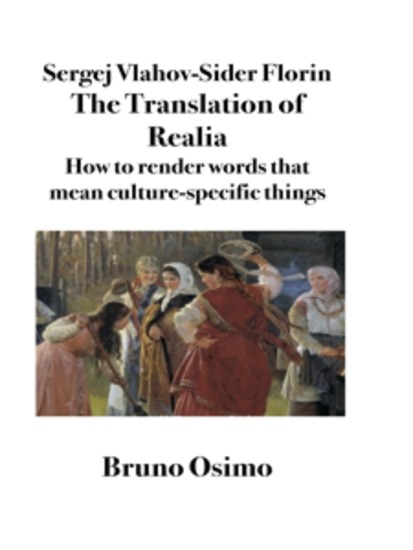
The Translation of Realia - How to render words that mean culture-specific things - cover

The Translation of Realia - How to render words that mean culture-specific things

Sergej Vlahov, Sider Florin

Maison d'édition: Bruno Osimo

  • 0
  • 2
  • 0

Synopsis

The concept of 'translation of realia' is doubly conventional: realia are normally untranslatable (from a dictionary perspective) and, again, are normally not rendered (in context) by means of translation.With respect to dictionary translation, however, "there are no words that could not be translated into another language, at least descriptively, i.e. by means of a widespread combination of words of the given language", and "what is not possible with respect to a single element, is possible with respect to a complex whole", i.e. with respect to a contextual translation.
Disponible depuis: 23/03/2023.
Longueur d'impression: 94 pages.
D'autres livres qui pourraient vous intéresser

  • Wingless Victory - The Story of Sir Basil Embry's Escape From Occupied France in the Summer of 1940 - cover

    Wingless Victory - The Story of...

    Anthony Richardson

    • 0
    • 0
    • 0
    The true story of an airman's audacious escape from occupied France in World War Two. 


    Perfect for fans of The Great Escape, The 21 Escapes of Lt Alastair Cram, and The Wooden Horse. 


    Sir Basil Embry's Blenheim bomber was shot down in the summer of 1940. 


    During the course of his time in enemy territory he broke out from a column of prisoners while having a Nazi machine gun aimed at him, fought against his captors with stolen weapons, hid in stinking manure, and even posed as a member of the Irish Republican Army in order to throw his captors off the scent of his true identity. 


    In total he was captured three times and three times he refused to submit. Only through sheer courage and wit did he make his way back to Britain to fight and fly again. This is his remarkable story. 


    Anthony Richardson served as Adjutant in the same squadron as Embry later in the war and was told about these astounding exploits first-hand. This book will undoubtedly amaze all interested in moments of amazing fortitude in the face of overwhelming odds.
    Voir livre
  • Swami Satchidananda - The Wisdom Of The Saints - cover

    Swami Satchidananda - The Wisdom...

    Raj Rass

    • 0
    • 0
    • 0
    Swami Satchidananda was the founder of Integral Yoga International. He taught that the birthright of all is to realize the spiritual unity behind the diversity throughout creation and live harmoniously as members of “one universal family”. Swami was born into a loving spiritual family on December 22nd in 1914 during the month known as Margali, the Dawn of the Devas. From an early age, Swami (or Ramaswamy as he was known at the time) displayed many spiritual tendencies and a deep dedication to the truth. Thus, at the age of 28 he decided to devote himself full time to his spiritual practice. There then followed a period of seeking the wisdom and blessing of various saints and sages. Although a sannyasin Satchidananda was active in serving others and was happy to use modern technology to disseminate the teachings of yoga. Like many great Saints, Satchidananda believed all religions could lead seekers to the same goal. His interfaith motto was “Truth Is One, Paths Are Many.” In 1966 the artist Peter Max invited him to New York this led to Satchidananda deciding to stay becoming an American citizen. In the west, he initiated many and lectured throughout the world. He often participated in interfaith initiatives. His mission was to bring people together in the spirit of harmony.
    Voir livre
  • The Aeneid - Virgil's Mythic Journey through Ancient Rome - cover

    The Aeneid - Virgil's Mythic...

    Odessa Nightshade

    • 0
    • 0
    • 0
    The Aeneid stands as one of the most influential literary works of the ancient world, a masterpiece that shaped Rome’s cultural and political identity. Written by the poet Virgil between 29 and 19 BCE, this epic tells the story of Aeneas, a Trojan hero destined to lay the foundations for what would become Rome. Blending myth, history, and divine intervention, Virgil crafted a narrative that not only honored Rome’s past but also justified its imperial destiny. Commissioned during the reign of Augustus, The Aeneid served as both a patriotic epic and a moral guide, emphasizing duty, sacrifice, and perseverance.  
      
    At its core, The Aeneid explores Rome’s divine origins through the trials and triumphs of Aeneas. His journey mirrors the struggles of Rome itself—facing adversity, enduring loss, and ultimately fulfilling a grand destiny. Unlike Homer’s heroes, Aeneas is driven by pietas, a sense of duty to the gods, his people, and his future nation. This concept of duty over personal desire defines him, setting him apart from figures like Achilles, who is ruled by rage, or Odysseus, who relies on cunning. Through Aeneas, Virgil presents an ideal Roman leader—one who sacrifices personal happiness for the greater good.  
      
    The themes of fate and duty play a central role in The Aeneid, reinforcing the idea that Rome’s supremacy was preordained by the gods. From the moment Aeneas flees Troy, his path is guided by prophecy. Though he faces obstacles—such as the wrath of Juno, the temptations of love, and the horrors of war—his unwavering commitment to his destiny ensures that he prevails. Virgil uses this theme to legitimize Augustus’ rule, portraying Rome’s rise as part of a divine plan rather than mere political ambition. 
    Voir livre
  • Plato of Athens - A Life in Philosophy - cover

    Plato of Athens - A Life in...

    Robin Waterfield

    • 0
    • 0
    • 0
    Considered by many to be the most important philosopher ever, Plato was born into a well-to-do family in wartime Athens at the end of the fifth century BCE. He finally decided to go into politics, but became disillusioned, especially after the Athenians condemned his teacher, Socrates, to death. He began teaching in his twenties and later founded the Academy, the world's first higher-educational research and teaching establishment. Eventually, he returned to practical politics and spent a considerable amount of time and energy trying to create a constitution for Syracuse in Sicily that would reflect and perpetuate some of his political ideals. The attempts failed, and Plato's disappointment can be traced in some of his later political works. 


    In his lifetime and after, Plato was considered almost divine. This led to the invention of many tall tales about him-both by those who adored him and his detractors. In this first ever full-length portrait of Plato, Robin Waterfield steers a judicious course among these stories, debunking some while accepting the kernels of truth in others. He explains why Plato chose to write dialogues rather than treatises and gives an overview of the subject matter of all of Plato's books. Clearly and engagingly written throughout, Plato of Athens is the perfect introduction to the man and his work.
    Voir livre
  • A Dignified Life - Revised and Expanded: The Best Friends™ Approach to Alzheimer’s Care: A Guide for Care Partners - cover

    A Dignified Life - Revised and...

    MPH David Troxel, MSW Virginia Bell

    • 0
    • 0
    • 0
    More than 5 million Americans are currently living with Alzheimer's disease or a related form of dementia. By the year 2030, experts estimate that as many as 66 million people will be faced with this life-altering disease. These statistics impact millions of caregivers. Compared with all types of caregivers, those who assist someone with dementia experience the highest levels of burnout, depression, poor health, and premature death. A Dignified Life, Revised and Expanded offers hope and help. 


    Ten years ago, the first edition of A Dignified Life changed the way the caregiving community approached Alzheimer's disease by showing caregivers how to act as a Best Friend to the person. Firmly grounded in the latest knowledge about dementia, this expanded edition offers a wealth of tips and advice. 


    While medical treatment of the disease hasn't changed, our understanding and awareness of treating people in a more caring way has changed. With no cure, respectful care by effective and compassionate care partners is the only real "treatment" available. The Best Friends Approach is successful because it sustains people's connection to their world, their loved ones, and themselves. A Dignified Life shows how to bring dignity, meaning, and peace of mind to the lives of both those who have Alzheimer's and dementia and those who care for them.
    Voir livre
  • Family Lexicon - cover

    Family Lexicon

    Natalia Ginzburg, Peg Boyers

    • 0
    • 0
    • 0
    An Italian family, sizable, with its routines and rituals, crazes, pet phrases, and stories, doubtful, comical, indispensable, comes to life in the pages of Natalia Ginzburg's Family Lexicon. Giuseppe Levi, the father, is a scientist, consumed by his work and a mania for hiking—when he isn't provoked into angry remonstration by someone misspeaking or misbehaving or wearing the wrong thing. Giuseppe is Jewish, married to Lidia, a Catholic, though neither is religious; they live in the industrial city of Turin where, as the years pass, their children find ways of their own to medicine, marriage, literature, politics. It is all very ordinary, except that the background to the story is Mussolini's Italy in its steady downward descent to race law and world war. The Levis are, among other things, unshakeable anti-fascists. That will complicate their lives. 


    Family Lexicon is about a family and language—and about storytelling not only as a form of survival but also as an instrument of deception and domination. The book takes the shape of a novel, yet everything is true. "Every time that I have found myself inventing something in accordance with my old habits as a novelist, I have felt impelled at once to destroy [it]," Ginzburg tells us at the start. "The places, events, and people are all real."
    Voir livre