Rejoignez-nous pour un voyage dans le monde des livres!
Ajouter ce livre à l'électronique
Grey
Ecrivez un nouveau commentaire Default profile 50px
Grey
Abonnez-vous pour lire le livre complet ou lisez les premières pages gratuitement!
All characters reduced
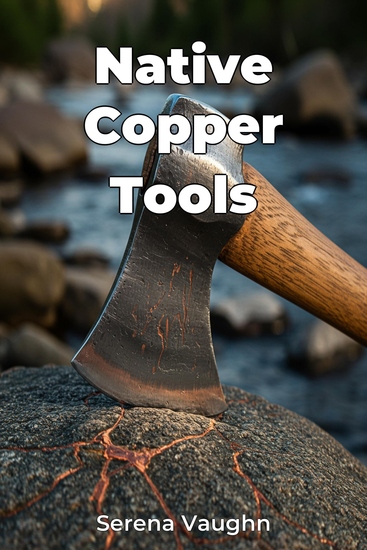
Native Copper Tools - cover

Native Copper Tools

Serena Vaughn

Traducteur A AI

Maison d'édition: Publifye

  • 0
  • 0
  • 0

Synopsis

Native Copper Tools explores the remarkable story of how indigenous peoples in pre-Columbian North America crafted sophisticated tools from raw copper. These artifacts offer a window into their societies, technologies, and beliefs.

 
The book emphasizes how indigenous metallurgists located geological sources of native copper and employed techniques like cold-working and annealing to shape the metal, creating implements for various purposes, from hunting and fishing to ceremonial rituals.

 
One fascinating insight is how the Great Lakes region provided unusually pure copper sources, allowing for advanced metalworking. Another is that copper tools were not merely utilitarian; they held ritual and status value, reflecting complex social structures.

 
The book examines the geological origins of copper, the metallurgical processes involved, and the cultural significance of the tools. It presents detailed analyses of copper artifacts found across North America, drawing on archaeological excavations, geological surveys, and metallurgical analyses.

 
This approach combines archaeological findings with modern science to understand the technological processes used by indigenous populations. The book progresses from discussing copper procurement to explaining metalworking techniques and then exploring the cultural context, culminating in a holistic understanding of native copper technology's role in shaping indigenous life.
Disponible depuis: 29/03/2025.
Longueur d'impression: 60 pages.


D'autres livres qui pourraient vous intéresser

  • Political Choice in a Polarized America - How Elite Polarization Shapes Mass Behavior - cover

    Political Choice in a Polarized...

    Joshua N. Zingher

    • 0
    • 0
    • 0
    What motivates citizens to support one party over the other? Do they carefully weigh all of the relevant issues and assess which party or candidate best matches their own positions? Or do people look at politics as something more akin to a team sport—the specifics do not matter as long as you know what side your team is on? Answering these questions requires us to think about how much the average American knows about politics. Many scholars of public opinion believe that the majority of Americans only pay passing attention to politics. Thus the electorate's apparent lack of political competence presents a direct challenge to normative theories of democracy. How are citizens supposed to exert control over the government if they have no idea what is going on? 


    In Political Choice in a Polarized America, Joshua N. Zingher argues that these fears are overblown. Not only do individuals have core beliefs about what the government should or should not do, but individuals have become more likely to support the party that best matches their policy attitudes by both identifying as a member of that party and voting for that party in elections. However, as Zingher demonstrates, voters' ability to match their attitudes to a party or candidate varies according to signals sent by elites and increases as parties become more polarized.
    Voir livre
  • 20 Embodied Practices for Healing Trauma and Addiction - Using the Felt Sense Polyvagal Model - cover

    20 Embodied Practices for...

    Jan Winhall, PhD Stephen Porges

    • 0
    • 0
    • 0
    Trauma and addiction heal in tandem with this paradigm-shifting approach. 


    What if addiction, dissociation, and other manifestations of trauma were not framed as diseases or disorders, but rather as adaptive methods of regulating the autonomic nervous system (ANS)? This book takes that approach, and guides listeners through twenty embodied practices that promote the rewiring of the ANS. By integrating the latest neuroscience from Stephen Porges's Polyvagal Theory with Eugene Gendlin's embodied felt sense, Jan Winhall's Felt Sense Polyvagal Model is a paradigm-shifting, deeply somatic approach to healing trauma and addiction. 


    Listeners are presented with two vital tools for healing: learning how to recognize and rewire their autonomic state, and finding the felt sense of somatic wisdom. This compassionate and inviting model centers the intelligence of the body to allow for deep healing, and these twenty step-by step exercises present an accessible approach for clinicians, their clients, and anyone on the journey to healing from trauma and addiction. The book's exercises are uniquely designed to be completed either with a mental health professional, another person engaged in this embodied process (a felt sense partner), or both.
    Voir livre
  • Global Collapse and the Path to Rebirth - "Embark on the Global Collapse journey! Dive into impactful audio lessons for a powerful path to rebirth" - cover

    Global Collapse and the Path to...

    Boden Sinclair

    • 0
    • 0
    • 0
    Global Collapse and the Path to Rebirth 
    ⭐⭐ A Simplified Guide with Essential Insights ⭐⭐ 
    Are you eager to advance in your career and enhance your understanding of the future challenges and opportunities that lie ahead? 
    Searching for an all-encompassing resource that covers everything you need to know to navigate the complexities of the evolving world? 
    Your quest ends here! 
    This guide acts as your ultimate resource for gaining deeper insights, applying practical skills, and participating in engaging exercises. With this material, you’ll be well-prepared for success. 
    Updated to reflect the emerging trends and structures of 2025. 
    Key Features of This Comprehensive Guide: 
    - In-depth insights into the challenges and opportunities of 2025  
    - Clear explanations of future societal transitions  
    - Effective strategies for navigating these challenges and achieving your goals 
    Our guide stands out through its thorough coverage, which is crucial for your understanding and application of key concepts. We don’t just skim the surface; we delve deep into essential topics with clarity and precision. 
    Please note that this guide is an independent resource and not affiliated with any official organization related to future studies. 
    Crafted with a straightforward structure and user-friendly language, our guide ensures seamless navigation between subjects. Say farewell to convoluted terminology and embrace content that is clear, concise, and technically accurate. 
    So, why hesitate? Click the BUY NOW button, secure your guide, and embark on your journey to comprehending the future of 2025!
    Voir livre
  • Now Comes Good Sailing - Writers Reflect on Henry David Thoreau - cover

    Now Comes Good Sailing - Writers...

    Andrew Blauner

    • 0
    • 0
    • 0
    This audiobook brings together original pieces on Thoreau by twenty-seven of today's leading writers
    
    With narration by William Hope, Barbara Barnes, Kaliswa Brewster, Kate Harper, Peter Marinker, and Ako Mitchell
    Features essays by Jennifer Finney Boylan • Kristen Case • George Howe Colt • Gerald Early • Paul Elie • Will Eno • Adam Gopnik • Lauren Groff • Celeste Headlee • Pico Iyer • Alan Lightman • James Marcus • Megan Marshall • Michelle Nijhuis • Zoë Pollak • Jordan Salama • Tatiana Schlossberg • A. O. Scott • Mona Simpson • Stacey Vanek Smith • Wen Stephenson • Robert Sullivan • Amor Towles • Sherry Turkle • Geoff Wisner • Rafia Zakaria • and a cartoon by Sandra Boynton
    
    The world is never done catching up with Henry David Thoreau (1817–1862), the author of Walden, "Civil Disobedience," and other classics. A prophet of environmentalism and vegetarianism, an abolitionist, and a critic of materialism and technology, Thoreau even seems to have anticipated a world of social distancing in his famous experiment at Walden Pond. In Now Comes Good Sailing, twenty-seven of today's leading writers offer wide-ranging original pieces exploring how Thoreau has influenced and inspired them—and why he matters more than ever in an age of climate, racial, and technological reckoning.
    
    Here, Lauren Groff retreats from the COVID-19 pandemic to a rural house and writing hut, where, unable to write, she rereads Walden; Pico Iyer describes how Thoreau provided him with an unlikely guidebook to Japan; Gerald Early examines Walden and the Black quest for nature; Rafia Zakaria reflects on solitude, from Thoreau's Concord to her native Pakistan; Mona Simpson follows in Thoreau's footsteps at Maine's Mount Katahdin; Jennifer Finney Boylan reads Thoreau in relation to her experience of coming out as a trans woman; Adam Gopnik traces Thoreau's influence on the New Yorker editor E. B. White and his book Charlotte's Web; and there's much more.
    
    The result is a lively and compelling collection that richly demonstrates the countless ways Thoreau continues to move, challenge, and provoke readers today.
    Voir livre
  • Lead with Truth - How to Make a Difference in Your School Your Life and the Lives of Your Students - cover

    Lead with Truth - How to Make a...

    Dr. Qiana O'Leary

    • 0
    • 0
    • 0
    The sacrificial nature of juggling instructional, operational, managerial, and collegial goals often leaves school leaders feeling so desperate to resolve conflicts that they lose self, abandoning their core values and forgetting their "why." In this timely and impactful resource, author and professor "Dr. O" draws on her own leadership journey—a journey where she remained true to her beliefs and commitment to serve BIPOC communities, even when that meant choosing the road less traveled—offering nine anchor principles to help guide educational leaders in returning to their core values; communicate and build trusting relationships with staff members, students, and parents; and recognize their self-worth beyond their role on school campuses. 


    Lead with Truth is an interactive text that invites you to identify learning objectives and reflect on guided questions throughout the chapters, geared to help you make personal connections with the content. This engaging resource is for current and aspiring school leaders who aim to make lifelong impacts and transform their practice, while remaining true to their own beliefs.
    Voir livre
  • Spanish Empire in the Americas The: The History of Spain’s Colonization across Central America and South America - cover

    Spanish Empire in the Americas...

    Editors Charles River

    • 0
    • 0
    • 0
    By the time Christopher Columbus started setting east from the New World, he had explored San Salvador in the Bahamas (which he thought was Japan), Cuba (which he thought was China), and Hispaniola, the source of gold. As the common story goes, Columbus, en route back to Spain from his first journey, called in at Lisbon as a courtesy to brief the Portuguese King John II of his discovery of the New World. King John subsequently protested that according to the 1479 Treaty of Alcáçovas, which divided the Atlantic Ocean between Spanish and Portuguese spheres of influence, the newly discovered lands rightly belonged to Portugal. To make clear the point, a Portuguese fleet was authorized and dispatched west from the Tagus to lay claim to the “Indies,” which prompted a flurry of diplomatic activity in the court of Ferdinand and Isabella. At the time, Spain lacked the naval power to prevent Portugal from acting on this threat, and the result was the hugely influential 1494 Treaty of Tordesillas. 
    The Treaty of Tordesillas was one of the most important documents of its kind of the age, for it established the essential parameters of the two competing empires, the first of the major European imperial entities. The Treaty of Tordesillas drew an imaginary line from pole to pole, running 100 leagues west of the westernmost islands of the Azores. According to the terms of a supporting papal bull, all the lands to the west of that belonged to Spain, and all of those to the east belonged to Portugal. What this meant in practical terms was that Portugal was given Africa and the Indian Ocean while Spain was granted all the lands to the west, including the Americas and the Caribbean, all collectively known as the “Indies,” or the New World. 
    Perhaps inevitably, a regional rivalry had developed as the Portuguese began to establish a colony in Brazil and push its boundaries southwards. 
    Voir livre