Rejoignez-nous pour un voyage dans le monde des livres!
Ajouter ce livre à l'électronique
Grey
Ecrivez un nouveau commentaire Default profile 50px
Grey
Abonnez-vous pour lire le livre complet ou lisez les premières pages gratuitement!
All characters reduced
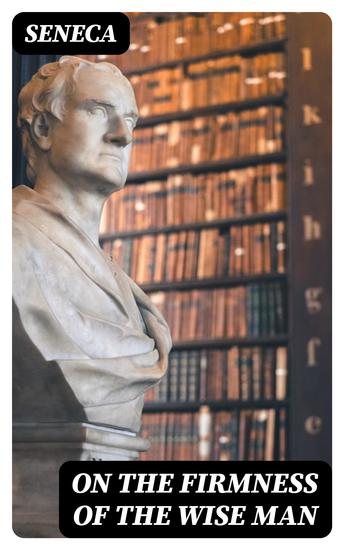
On the Firmness of the Wise Man - Enriched edition - cover

On the Firmness of the Wise Man - Enriched edition

Seneca

Traducteur Aubrey Stewart

Maison d'édition: DigiCat

  • 0
  • 0
  • 0

Synopsis

In "On the Firmness of the Wise Man," Seneca, a prominent Stoic philosopher and statesman, explores the nature of resilience and the internal fortitude required to navigate life's adversities. Through a series of poignant essays, he employs a reflective and persuasive literary style characterized by vivid metaphors and rhetorical questions that challenge readers to examine their moral convictions and emotional responses. Set against the backdrop of a tumultuous Roman Empire, Seneca's work is deeply entrenched in Stoic thought, advocating for a life led by reason and virtue rather than the whims of fortune. Seneca's own life experiences, including his exile, political intrigues, and relationship with power, inform his philosophical outlook. A tutor to Emperor Nero, he witnessed both the heights of privilege and the depths of despair, prompting him to articulate a philosophy that emphasizes the importance of inner strength and clarity in times of crisis. His personal struggles with the very ideas he espouses enrich the text, offering authenticity and depth to his philosophical discourse. This eloquent treatise is essential reading for anyone seeking wisdom in the face of adversity. Seneca's insights resonate across ages, offering timeless guidance on cultivating resilience and achieving emotional equilibrium. Readers will find inspiration in his call to embrace reason, thereby navigating the storms of life with unyielding firmness.

In this enriched edition, we have carefully created added value for your reading experience:
- A succinct Introduction situates the work's timeless appeal and themes.
- The Synopsis outlines the central plot, highlighting key developments without spoiling critical twists.
- A detailed Historical Context immerses you in the era's events and influences that shaped the writing.
- An Author Biography reveals milestones in the author's life, illuminating the personal insights behind the text.
- A thorough Analysis dissects symbols, motifs, and character arcs to unearth underlying meanings.
- Reflection questions prompt you to engage personally with the work's messages, connecting them to modern life.
- Hand‐picked Memorable Quotes shine a spotlight on moments of literary brilliance.
- Interactive footnotes clarify unusual references, historical allusions, and archaic phrases for an effortless, more informed read.
Disponible depuis: 21/07/2022.
Longueur d'impression: 22 pages.


D'autres livres qui pourraient vous intéresser

  • A Short History of Financial Euphoria - cover

    A Short History of Financial...

    John Kenneth Galbraith

    • 0
    • 0
    • 0
    The world-renowned economist offers "dourly irreverent analyses of financial debacle from the tulip craze of the seventeenth century to the recent plague of junk bonds." —The Atlantic. 


    With incomparable wisdom, skill, and wit, world-renowned economist John Kenneth Galbraith traces the history of the major speculative episodes in our economy over the last three centuries. Exposing the ways in which normally sane people display reckless behavior in pursuit of profit, Galbraith asserts that our "notoriously short" financial memory is what creates the conditions for market collapse. By recognizing these signs and understanding what causes them we can guard against future recessions and have a better hold on our country's (and our own) financial destiny.
    Voir livre
  • Who’s the Devil: the Other or the West? - cover

    Who’s the Devil: the Other or...

    Régis Le Sommier

    • 0
    • 0
    • 0
    “We’ve spent nine trillion dollars bombing the Middle East like mad. We’ve sown death there, including our own. And what has it gotten us? Nothing.” 
    Donald Trump, November 1, 2024. 
    
    The figure of the devil has haunted our collective consciousness since the dawn of time. He structures our societies, whether religious or secular. Sometimes, the devil has been a friend before being “demonized”. Sometimes, by force of circumstance, he has become an ally. And sometimes, the devil must be eliminated to mask or even justify the errors of our societies. 
    Thus, during the Second World War, we made a pact with Stalin to bring down a devil deemed more formidable: Hitler. In Northern Ireland, the British ended up talking with representatives of the IRA, just as the French did a few years earlier with the Algerian FLN. Recently, the Americans negotiated with the Taliban, another terrorist group, before handing over the keys to Afghanistan. Saddam Hussein, Muammar Gaddafi and Bashar al-Assad were friends of the West before the latter precipitated their downfall, even if it meant causing chaos in their countries.
    Régis Le Sommier has been a war reporter for 27 years, and has himself interviewed a number of infamous figures. His aim is to revisit the concept of the devil in the light of recent and current conflicts, in order to answer one question: shouldn’t the deleterious consequences of geopolitics conducted “in the name of good” lead us to doubt the validity of the actions taken by our governments, even today, against those they like to refer to as devils?
    Voir livre
  • Democritus - Atoms and the Birth of Materialism - cover

    Democritus - Atoms and the Birth...

    Hector Davidson

    • 0
    • 0
    • 0
    Democritus, often referred to as the "laughing philosopher," was a pre-Socratic Greek philosopher who is best known for his atomic theory of the universe. His ideas have significantly shaped modern science, especially in physics and chemistry. Democritus proposed that everything in the universe is made up of small, indivisible particles called atoms. These atoms are eternal, unchangeable, and infinite in number, differing only in shape, size, and arrangement. He was a strong proponent of materialism, the idea that everything that exists is composed of matter and that the properties of the world can be explained by the properties and interactions of atoms. 
    In addition to his contributions to atomic theory, Democritus also made significant contributions to epistemology, the study of knowledge. He suggested that our senses are the primary means by which we perceive the world, though they can sometimes be deceptive. His ideas influenced many later philosophers, including Leucippus, Epicurus, and even modern scientists like John Dalton, whose 19th-century atomic theory was inspired by Democritus's concepts. 
    Despite the lack of direct empirical evidence in his time, Democritus's theories laid the groundwork for the development of scientific thought and inquiry. He emphasized reason and observation over mythological explanations, helping to shape the way we understand the material world. Though much of his work has been lost to history, Democritus's legacy endures, continuing to inspire scientific exploration and contributing to our understanding of the universe.
    Voir livre
  • TANTRUMS Tips and Tricks Effective Methods to Calm Your Child Fast! - cover

    TANTRUMS Tips and Tricks...

    Dr. Emily Rodriguez

    • 0
    • 0
    • 0
    Are you tired of dealing with your child's tantrums? Do you want to learn effective strategies to prevent and calm tantrums quickly? 
    Tantrums can be frustrating for both parents and children. But there are practical ways to manage them, and this book provides all the tips and tricks you need to know. 
    In Tantrums: Tips and Tricks, Effective Strategies to Calm Your Child Fast!, you will learn: 
    1.The causes and signs of tantrums 
    2.How to recognize and differentiate between a tantrum and a meltdown 
    3.Practical ways to create a calm environment at home 
    4.The benefits of routines and how to establish them effectively 
    5.Effective communication strategies to connect with your child 
    6.How to teach emotional regulation and coping skills 
    7.The power of positive reinforcement and practical examples 
    8.The benefits of time-outs and how to use them effectively 
    9.Strategies for distraction and redirection 
    10.The importance of acknowledging your child's feelings 
    11.How to establish boundaries and consequences 
    12.Relaxation techniques to calm your child 
    13.Coping strategies for tantrums in public places 
    With Tantrums: Tips and Tricks, Effective Strategies to Calm Your Child Fast!, you can say goodbye to the frustration of tantrums and hello to a more peaceful home environment. Don't wait any longer and get your copy today!
    Voir livre
  • Stories from Kathasaritasagara series - 13 - From Various sources - cover

    Stories from Kathasaritasagara...

    Anusha HS

    • 0
    • 0
    • 0
    The book Kathasaritsagara has been created by Soma Deva. It consists of 21,500 shlokas. 
    This book Kathasaritsagara has been divided into 18 lambakaas, and those 18 lambakaas are still more divided into 125 Tharanga's. 
    Some lambakaas are very big, while some are very small. 
    If there are 115 Shlokas in the 11th Lambaka, there are around 4925 Shlokas in 12th Lambaka. 
    During ancient times from the mouth of Lord Shiva, this story got birth. Those who listen to this story will experience all sorts of worldly pleasures. They will be blessed by Lord Shiva and at last reach jnana Loka by the blessings of lord Shiva.
    Voir livre
  • Neem Karoli Baba's Beautiful Gang Of Four - cover

    Neem Karoli Baba's Beautiful...

    Sripad Jaganantha Das

    • 0
    • 0
    • 0
    Neem Karoli Baba, known to his followers as Maharaj-ji, was a mystic saint and devotee of Hanuman. Maharaj-ji’s teachings were simple and universal. He often said, “Sub Ek” — All is One. He taught us to “love everyone, serve everyone, remember God, and tell the truth.” Strongly connected to Hanuman, God in the form of a monkey, Maharaj-ji taught in a highly personalized, non-traditional way that reflected the deep devotion of the bhakti path of the heart. Known as the “Miracle Baba” throughout north India, he manifested many siddhis (powers), such as being in two places at once or putting devotees in samadhi (elevated state of God consciousness) at the touch of a finger. Here is the essence of his remarkable life and teachings. He is known outside India for being the spiritual master of a number of Americans who traveled to India in the '60s and '70s, including Ram Dass and Bhagavan Das, as well as musician Krishna Das. For many years Baba was closely associated with silent sadhu Baba Hari Dass. 
     
    Dr. Richard Alpert, a former Harvard professor was an icon of the hippie, LSD-fueled revolution of the '60s. After that, on a trip to India - like Clark Kent changing into Superman - he became the much-beloved spiritual teacher Baba Ram Das. His '70s iconic book, Be Here Now, turned on a generation to the deep, nonsectarian spirituality within us all. Krishna Das is an American vocalist known for performing Vedic devotional music known as kirtan. Bhagavan Das is an American yogi who lived for six years in India, Nepal, and Sri Lanka. He is a bhakti yogi, kirtan singer, spiritual teacher, and writer. Baba Hari Dass was initiated in the Vairagi Vaishnava order in 1942. Dass has practiced continual silence since 1952. This is the true story of each of the spiritual "Gang of four" and their master and deep inspiration Neem Karol Baba.
    Voir livre