Rejoignez-nous pour un voyage dans le monde des livres!
Ajouter ce livre à l'électronique
Grey
Ecrivez un nouveau commentaire Default profile 50px
Grey
Abonnez-vous pour lire le livre complet ou lisez les premières pages gratuitement!
All characters reduced
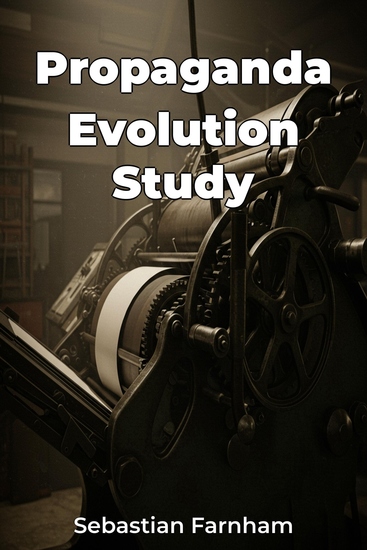
Propaganda Evolution Study - cover

Propaganda Evolution Study

Sebastian Farnham

Traducteur A AI

Maison d'édition: Publifye

  • 0
  • 0
  • 0

Synopsis

"Propaganda Evolution Study" explores the historical development of propaganda, from ancient rhetoric to its modern digital forms. It examines how propaganda's core principles of influence have remained consistent despite evolving tools and tactics. Understanding these principles is crucial for navigating today's complex information landscape.

 
The book highlights how propaganda leverages psychological principles, like cognitive biases and emotional appeals, to shape public opinion. The study traces propaganda's evolution through various media, including print, radio, television, and the internet, showing how each medium has shaped propaganda strategies. Disinformation campaigns, echo chambers, and the weaponization of social media are dissected as modern tactics.

 
The book uniquely integrates media theory with historical analysis, providing a comprehensive framework for understanding propaganda's underlying mechanisms and societal impacts. The book begins by defining propaganda and differentiating it from related concepts. It progresses through historical case studies, media analysis, and discussions of modern techniques.

 
The study concludes with strategies for countering propaganda, promoting media literacy, and fostering critical thinking. This approach equips readers with the knowledge to critically evaluate information and resist manipulation, making it valuable for students, scholars, and anyone interested in understanding the power of propaganda.
Disponible depuis: 21/02/2025.
Longueur d'impression: 68 pages.

D'autres livres qui pourraient vous intéresser

  • The Rise of the Ottoman Empire - A New Power Emerges - cover

    The Rise of the Ottoman Empire -...

    Harris Ropes

    • 0
    • 0
    • 0
    The story of the Ottoman Empire begins not with grandeur and empire-building, but with the survival and adaptation of a small Turkic tribe navigating the collapse of greater powers. In the late 13th century, the Anatolian region was a mosaic of fragmented states, weakened by internal conflict and external invasions. Among these groups were the Turks, originally Central Asian nomads, who had migrated westward in waves over centuries. Their destiny would shift dramatically with the decline of the Seljuk Sultanate of Rum and the vacuum left by the Mongol invasions, creating space for new leadership to emerge. 
    The Seljuks had once dominated much of Anatolia, but their weakening rule after the Mongol defeat at the Battle of Köse Dağ in 1243 left the region divided among various beyliks, or small principalities. One such principality was led by a chieftain named Ertuğrul, who had settled near the Byzantine frontier. Upon his death, leadership passed to his son, Osman, a bold and ambitious leader who would become the namesake of the Ottoman dynasty. Osman’s emergence marked a turning point, as his military successes and political acumen allowed him to consolidate power and expand his territory, laying the foundation for what would become the Ottoman Empire. 
    Osman I’s rise coincided with a period of instability within the Byzantine Empire, which was plagued by civil wars and weakened borders. Taking advantage of this, Osman led raids into Byzantine lands, gradually carving out a small but growing domain. More than just a warrior, Osman capitalized on the frontier spirit, attracting ghazis—Muslim warriors motivated by the idea of fighting non-Muslims. These fighters brought not only military strength but also religious legitimacy to Osman’s rule, enabling him to establish a principality that combined spiritual purpose with political ambition.
    Voir livre
  • The Great Famine of 1315-1317 - Europe's Darkest Hour - cover

    The Great Famine of 1315-1317 -...

    Sarah Willards

    • 0
    • 0
    • 0
    The Great Famine of 1315-1317 stands as one of the darkest periods in European history, marking a time of immense suffering, social upheaval, and devastation. It was not a single event but rather a prolonged crisis, which compounded existing vulnerabilities within medieval European society. The origins of the famine can be traced back to a confluence of environmental, social, and economic factors, all of which led to one of the worst food shortages ever experienced on the continent. 
    The famine’s roots can be found in the dramatic climatic changes of the early 14th century. The period known as the Little Ice Age brought cooler temperatures, and the years leading up to the famine saw unusual weather patterns. Prolonged rain, particularly during the summer months of 1315, led to flooding and crop failure, especially in regions dependent on staple grains like wheat, oats, and barley. The disastrous harvests were compounded by already strained food supplies and a growing population. 
    The impact of the famine was felt most acutely by the poorer classes, whose subsistence farming could not sustain them through such harsh conditions. The majority of the population in rural areas relied on farming for food and income, and with crops failing, their livelihoods were destroyed. Urban centers, though slightly better equipped to withstand hardship, faced sharp increases in food prices, making it difficult for even the wealthier classes to procure sustenance. Starvation, malnutrition, and poverty became widespread, leading to mass suffering across the continent.
    Voir livre
  • LIBAN State of survival - cover

    LIBAN State of survival

    Fouad Khoury-Helou

    • 0
    • 0
    • 0
    Lebanon is often described as “the most successful failed state of the 21st century”. This irony perfectly describes the reality of the country, which harbors vital forces and remarkable economic and cultural potential, but which suffers from extreme and inextricable violence. 
    This book, which reads like a thriller, traces this turbulent history since the 19th century: that of a country condemned to constant struggle, constantly buffeted by external interventions, from the Ottomans to the Iranians, via the Syrians, the Israelis, the British and the Americans, not forgetting France, which continues to play a pre-eminent role. 
    Although Lebanon, the gateway to the Middle East and hostage to international rivalries, has managed, despite everything, to survive, and, like Sisyphus, to heal its internal dissensions in order to constantly climb back up the slope, it has nevertheless been hit in recent years by a succession of unprecedented crises, with a financial and economic collapse that has brought the country to its knees, This has been compounded by a huge influx of Syrian migrants fleeing the war in their homeland, equivalent to half the Lebanese population, and topped off by a particularly destructive confrontation between Israel and Hezbollah, which has ravaged whole swathes of Lebanon. 
    What are the possible solutions for Lebanon's future? What scenarios are on the horizon? These are the answers that this book also seeks to provide.
    Voir livre
  • Hobbies - Learn about Bird Watching Genealogy Larping Metal Detecting Podcasting and Stand-up Comedy - cover

    Hobbies - Learn about Bird...

    Sophie Henner

    • 0
    • 0
    • 0
    This book contains 6 titles of different hobbies to explore: 
    Bird Watching - Bird watching, also known as birding, is a recreational activity where individuals observe and study birds in their natural habitats. It can range from casual observation in one's backyard to more serious pursuits involving travel to specific locations to see rare or interesting bird species. 
    Genealogy - Genealogy delves into the complex web of family relationships and historical contexts that shape individual and collective identities. It often begins with an inquiry into one's own family background, such as understanding the origins and branches of one’s family tree. Researchers use various resources, including birth, marriage, and death records, census data, military records, and immigration documents, to trace the lineage and connections of family members across generations. 
    Larping - Live Action Role Playing, commonly known as LARP, is a form of role-playing game where participants embody their characters physically and interact within a structured narrative. Unlike traditional tabletop role-playing games, LARP involves players dressing in costumes, using props, and engaging in live-action scenarios that unfold in real-time. 
    Metal Detecting - Metal detecting involves using a metal detector, an electronic device designed to find metal objects nearby. These devices vary in form, from handheld wands to large industrial machines. 
    Podcasting - Podcasting has revolutionized the way we consume content, offering a platform for voices from all walks of life to share their stories, expertise, and passions with a global audience. 
    Stand-up Comedy - Stand-up comedy, as a form of entertainment, has deep roots that trace back through various historical and cultural practices of humor and performance.
    Voir livre
  • The Land of Peek-a-Boo - cover

    The Land of Peek-a-Boo

    Roz Rosenbluth

    • 0
    • 0
    • 0
    Fun sound-effects and whimsical music help tell the story of “The Land Of Peek-a-Boo!” Tina loves to play Peek-a-Boo with her brother Timmy. When Tina jumps out of the closet and yells “Peek-A-Boo”, her brother is afraid.  And when Tina jumps out of the toy chest and yells “Peek-A-Boo,” Timmy tells her to STOP! Tina loves to scare Timmy and doesn't understand why he doesn't want to play this game. Find out what happens when Tina has a dream and goes to The Land of Peek-A-Boo. Will Tina understand how Timmy feels after being frightened in Peek-A-Boo Land? A positive ending adds interest to this adorable story and encourages a lifelong love for storytime.
    Voir livre
  • Treasure - cover

    Treasure

    Jemima Foxtrot

    • 0
    • 0
    • 0
    "religion's been cruel to people like usthe darkwood sluts      the good time girlsbut god as my witnesssome of us           we're just trying to wrangle our powerback from the species that took it"
    Jemima Foxtrot's Treasure is a shining work of alchemy and liberation which explores power dynamics, sex work, desire, and female friendship with a fresh and playful perspective. Foxtrot investigates shimmering sexualities, the economies of desire, the theft of childhood and pathways towards reclaiming it. Her language is lush: intimate, intricate, full of fertile earth's possibility. The poems of Treasure live up to its name: showing us where the gold is—the joy—how to feed it into the soil of our lives.
    "Treasure is an aptly chosen title for this collection, both as a noun (that quantity of precious ore dug from the stuff of experience) and as a verb (the imperative to seek out, sing, and cherish joy through the sharing of it). Foxtrot is a savvy, sometimes savage, sensualist; her poetic speakers alert to injustice, but alive to pleasure in every way that counts. These are superbly tactile poems, poems of being-in-the-body, and being-in-the-world; they are full of wit, vigour and feminist jouissance. These are also formally exciting poems, poems that showcase a beautifully bold and oddly tender lyric defiance." Fran Lock, Hyena, T.S. Eliot Prize Shortlist
    Voir livre