Rejoignez-nous pour un voyage dans le monde des livres!
Ajouter ce livre à l'électronique
Grey
Ecrivez un nouveau commentaire Default profile 50px
Grey
Abonnez-vous pour lire le livre complet ou lisez les premières pages gratuitement!
All characters reduced
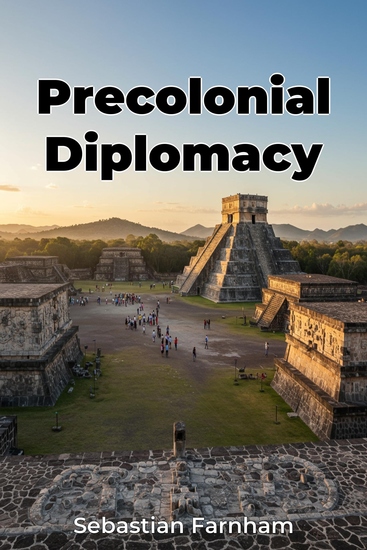
Precolonial Diplomacy - cover

Precolonial Diplomacy

Sebastian Farnham

Traducteur A AI

Maison d'édition: Publifye

  • 0
  • 0
  • 0

Synopsis

Precolonial Diplomacy explores the sophisticated political systems of Indigenous nations in the Americas before European contact. Challenging Eurocentric views, the book reveals intricate methods of alliance-building, from kinship-based pacts to formal treaties, and diverse mechanisms for conflict resolution, such as mediation and ritualized warfare. Understanding these pre-Columbian civilizations provides a more accurate depiction of history, highlighting their capacity for governance. The book argues that Indigenous nations possessed adaptable and resilient political systems rooted in a deep understanding of human relationships. For instance, precolonial diplomacy involved complex negotiations and strategies that maintained peace and order across vast territories. Precolonial Diplomacy progresses by first introducing core concepts and terminology, then delving into case studies of specific Indigenous nations in North, Central, and South America, and concludes with a comparative analysis and a discussion of the legacy of precolonial diplomacy.
Disponible depuis: 29/03/2025.
Longueur d'impression: 62 pages.

D'autres livres qui pourraient vous intéresser

  • Futanari Experiments: Complete (futa on futa futa on female) - cover

    Futanari Experiments: Complete...

    Adrian Adams

    • 1
    • 2
    • 0
    When Brie receives a large, attachable "finger" that enhances sensation, the first thing she does is stick it on her clit. It works as planned and she proceeds to use it and abuse it, losing track of time in the process. Her best friend and co-worker, Erica, visits to investigate why Brie missed work, and Brie shares her new toy with her, allowing Erica to experience penetration as the giver for the first time. 
    The time finally comes to return the "finger," but Brie ends up trading it for a little red pill that creates a sizeable growth between her legs. This thing is the real deal, and Brie knows exactly who she wants to try it with. 
    When Erica begins having trouble keeping her food down, Brie starts to suspect something's up. While she first fears her lover's gotten herself knocked up by someone else, she soon realizes the most likely culprit is actually... herself. 
    Their use of the magical pill will determine the direction of not only their relationship, but their lives. 
    This book contains explicit sex, including use of toys, futa on female, and futa on futa.
    Voir livre
  • Big Mall - Shopping for Meaning - cover

    Big Mall - Shopping for Meaning

    Kate Black

    • 0
    • 0
    • 0
    A phenomenology of the mall: If the mall makes us feel bad, why do we keep going back? In a world poisoned by capitalism, is shopping what makes life worth living?
    		 
    In less than a century, the shopping mall has morphed from a blueprint for a socialist utopia to something else entirely: a home to disaffected mallrats and depressed zoo animals, a sensory overload and consumerist trap.
    		 
    Kate Black grew up in North America’s largest mall: West Edmonton Mall — a mall on steroids. It’s the site of a notoriously lethal rave for teenagers, a fatal rollercoaster accident, and more than one gun-range suicide; it’s where oil field workers reap the social mobility of a boom-and-bust economy, the impossibly large structure where teens attempt to invent themselves in dark Hollister sales racks and weird horny escapades in the indoor waterpark. It’s a place people love to hate and hate to love — a site of pleasure and pain, of death and violence, of (sub)urban legend.
    		 
    Can malls tell us something important about who we are? Blending a history of shopping with a story of coming-of-age in North America’s largest and strangest mall, Big Mall nvestigates how these structures have become the ultimate symbol of late-capitalist dread — and, surprisingly, a subversive site of hope. Ultimately, a close look at the mall reveals clues to how a good life in these times is possible.
    		 
    “Speaking as a child of PacSun and Hot Topic myself, Big Mall is like a madeleine dipped in Orange Julius. Like a mall, the book itself has a lot of everything, a sublime mix of memoir, history, and cultural criticism. Kate Black is a learned Virgil in the consumerist Inferno, always avoiding the obvious and leading us to surprising connections — oil, suicide, Reddit, squatters, dolphins. Whether malls fill you with nostalgia or horror, this book will change your relationship to the world we've constructed around us.” — Tony Tulathimutte, author of Private Citizens
    		 
    “Before there was Instagram, there was the mall. But what happens when a seasonless, tacky, fantasyland is all you knew growing up? How does one embrace a genuinely fake experience? Or to be more precise, a fake but genuine experience? Kate Black’s Big Mall is a smart, sentimental, and perspective-shifting look at the outsized role that big malls play in modern life. Love ’em or hate ’em, one thing’s for sure: after reading this book, you’ll never look at a mall in the same way again.” — Ziya Tong, Science broadcaster & author of The Reality Bubble
    Voir livre
  • Running from Bondage - Enslaved Women and their Remarkable Fight for Freedom in Revolutionary America - cover

    Running from Bondage - Enslaved...

    Karen Cook Bell

    • 0
    • 0
    • 0
    Running from Bondage tells the compelling stories of enslaved women, who comprised one-third of all runaways, and the ways in which they fled or attempted to flee bondage during and after the Revolutionary War. Karen Cook Bell's enlightening and original contribution to the study of slave resistance in eighteenth-century America explores the individual and collective lives of these women and girls of diverse circumstances, while also providing details about what led them to escape. She demonstrates that there were in fact two wars being waged during the Revolutionary Era: a political revolution for independence from Great Britain and a social revolution for emancipation and equality in which Black women played an active role. Running from Bondage broadens and complicates how we study and teach this momentous event, one that emphasizes the chances taken by these 'Black founding mothers' and the important contributions they made to the cause of liberty.
    Voir livre
  • Beyond Guilt Trips - Mindful Travel in an Unequal World - cover

    Beyond Guilt Trips - Mindful...

    Anu Taranath

    • 0
    • 0
    • 0
    Every year, hundreds of thousands of young people pack their bags to study or volunteer abroad. Well-intentioned and curious Westerners—brought up to believe that international travel broadens our horizons—travel to low-income countries to learn about people and cultures different from their own. While travel abroad can provide much-needed perspective, it can also be deeply unsettling, confusing, and discomforting. Travelers can find themselves unsure about how to think or speak about the differences in race or culture they find, even though these differences might have fueled their desire to travel in the first place. 


    In Beyond Guilt Trips: Mindful Travel in an Unequal World, storyteller Anu Taranath begins at home, unpacking our baggage about who we are, where we come from, and how much we have. She takes us on a journey through engaging personal travel stories and thought-provoking questions, providing us with tools to grapple with our discomfort and navigate differences with accountability and connection. Yes, travel! But be mindful. Be present.
    Voir livre
  • Sunan an Nasai English Audio - cover

    Sunan an Nasai English Audio

    Imam An-Nasa'i,...

    • 0
    • 0
    • 0
    Sunan an-Nasa'i is a collection of hadith compiled by Imam Ahmad an-Nasa'i (rahimahullah). His collection is unanimously considered to be one of the six canonical collections of hadith (Kutub as-Sittah) of the Sunnah of the Prophet Muhammad (ﷺ). It contains roughly 5700 hadith (with repetitions) in 52 books.
    Voir livre
  • U-Boats in the Atlantic: The History of Germany’s Submarines during World War I and World War II - cover

    U-Boats in the Atlantic: The...

    Editors Charles River

    • 0
    • 0
    • 0
    World War I witnessed the First Battle of the Atlantic, when the Kaiserreich unleashed its U-boats against England. During the war, the German submarines sent much of the British merchant marine to the bottom. Indeed, German reliance on U-boats in both World War I and World War II stemmed largely from their nation's geography. The Germans eventually recognized the superiority of the Royal Navy and its capacity to blockade Germany's short coastline in the event of war. While the British could easily interdict surface ships, submarines slipped from their Kiel or Hamburg anchorages unseen, able to prey upon England's merchant shipping. 
    The sleek hunter-killers lurking beneath the waves, using periscopes to close in unnoticed on their prey, added a new, nerve-wracking element to naval warfare. The mere threat of submarine attack immediately altered naval tactics and strategies employed by both the Western Allies and the Central Powers, shifting them towards a more cautious approach, especially at the war’s start when the submarine threat remained untested. 
    One critical innovation in World War II's Atlantic U-boat operations consisted of wolf-pack tactics, in which Admiral Karl Dönitz put great faith: “The greater the number of U-boats that could be brought simultaneously into the attack, the more favourable would become the opportunities offered to each individual attacker. […] it was obvious that, on strategic and general tactical grounds, attacks on convoys must be carried out by a number of U-boats acting in unison.” (Dönitz, 1990, 4). 
    However, even the wolf-pack proved insufficient to defeat the Atlantic convoys and stop Allied commerce – the precise opposite of the Pacific theater, where America's excellent submarine forces annihilated much of Japan's merchant marine and inflicted severe damage on the Imperial Japanese Navy.
    Voir livre