Begleiten Sie uns auf eine literarische Weltreise!
Buch zum Bücherregal hinzufügen
Grey
Einen neuen Kommentar schreiben Default profile 50px
Grey
Jetzt das ganze Buch im Abo oder die ersten Seiten gratis lesen!
All characters reduced
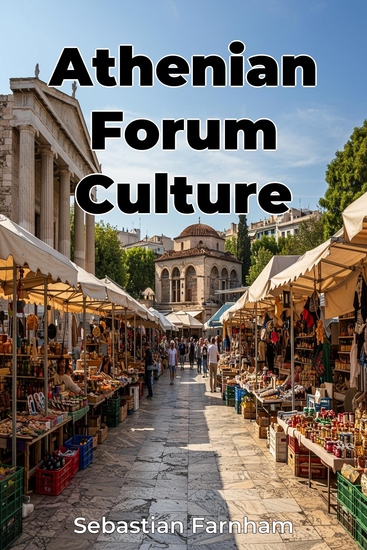
Athenian Forum Culture - cover

Athenian Forum Culture

Sebastian Farnham

Übersetzer A AI

Verlag: Publifye

  • 0
  • 0
  • 0

Beschreibung

Athenian Forum Culture explores the Athenian agora as more than just a marketplace; it was the epicenter of civic life, where democracy, rhetoric, and education intertwined. This environment fostered democratic participation and shaped civic identity, concepts still relevant today. The book argues the agora was a carefully cultivated space, offering rhetorical training and informal education accessible to many citizens. Intriguingly, the agora wasn't just for commerce; it was a place where citizens honed their debating skills and engaged in the administration of justice. The book's unique value lies in its holistic approach, examining the interplay between democratic practices, rhetorical training, and informal education. Drawing from archaeological findings and classical texts, it paints a detailed picture of the agora's civic communication dynamics. For example, citizens learned about history and philosophy through casual conversations and participation in public life. The book progresses by first establishing the historical context, then analyzing democratic practices, rhetorical training, and the agora's informal educational environment.
Verfügbar seit: 05.05.2025.
Drucklänge: 75 Seiten.

Weitere Bücher, die Sie mögen werden

  • Giver by Lois Lowry The (Book Analysis) - Detailed Summary Analysis and Reading Guide - cover

    Giver by Lois Lowry The (Book...

    Bright Summaries

    • 0
    • 0
    • 0
    Unlock the more straightforward side of The Giver with this concise and insightful summary and analysis!
    This engaging summary presents an analysis of The Giver by Lois Lowry, which follows a young boy in a futuristic society who is called on to become his community's "Receiver of Memory". As he shoulders the burden of his society's collective memory, he soon realises that the apparently idyllic world he lives in is based on a shocking lie. As he uncovers the truth about the world around him, the reader is encouraged to reflect on profound themes such as individuality and conformism, euthanasia and the role of language in totalitarian societies. The Giver is the first novel in Lowry's The Giver Quartet, and won the prestigious Newbery Medal for children's literature in 1994. It was adapted into a film starring Jeff Bridges and Meryl Streep in 2014.
    Find out everything you need to know about The Giver in a fraction of the time!
    
    This in-depth and informative reading guide brings you:
    •A complete plot summary
    •Character studies
    •Key themes and symbols
    •Questions for further reflection
    Why choose BrightSummaries.com?
    Available in print and digital format, our publications are designed to accompany you on your reading journey. The clear and concise style makes for easy understanding, providing the perfect opportunity to improve your literary knowledge in no time.
    See the very best of literature in a whole new light with BrightSummaries.com!
    Zum Buch
  • Science and Health - Knowledge and Medicine in Ancient Rome (3 in 1) - cover

    Science and Health - Knowledge...

    Rogan Fish

    • 0
    • 0
    • 0
    Science and Health: Knowledge and Medicine in Ancient Rome (3 in 1) explores the intellectual and spiritual forces that shaped Roman civilization, from its groundbreaking scientific ideas to its religious beliefs and the formidable enemies it battled across centuries. 
    In Roman Medicine and Science, uncover the practical and philosophical roots of Roman knowledge—how doctors, engineers, and scholars applied Greek theory, astrology, and firsthand experience to treat the sick, build aqueducts, and study the stars. Roman Religion and Mythology dives into the gods, rituals, and sacred practices that infused daily life with divine meaning and political power. From Jupiter to household spirits, religion in Rome was deeply entwined with science, healing, and war. The Roman Empire and Their Enemies offers a dynamic look at Rome’s greatest rivals—Persians, Carthaginians, Germanic tribes, and more—examining how these conflicts influenced Rome’s scientific developments, medical needs, and mythic self-image. 
    Together, these three books reveal how Romans understood the world—through logic and legend, reason and ritual. Ideal for readers fascinated by ancient science, belief systems, and military history, this volume reveals how Rome's view of knowledge shaped its rise—and echoed through its fall.
    Zum Buch
  • Montesquieu & the Despotic Ideas of Europe - An Interpretation of The Spirit of the Laws - cover

    Montesquieu & the Despotic Ideas...

    Vickie B. Sullivan

    • 0
    • 0
    • 0
    Montesquieu is rightly famous as a tireless critic of despotism, which he associates in his writings overtly with Asia and the Middle East and not with the apparently more moderate Western models of governance found throughout Europe. However, a careful reading of Montesquieu reveals that he recognizes a susceptibility to despotic practices in the West—and that the threat emanates not from the East, but from certain despotic ideas that inform such Western institutions as the French monarchy and the Roman Catholic Church.             Nowhere is Montesquieu’s critique of the despotic ideas of Europe more powerful than in his enormously influential The Spirit of the Laws, and Vickie B. Sullivan guides readers through Montesquieu’s sometimes veiled, yet sharply critical accounts of Machiavelli, Hobbes, Aristotle, and Plato, as well as various Christian thinkers. He finds deleterious consequences, for example, in brutal Machiavellianism, in Hobbes’s justifications for the rule of one, in Plato’s reasoning that denied slaves the right of natural defense, and in the Christian teachings that equated heresy with treason and informed the Inquisition. In this new reading of Montesquieu’s masterwork, Sullivan corrects the misconception that it offers simple, objective observations, showing it instead to be a powerful critique of European politics that would become remarkably and regrettably prescient after Montesquieu’s death when despotism wound its way through Europe.  
    Zum Buch
  • Kargil - From Surprise To Victory - cover

    Kargil - From Surprise To Victory

    V.P. Malik

    • 0
    • 0
    • 0
    In February 1999, Pakistani Army personnel, disguised as jihadi militants, infiltrated into mountainous Kargil and occupied key vantage points. Their intrusion triggered a limited war between the world's newest nuclear states. It was a bitter battle, and one that threw up important lessons for India's defence preparedness, as also its responses to conflicts such as this. This incisive book by General V.P. Malik, former Chief of the Army Staff, analyses the reasoning behind the Pakistani Army's moves and tactics and reviews crucial issues such as the extent of intelligence and surveillance failure on the Indian side and the measures necessary to redress these failings. Away from questions of strategy and tactics, however, Kargil is also a reminder of the unalloyed heroism that was on display during those grim weeks, heroism that become a benchmark for valour.
    Zum Buch
  • Kingdom of Kongo - Christianity Trade and the Kingdom That Resisted Colonization - cover

    Kingdom of Kongo - Christianity...

    Rolf Hedger

    • 0
    • 0
    • 0
    The Kingdom of Kongo emerged as one of the most powerful and centralized states in Central Africa. Its origins can be traced back to the early Bantu migrations, which spread agriculture, ironworking, and complex social structures across the region. By the 14th century, various smaller chiefdoms in present-day Angola and the Democratic Republic of Congo began to coalesce under a single authority, forming what would become the Kingdom of Kongo. 
    The region’s fertile lands and access to major rivers facilitated both agriculture and trade. Kongo’s early economy relied on the cultivation of crops such as millet, sorghum, and bananas, as well as the production of iron tools and weapons. The abundance of natural resources allowed the ruling elite to accumulate wealth and expand their influence. As trade networks developed, Kongo became a center of commerce, linking the interior regions of Central Africa with coastal markets. 
    Kongo's social and political organization was highly structured. At the top of the hierarchy was the king, known as the Manikongo, who ruled from the capital, Mbanza Kongo. The Manikongo exercised authority over provincial rulers, who governed different regions of the kingdom. This system allowed for centralized administration while also granting local leaders autonomy in managing their territories. The kingdom was further divided into districts and villages, with a bureaucratic structure that ensured tax collection, military organization, and judicial functions.
    Zum Buch
  • The Shortest History of Italy - 3000 Years from the Romans to the Renaissance to a Modern Republic―A Retelling for Our Times - cover

    The Shortest History of Italy -...

    Ross King

    • 0
    • 0
    • 0
    A concise, star-studded retelling of Italy's past, from Caesar and Augustus to da Vinci and Michelangelo, tracing the story of a country with prodigious global influence—from a foremost author of historic Italy. 


    The calendar. The Senate. The university. The piano, the heliocentric model, and the pizzeria. It's hard to imagine a world without Italian influence—and easy to assume that inventions like these could only come from a strong, stable peninsula, sure of its place in the world. In this breakneck history, bestselling author Ross King dismantles this assumption, uncovering the story of a land rife with inner uncertainty even as its influence spread. 


    As the Italian tale unfolds, prosperity and power fluctuate like the elevation in the Dolomites. If Rome's seven hills could talk, they might speak of the glorious time of Trajan—or bemoan the era of conquest and the Bubonic Plague that decimated Rome's population. Episodes of wealth like the First Triumvirate and the time of the Medicis are given fresh life alongside descriptions the Middle Ages, the early days of Venice, the invasion of Napoleon, and the long struggle for unification. King paints a colorful, fascinating portrait of a country that remains compelling not just to tens of millions of Italian Americans, but to the millions of Americans who visit Italy every year.
    Zum Buch