Begleiten Sie uns auf eine literarische Weltreise!
Buch zum Bücherregal hinzufügen
Grey
Einen neuen Kommentar schreiben Default profile 50px
Grey
Jetzt das ganze Buch im Abo oder die ersten Seiten gratis lesen!
All characters reduced
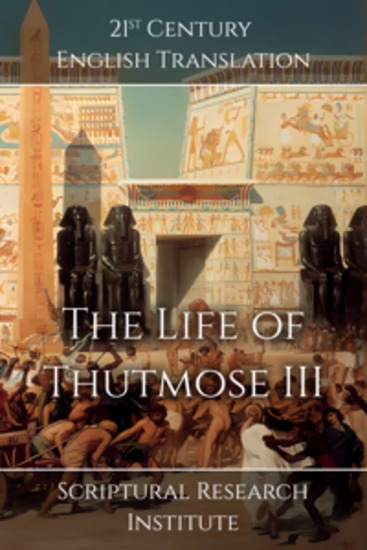
The Life of Thutmose III - cover

The Life of Thutmose III

Scriptural Research Institute

Verlag: Digital Ink Productions

  • 0
  • 0
  • 0

Beschreibung

Thutmose III was the king of Egypt between circa 1491 and 1459 BC, after inheriting the throne from his father Thutmose II and his aunt Hatshepsut, however, after Hatshepsut died Thutmose III claimed to have been the king of Egypt throughout Hatshepsut’s reign, meaning his regal years began circa 1513 BC when his father Thutmose II died. This attempt to erase Hatshepsut as a king of Egypt was likely not personal, as he did not attempt to usurp her authority during his life, but more likely an attempt to restore the respect for the kingship that appears to have been lost while Hatshepsut was on the throne. The graffiti of Hatshepsut having sex with a man found near her mortuary temple clearly shows that she was not respected the way the previous god-like pharaohs had been, and Thutmose III was almost certainly trying to erase what many Egyptians viewed as a distasteful episode of their history. Ironically, her mortuary temple is viewed as one of the greatest architectural monuments of the New Kingdom and served as the basis of all later mortuary temples of the New Kingdom. Thutmose III did not attempt to erase Hatshepsut’s existence from Egyptian history, just her kingship, and she was still spoken of fondly as the ‘queen’ and ‘favorite wife of Karnak and is spoken Thutmose II.’It is accepted that he was only 2 years old when his father died and he became king in 1513 BC, although Hatshepsut held power as king until she died in 1491 BC. The two-year-old Thutmose III’s reign was established by Queen Hatshepsut over the objections of other claimants, as, she claimed that her husband Thutmose II had wanted Thutmose III to become king. Her reasons are not clear, and it is debated whether she was simply trying to seize power for herself and using her two-year-old nephew and stepson as a pawn, or following the legitimate wishes of her husband. Even her gender identity seems to have been in question, as there is evidence that she took her sister Iset, Thutmose III’s mother, as her great royal wife and queen. This may have also been to protect Thutmose III, as Iset could claim the co-regency if something happened to her, however, she does appear to have lived as a man, treating Thutmose III as her own son. Whether this behavior was an affectation due to the male-dominated culture they lived in, or a genuine male identity may never be known, however, she is claimed as a hero to feminists and transgender people today.
Verfügbar seit: 14.02.2025.
Drucklänge: 44 Seiten.


Weitere Bücher, die Sie mögen werden

  • The Fifth History of Man - cover

    The Fifth History of Man

    MD John Bershof

    • 0
    • 0
    • 0
    In the spirit of medieval writer Chaucer, all human activity lies within the artist’s scope, the History of Man Series uses medicine as a jumping off point to explore precisely that, all history, all science, all human activity since the beginning of time. The jumping off style of writing takes the reader, the listener into worlds unknown, always returning to base, only to jump off again. History of Man are stories and tales of nearly everything. 
    The Fifth History of Man has a few parting shots at viruses but mostly continues with the world of parasites, from tick disease that tick us off, Old Lyme, Connecticut and Lyme disease, toxoplasmosis, Crazy Cat Lady and her clowder of cats, then on into a discussion of the avatar of parasites: malaria. Our travels will venture down into the valley: Valley Girls, Valspeak, Valley Fever, fungus and fungal infections. We’ll jump into the biology of evolution, Darwin, Huxley and the great debates, the geology of earthquakes, volcanos, the Ring of Fire, and Johnny Cash, and then through the homos: Homo habilis, Homo erectus, and Homo sapiens, and once the dust cleared how the opposable thumbs, walking erect, and bigger brains left one man standing, one woman, too. No discussion of human history can leave out the G.O.A.T. of French history, heck, of European history; the man, the legend, Napoleon Bonaparte, loved and admired by everyone, even his enemies. Our path will take us into war & military, World War I versus the 1918 Swine Flu, some Russian history and how Stalin got Lenin wrong.
    Zum Buch
  • The Cultural Politics of Affect and Emotion - A Case Study of Chinese Reality TV - cover

    The Cultural Politics of Affect...

    Wei Dong

    • 0
    • 0
    • 0
    Against the background of the media commercialization reform since the 1990s in China and drawing on the case of »X-Change« (2006-2019), Wei Dong investigates the affective meaning-making mechanism in the multimodal text of Chinese reality TV. The focus lies on the ways in which emotions are appropriated and disciplined by regimes of power and identity, and the ways in which affect - in this case primarily kuqing (bitter emotions) communicated by the material and the body - have the potential to challenge or exceed existing relations of power in the mediascape. Wei Dong shows how Chinese reality TV provides a historical and theoretical opportunity for understanding the affective structures of contemporary China in the dynamic process of fracture and integration.
    Zum Buch
  • A Rare Recording of President Franklin D Roosevelt’s December 29 1940 Fireside Chat - cover

    A Rare Recording of President...

    President Franklin D. Roosevelt

    • 0
    • 0
    • 0
    Franklin Delano Roosevelt (January 30, 1882 to April 12, 1945), also known as FDR, was the 32nd president of the United States, serving from 1933 until his death in 1945. The longest-serving U.S. president, he is the only president to have served more than two terms. His initial two terms were centered on combating the Great Depression, while his third and fourth saw him shift his focus to America's involvement in World War II. The following recording is of a December 29, 1940 fireside chat FDR gave discussing national security.
    Zum Buch
  • The Seven Deadly Stupidities - Using Other People’s Failures to Make Better Decisions - cover

    The Seven Deadly Stupidities -...

    George Pillari, Guy Kawasaki

    • 0
    • 0
    • 0
    “It’s good to learn from your mistakes. It’s better to learn from other people’s mistakes.” ~Warren Buffet 
    Crisis manager George Pillari takes the reader through a series of real-life case studies to show us that decision making in tense situations is a skill to be learned and perfected. Different from most business books that talk about recipes for success (improve your habits, be more productive, etc.), Stupidities highlights what you need to avoid in order to be successful. 
    In his foreword to the book, Guy Kawasaki sums it up: 
    “80% of success is avoiding stupidity.” 
    We learn from the success and failures of Elon Musk, Peter Thiel, Oprah Winfrey, Elizabeth Holmes, Google X, JP Morgan, the New York Yankees, the Titan Sub, Thomas Edison, Taylor Swift, and others. 
    The Seven Deadly Stupidities: 
    Going for the Moonshot 
    Surrendering to FOMO 
    Relying on Family and Friends 
    Being Blinded by the Upside 
    Trusting the Media 
    Using Quick and Dirty Thinking 
    Neglecting to Measure Twice 
    There is the amazing story of Soviet General Petrov, who avoided all seven of the stupidities and prevented a global thermonuclear war. 
    The chapter-by-chapter format lets the reader thumb through and pick the order to read the book. The summary of each stupidity includes lessons learned and advice on how to avoid the stupidity and “be smarter.” 
    We are twice as likely to respond to negative events than positive ones. Pillari uses this behavioral sciences insight to guide the reader through how to learn from the failures of others and become a better decision-maker.
    Zum Buch
  • Meditations - cover

    Meditations

    Marcus Aurelius

    • 0
    • 0
    • 0
    Step into the private thoughts of one of history’s greatest leaders. Meditations by Marcus Aurelius offers timeless guidance on self-discipline, purpose, and inner peace — the quiet strength of a philosopher who ruled an empire. Written not for an audience, but for himself, these reflections reveal the Stoic path to clarity amidst chaos, reminding us that the truest victory lies in mastering one’s own mind. 
    Through vivid narration by Gary Middleton, this classic text comes alive as both an intimate confession and a practical handbook for modern life. Whether facing personal hardship or seeking calm in a turbulent world, Meditations invites you to pause, reflect, and rediscover virtue as the ultimate freedom.
    Zum Buch
  • On Collective Memory - cover

    On Collective Memory

    Maurice Halbwachs

    • 0
    • 0
    • 0
    How do we use our mental images of the present to reconstruct our past? Maurice Halbwachs (1877-1945) addressed this question for the first time in his work on collective memory, which established him as a major figure in the history of sociology. This volume, the first comprehensive English-language translation of Halbwach’s writings on the social construction of memory, fills a major gap in the literature on the sociology of knowledge. 
    Halbwachs’ primary thesis is that human memory can only function within a collective context. Collective memory, Halbwachs asserts, is always selective; various groups of people have different collective memories, which in turn give rise to different modes of behavior. Halbwachs shows, for example, how pilgrims to the Holy Land over the centuries evoked very different images of the events of Jesus’ life; how wealthy old families in France have a memory of the past that diverges sharply from that of the nouveaux riches; and how working class construction of reality differ from those of their middle-class counterparts. 
     
    With a detailed introduction by Lewis A. Coser, this translation will be an indispensable source for new research in historical sociology and cultural memory.
    Zum Buch