Rejoignez-nous pour un voyage dans le monde des livres!
Ajouter ce livre à l'électronique
Grey
Ecrivez un nouveau commentaire Default profile 50px
Grey
Abonnez-vous pour lire le livre complet ou lisez les premières pages gratuitement!
All characters reduced
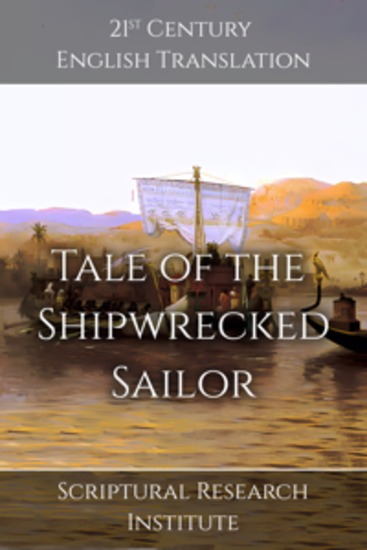
Tale of the Shipwrecked Sailor - cover

Tale of the Shipwrecked Sailor

Scriptural Research Institute

Maison d'édition: Digital Ink Productions

  • 0
  • 0
  • 0

Synopsis

The Tale of the Shipwrecked Sailor is the earliest known surviving story of a shipwrecked sailor, and as such is the forerunner of many stories of nautical adventure encountering strange magical creatures, from Homer's Odyssey to Sinbad the Sailor. In a broader sense, it is generally considered the oldest piece of Egyptian fiction to survive to the present. Only one copy has been found to date, a single papyrus manuscript which resides as the Hermitage Museum in St. Petersburg, Russia, and is designated pHermitage 1115. The exact origin of the papyrus was not properly documented at the time, which was common of early Egyptologists, however, it was most likely recovered in Vladimir Golenishchev's 1884-85 expedition to the Wadi Hammamat, which was the major trade route between the Nile in southern Egypt and the port of El Qoseir on the Red Sea.The papyrus does appear to be complete, however, the story is not. It begins abruptly, and ends abruptly, and suggests that it was excised from an older text. The story begins as a ship's captain is returning home from Nubia, on a failed mission of some kind, and then segues to the narrator telling the disinterested captain of a time when was shipwrecked on an island near Punt. It ends as abruptly as it begins, but the scribe confirms that this is the end of the story. Based on the content, it appears that the point of the papyrus was to copy the section of text dealing with the island and the 'Lord of Punt,' which was copied from a longer text in which the captain returned from his failed mission in Nubia, and told the king a story his crewman had told him to make up for the fact that he had nothing to report, but also downplayed the fantastic story by making it clear that it was his boring crewman's story, and not his.The reason for the extraction of the story, was probably because at the time, in the early Middle Kingdom era, the Egyptians were re-exploring their world, and trying to find the lands their ancestors had been trading with. This short work of probable fiction was, nevertheless, about the fabled land of Punt, which the Middle Kingdom reopened trade with in the 11th dynasty. Under the 11th dynasty's Mentuhotep III, an officer named Hannu reopened trade with Punt, however, it is unknown if he personally sailed there or simply organized the expedition. The most probable time for Imenyas pen-Imeny to have excised the story was before that first mission of Hannu, when the Egyptians were scouring their records for information on Punt. The fact that it was abandoned in the Wadi Hammamat, the route taken from the capital at Thebes to the Red Sea port of El Qoseir, seems to be a pretty strong indicator that the navigator did not see any value in the text, and did not even bother carrying it all the way to the harbor.
Disponible depuis: 14/01/2025.
Longueur d'impression: 34 pages.

D'autres livres qui pourraient vous intéresser

  • The Wonderful Wizard of Oz - cover

    The Wonderful Wizard of Oz

    Lyman Frank Baum

    • 0
    • 0
    • 0
    he Wonderful Wizard of Oz is an American children's novel written by author L. Frank Baum and illustrated by W. W. Denslow. The first novel in the Oz books, the Kansas farm girl named Dorothy ends up in the magical Land of Oz after she and her pet dog Toto are swept away from their home by a tornado. Upon her arrival in Oz, she learns she cannot return home until she has destroyed the Wicked Witch of the West.    The book was first published in the United States in May 1900 by the George M. Hill Company. In January 1901, the publishing company completed printing the first edition, a total of 10,000 copies, which quickly sold out. It had sold three million copies by the time it entered the public domain in 1956. It was often reprinted under the title The Wizard of Oz, which is the title of the successful 1902 Broadway musical adaptation as well as the classic 1939 live-action film.    The ground-breaking success of both the original 1900 novel and the 1902 Broadway musical prompted Baum to write thirteen additional Oz books which serve as official sequels to the first story. Over a century later, the book is one of the best-known stories in American literature, and the Library of Congress has declared the work to be "America's greatest and best-loved homegrown fairytale."
    Voir livre
  • I am a God : Reclaiming Your Inner Divinity and Beyond Masks and Limitations Awakening the God Within - Discover the God Within: Awaken Your True Potential and Transform Your Life - cover

    I am a God : Reclaiming Your...

    Beshoy Mahrous

    • 0
    • 0
    • 0
    This audiobook is narrated by an AI Voice.   
    Embark on a transformative journey of self-discovery and empowerment with "I Am a God." This groundbreaking book transcends conventional wisdom, inviting you to reclaim your inner divinity and awaken your true potential. Unveil the masks and limitations that have hindered your growth, and embrace the authentic essence of your being. 
    🌌 Dive Into the Depths of Your Soul: "I Am a God" delves into the profound concepts of divinity, exploring creation myths, defining the nature of God, and unraveling the mysteries of existence. Through introspective chapters like "Where is God?" and "Who is God?" you'll embark on a soul-stirring quest to unravel the essence of divine consciousness. 
    🌟 Explore the Uniqueness of Your Journey: This book is not just about abstract theories—it's about your personal journey to self-realization. Each chapter guides you through a transformative process, empowering you to awaken the god within and manifest your divine potential. From "Do I Am a God?" to "Manifesting the Divine," you'll embark on a journey of self-discovery unlike any other. 
    🔍 Navigate Through the Complexities: As you navigate through the challenges of life, "I Am a God" serves as your trusted companion, offering wisdom and guidance every step of the way. From navigating romantic relationships in "In the Image of God" to demystifying life's detours in "Demystifying the Detours," this book empowers you to overcome obstacles and embrace your true power. 
    🌈 Embrace Your Authenticity: "I Am a God" celebrates your authenticity, encouraging you to embrace every aspect of yourself. Through chapters like "Unfurling the God Within" and "Embracing the Wabi-Sabi," you'll learn to love and accept yourself unconditionally, transcending societal expectations and embracing your unique journey.
    Voir livre
  • Freedom of Choice is Not Freedom - cover

    Freedom of Choice is Not Freedom

    Jiddu Krishnamurti

    • 0
    • 0
    • 0
    Freedom of choice is not freedom - 11 November 1968 
    • What do we mean by free will? Is there such thing? 
    • Is choice ever necessary? 
    • Freedom exists only when I perceive very clearly, when the mind sees things as they are. 
    • Q: Is it possible to be free in society? 
    • Q: Is love the absence of hate? 
    • To find out what truth is you must be free of propaganda: the propaganda of 
    the Church, the propaganda of literature, propaganda of tradition, so that you see things clearly for yourself.
    Voir livre
  • Traced - Human DNA's Big Surprise - cover

    Traced - Human DNA's Big Surprise

    Nathaniel Jeanson

    • 0
    • 0
    • 0
    "Dr. Nathaniel Jeanson has found the Rosetta Stone of human history." — Ken Ham, CEO and founder of Answers in Genesis, the highly acclaimed Creation Museum, and the world-renowned Ark Encounter 
     
    What happened to the ancient Egyptians? The Persians? 
     
    Nathaniel T. Jeanson, a Harvard graduate with a Ph.D. in cell and developmental biology, has discovered a DNA-based family tree for global humanity that uncovers surprising links between us and the peoples of old—links that rewrite race, ethnicity, and human history. Traced: Human DNA’s Big Surprise takes you on a journey through these findings that will never let you see human history the same way again!
    Voir livre
  • Change the Story Save the World - Efficiency Is the Name of the Game - cover

    Change the Story Save the World...

    Moritz Davidesko

    • 0
    • 0
    • 0
    A WORLD SHAPED BY STORIES: HOW THE HUMAN NARRATIVE HAS ALTERED THE COURSE OF HISTORY.The global story is one that is 7.6 billion authors strong. It is rich and complex, and as of today, it is also perilously close to bringing about the destruction of our planet. So the question is, WHY do we continue to live in a bad story?In his latest work, Change the Story, Save the World, Moritz Davidesko– a USA Today best-selling author – presents a compelling analysis of human storytelling and explores how that behavior has informed our present understanding of the world. In chronicling our species’ collective powers of narration, Davidesko ushers us from the distant past, to the present state of global affairs– the story of our world as we know it! Keep reading to:Discover how storytelling has evolved as mechanism of evolutionary and social survivalAnalyze historical events that have led us to adopt certain varieties of storytelling while discarding othersUnderstand the distinction between local and global stories and the effect this has on our civil organizationsUnderstand the direction of the current Homo Sapiens narrative and the implications it has for our futureExplore the major ecological and humanitarian crises we presently faceHighlight the notable achievements of some of the leaders driving positive changes in our world todayDiscuss the future of our planet and the drastic changes we must implement to protect itWe can save the world. We can stop the destruction of our planet. We can rewrite the course of human history…but it all starts with you. Become an author of the NEXT generation of human history! Get your copy of Change the Story, Save the World today!
    Voir livre
  • Language and Writing in Ancient Mesopotamia: The History and Legacy of the Languages and Scripts Used across the Region in Antiquity - cover

    Language and Writing in Ancient...

    Editors Charles River

    • 0
    • 0
    • 0
    Along with Egypt, the cultural and geographic region known as Mesopotamia was home to some of the world’s earliest civilizations and also the first known form of writing, cuneiform. Many different ethnic groups vied for power in ancient Mesopotamia over the course of antiquity, spanning about 3,000 years, and many of them spoke different languages. Despite these differences, the people in Mesopotamia shared many cultural attributes, including similar religious practices, a common art and architecture style, and a shared use of the cuneiform script.  
    	As this suggests, language and writing were different but also interconnected. The languages spoken by the peoples of Mesopotamia were as diverse as the many ethnic groups, but as those groups asserted their military, economic, and cultural power over the other groups, two languages became dominant in the region: Sumerian and Akkadian. These were the two languages that were primarily used by the people of Mesopotamia to record their myths, religious rituals, government records, and historiographical accounts.  
    	Indeed, the languages and written scripts of Mesopotamia were not just enduring over time in the region, but they also had wide geographic influence, much more than any language groups or scripts at the time. The Sumerian language continued to be learned by scribes throughout Mesopotamia centuries after it had become a “dead language,” and the Akkadian language eventually became the lingua franca of the Near East by the Late Bronze Age. Akkadian became the language of diplomacy and trade, while cuneiform was used to record agreements in Akkadian between the "Great Powers” of the era. Cuneiform was also adopted by people outside of Mesopotamia, such as the Hittites and Elamites, who modified the script to fit the lexicons and rules of grammar for their own languages.
    Voir livre