Join us on a literary world trip!
Add this book to bookshelf
Grey
Write a new comment Default profile 50px
Grey
Subscribe to read the full book or read the first pages for free!
All characters reduced
Stele of Kars the Herald - cover

Stele of Kars the Herald

Scriptural Research Institute

Publisher: Digital Ink Productions

  • 0
  • 0
  • 0

Summary

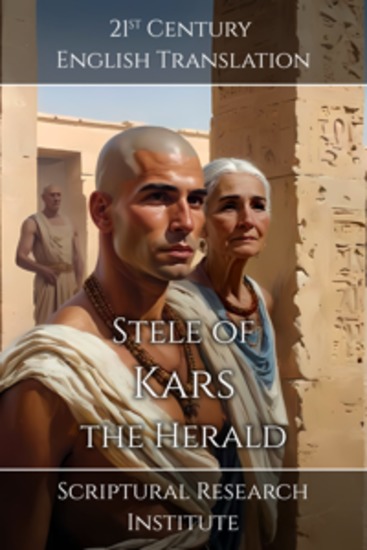
Kars, sometimes translated as Keres, was the herald of one of the queen-mothers named Ahhotep at the beginning of the New Kingdom era. There were two queen-mothers named Ahhotep at the beginning of the New Kingdom era: Ahhotep, the wife of King Amenhotep I, and Ahhotep, the mother of King Ahmose. This stele was erected during regal year 10 of King Amenhotep I, and therefore it is accepted that this Ahhotep was his wife. King Amenhotep I was the king of Egypt between approximately 1557 and 1537 BCE. This date is based on the radiocarbon dating of the mummy of the previous king, Ahmose I, meaning the stele would have been erected circa 1547 BCE.Kars was a senior member of the Egyptian nobility during the reign of King Amenhotep I; however, his stele was much shorter than the stele of his contemporaries Ahmose pen-Nekhbet and Ahmose pen-Ebana. Unlike his major contemporaries, he would have been a homosexual, and therefore, probably never had any children to maintain his tomb and stele. The stele was erected by the queen-mother after Kars died, which supports the idea that he did not have children. The stele was maintained by the royal court until the reign of Akhenaten, when it was defaced. King Ahkenaten tried to suppress the ancient gods of Egypt in favor of his preferred god: Aten. Several names were destroyed within the text of the stele, mostly the names of gods. Based on the context, the gods' names can be reconstructed as Amen, Aani, and Ma'at.Kars’ stele was accompanied by a statue of Kars, which Queen-mother Ahhotep had commissioned and erected at his tomb in Abydos. Both the stele and the statue have survived; however, the stele was damaged during the reign of Akhenaten, when the names of the old gods were systematically destroyed in ancient steles. Unfortunately, the stele did not go into great detail about Kars’ life, not even mentioning his last name. It spoke more about Ahhotep, who had commissioned it. Nevertheless, it does give a glimpse into the relationships within the royal court of Amenhotep I circa 1547 BCE.
Available since: 11/28/2025.
Print length: 24 pages.

Other books that might interest you

  • South Africa: The History and Legacy of the Nation from European Colonization to the End of the Apartheid Era - cover

    South Africa: The History and...

    Charles River Editors

    • 0
    • 0
    • 0
    The Boer War was the defining conflict of South African history and one of the most important conflicts in the history of the British Empire. Naturally, complicated geopolitics underscored it, going back centuries. In fact, the European history of South Africa began with the 1652 arrival of a small Dutch flotilla in Table Bay, at the southern extremity of the African continent, which made landfall with a view to establishing a victualing station to service passing Dutch East India Company (Vereenigde Oost-Indische Compagnie) ships. The Dutch at that point largely dominated the East Indian Trade, and it was their establishment of the settlement of Kaapstad, or Cape Town, that set in motion the lengthy and often turbulent history of South Africa. 
    	The Napoleonic Wars radically altered the old, established European power dynamics, and in 1795, the British, now emerging as the globe’s naval superpower, assumed control of the Cape as part of the spoils of war. In doing so, they recognized the enormous strategic value of the Cape as global shipping routes were developing and expanding. Possession passed back and forth once or twice, but more or less from that point onwards, the British established their presence at the Cape, which they held until the unification of South Africa in 1910. However, it would only come after several rounds of conflicts.  
    	On June 1, 1948, Daniel Malan arrived in Pretoria by train to take office, and there he was met by a huge crowd of cheering whites. He told the audience, “In the past, we felt like strangers in our own country, but today, South Africa belongs to us once more. For the first time since Union, South Africa is our own. May God grant that it always remain our own.” Back in Johannesburg, the leadership of the ANC, including the young attorney Nelson Mandela, listened to these celebratory prognostications in a grim mood. As strangers in their own country, they all understood that the South African liberation struggle would not be won overnight. In fact, the era of apartheid was only just about to formally start.  
    	Although apartheid is typically dated from the late 1940s until its dismantling decades later, segregationist policies had been the norm in South Africa from nearly the moment European explorers sailed to the region and began settling there. Whether it was displacing and fighting indigenous groups like the Khoi and San, or fighting other whites like the Boer, separation between ethnicities was the norm in South Africa for centuries before the election of Malan signaled the true rise of the Afrikaner far right.  
    	The man most associated with dismantling apartheid, of course, is Nelson Mandela. With the official policy of apartheid instituted in 1948 by an all-white government, Mandela was tried for treason between the years of 1956-61 before being acquitted. He participated in the Defiance Campaign of 1952, and oversaw the 1955 Congress of the People, but when the African National Congress was banned in 1960, he proposed a military wing, despite his initial reluctance toward violent resistance, a reluctance which had its roots in original nonviolent protests through the South African Communist Party. The ANC did not openly discourage such an idea, and the Umkhonto we Sizwe was established. Mandela was again arrested in 1962 and tried for attempts to overthrow the government by violence. The sentence was five years of hard labor, but this was increased to a life sentence in 1964, a sentence handed down to seven of his closest colleagues as well. 
    Show book
  • Saving Ourselves - From Climate Shocks to Climate Action - cover

    Saving Ourselves - From Climate...

    Dana R. Fisher

    • 0
    • 0
    • 0
    We've known for decades that climate change is an existential crisis. For just as long, we've seen the complete failure of our institutions to rise to the challenge. Fossil fuel interests maintain a stranglehold on political and economic power. Even though we have seen growing concern from everyday people, civil society has succeeded only in pressuring decision makers to adopt watered-down policies. Is there any hope of achieving the systemic change we need? 


    Dana R. Fisher argues that there is a realistic path forward for climate action—but only through mass mobilization that responds to the growing severity and frequency of disastrous events. She assesses the current state of affairs and shows why public policy and private-sector efforts have been ineffective. Spurred by this lack of progress, climate activism has become increasingly confrontational. Fisher examines the radical flank of the climate movement: its emergence and growth, its use of direct action, and how it might evolve as the climate crisis worsens. She considers when and how activism is most successful, identifying the importance of creating community, capitalizing on shocking moments, and cultivating resilience. Clear-eyed yet optimistic, Saving Ourselves offers timely insights on how social movements can take power back and open windows of opportunity for transformative climate action.
    Show book
  • The Causes of the Rebellion in Ireland Disclosed - cover

    The Causes of the Rebellion in...

    Anonymous Anonymous

    • 0
    • 0
    • 0
    "The Causes of the Rebellion in Ireland Disclosed" is a pamphlet written anonymously that analyzes the causes and motivations behind the 1798 Irish Rebellion against British rule. 
    The pamphlet argues that the rebellion was not a spontaneous uprising, but rather the result of a combination of factors that had been building up over time. These factors included economic hardship, religious tensions, and a growing sense of Irish nationalism and desire for independence from British rule. 
    The pamphlet also examines the role of the United Irishmen, a political group that had been working towards Irish independence, and argues that their efforts were instrumental in organizing the rebellion. Additionally, the pamphlet discusses the role of British policies in exacerbating the tensions that led to the rebellion, including the Penal Laws and the suppression of Irish trade. 
    Overall, "The Causes of the Rebellion in Ireland Disclosed" provides a detailed analysis of the factors that led to the 1798 Irish Rebellion, shedding light on a significant event in Irish history and the ongoing struggle for independence from British rule.
    Show book
  • Medieval Invasions of Italy The: The History and Legacy of the Conflicts across the Italian Peninsula in the Middle Ages - cover

    Medieval Invasions of Italy The:...

    Editors Charles River

    • 0
    • 0
    • 0
    The gradual collapse of the Roman Empire brought monumental changes to Europe and beyond. The system that once bound both sides of the Mediterranean Basin together was gone, and with it, many of the connections people from Mesopotamia to Spain and from Gaul to Arabia once enjoyed. In its place, a period of transition began - once referred to as the “Dark Ages,” although that term has fallen out of favor with modern scholars - after the Western Roman Empire ended in 476 and a host of new, primarily Germanic people inherited Roman lands, wealth, and ideas in Western Europe. Many of these Germanic tribes established large kingdoms, such as the Vandals in Spain and North Africa, the Franks in Gaul, the Visigoths in Spain, and the Ostrogoths in Italy. 
    Like the other Germanic tribes, the Lombards originated in Scandinavia before migrating slowly through central Europe, and as the Western Roman Empire collapsed and the Byzantine successor state in Constantinople attempted to reestablish order, the Lombards took advantage of the chaos and planted themselves firmly on Italian soil.  
    	As the Roman Empire in the West collapsed, the Berbers succumbed to the Vandals, a Germanic tribe from Europe, in the 5th century CE. However, the Eastern Roman Empire, centered in Constantinople rather than Rome, underwent something of a renewal, and the whole of the African coast from the Sinai Peninsula to the Straits of Gibraltar returned to Byzantine rule. With that, the Berbers were once again subject to a foreign power, but soon they would exchange their new masters for another, the Arabs, who would bring a new religion, Islam. Through Islam the Berbers would once again come into their own and influence the course of Mediterranean history as their ancient ancestors had done.
    Show book
  • Trade War - cover

    Trade War

    Introbooks Team

    • 0
    • 0
    • 0
    The trade war is among the most crucial aspect of the trading world and economy, and it is essential to understand the entire concept. Some situations can give rise to the trade war and hamper the relationships among some countries. To figure out the trade war concept, it is also an urgent need to know about the protectionism and the other related concepts such as tariff. The trade war can make countries to attempt to destroy and damage the economic condition and trading of each other. This can hamper the relationship among the countries and give birth to the rivalry. Even though, there are a few advantages of the other concepts of the trade war. There are also a few disadvantages. The decisions that are taken for the goodwill of the domestic companies and industries can turn out to be a bad decision. So the trading world is extremely risky, and before commencing anything, it is essential to know the consequences of everything.
    Show book
  • Maximize ACT Prep Success: Secrets to Unbeatable Scores - "Unlock your potential! Try our immersive audio lessons to conquer the ACT and achieve unbeatable scores!" - cover

    Maximize ACT Prep Success:...

    Ronan Ashby

    • 0
    • 0
    • 0
    Maximize ACT Prep Success: Secrets to Unbeatable Scores 
    ⭐⭐ Simplified Audio Guide with Explanations ⭐⭐ 
    Are you eager to advance your academic journey and bolster your skills to achieve outstanding results on the ACT? 
    Looking for a thorough guide that encompasses everything you need to excel on the ACT? 
    Your search ends here! 
    This guide acts as your ultimate resource for enhancing your understanding, applying your skills, and engaging in practical exercises. With this resource, you’re set for success. 
    Updated for the 2024-2025 ACT Exam Structure. 
    Key Features of This Comprehensive Guide: 
    - In-depth insights on the ACT Exam and its Certification 
    - Detailed explanations of various test components  
    - Effective strategies for exam preparation and execution 
    Our guide stands out with its extensive coverage—essential for your success on the test. Concepts are explored in depth, ensuring clarity and understanding. 
    Please note that this guide is an independent resource and is not affiliated with any official ACT organization. 
    Crafted with a clear layout and accessible language, our ACT Prep Guide ensures seamless transitions between topics. Say goodbye to complex jargon and embrace straightforward, precise, and technically sound content. 
    So, why wait? Click the BUY NOW button, grab your guide, and embark on your journey to ACT success! 
    Start your path to unbeatable ACT scores today!
    Show book