




ÉCOUTER EXTRAIT

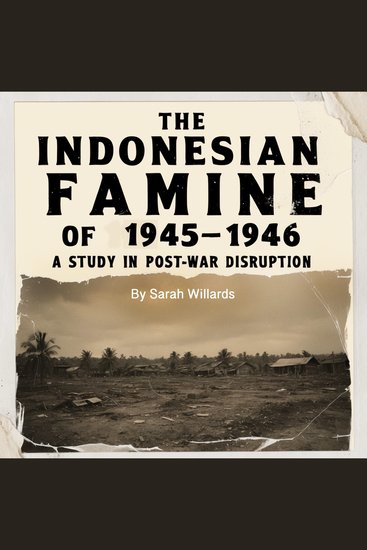
The Indonesian Famine of 1945-1946 - A Study in Post-War Disruption
Sarah Willards
Narrateur Judie Heths
Maison d'édition: Celestial Publishing
Synopsis
The conclusion of World War II marked a pivotal turning point in Indonesia’s history. As the Japanese forces surrendered in August 1945, the vacuum left behind in their wake exposed the fragility of colonial and wartime institutions. Indonesia, long under Dutch colonial rule and occupied by Japan since 1942, was suddenly thrust into a state of political and administrative chaos. The power void that followed the Japanese capitulation was quickly filled by nationalist fervor, culminating in the proclamation of Indonesian independence on August 17, 1945. However, the declaration did not result in immediate recognition or control. Instead, the country found itself caught between competing powers and clashing agendas.
The collapse of Japanese administrative structures left the newly proclaimed Republic of Indonesia struggling to assert its legitimacy. Republican leaders, including Sukarno and Mohammad Hatta, faced the monumental task of organizing a new government while also managing the fallout of war. Meanwhile, Dutch authorities, with Allied support, sought to re-establish their colonial presence. This led to violent confrontations and widespread instability, as various factions—including local militias, former Japanese-trained troops, and returning colonial forces—vied for control over towns, supply routes, and administrative posts.
The disintegration of centralized governance had far-reaching consequences. Essential services, including food distribution and public health, were severely disrupted. The chaos was further compounded by a breakdown in communication lines and transportation infrastructure, much of which had been damaged during the war or repurposed by occupying forces. With no clear authority in many regions, local leaders and grassroots organizations were left to manage crises as best they could, often with limited resources and no coordination.
Durée: environ 2 heures (01:45:59)
Date de publication: 16/04/2025; Unabridged; Copyright Year: — Copyright Statment: —




