Join us on a literary world trip!
Add this book to bookshelf
Grey
Write a new comment Default profile 50px
Grey
Subscribe to read the full book or read the first pages for free!
All characters reduced
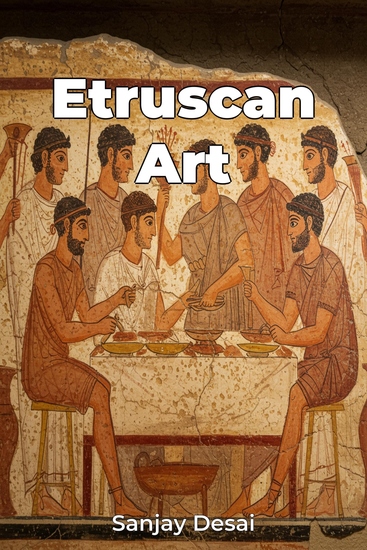
Etruscan Art - cover

Etruscan Art

Sanjay Desai

Translator A AI

Publisher: Publifye

  • 0
  • 0
  • 0

Summary

“Etruscan Art” unveils the rich artistic legacy of the Etruscans, an ancient civilization in Italy whose influence on Roman culture is often underestimated. Moving beyond the view of Etruscan art as merely a precursor to Roman art, the book presents a nuanced analysis of their unique artistic achievements. The Etruscans, flourishing from 900 BCE to 100 BCE, possessed sophisticated skills evident in their vibrant mural paintings found in tombs, which offer insights into their beliefs about the afterlife. Furthermore, their metalwork, including intricate gold jewelry and bronze vessels, showcases their technological prowess and aesthetic sensibilities. The book explores Etruscan art across various mediums, including mural painting, sculpture, and metalwork, highlighting their religious beliefs and social organization. The narrative progresses through chapters that first introduce key concepts and themes, then delve into specific artistic mediums, and finally discuss the transmission of Etruscan artistic elements to Roman culture. This approach reveals how Etruscan artistry profoundly shaped Roman culture and aesthetics, demonstrating the significant role of the Etruscans in the ancient Mediterranean world.
Available since: 03/29/2025.
Print length: 60 pages.

Other books that might interest you

  • The Cabbage Miller for Kids - cover

    The Cabbage Miller for Kids

    Tony R. Smith

    • 0
    • 0
    • 0
    Kids will learn about the Cabbage Miller
    Show book
  • Anime - according to ai - cover

    Anime - according to ai

    Steven Casteel, GPT-3.5, Claude 2

    • 0
    • 0
    • 0
    ☆ ☾アニメ☽ ☾アニメ☽ ☾アニメ☽ ☆ 
     75 Essays on anime classics.2000+ One-Sentence Summaries of many others. 
      
    A Comprehensive Curation for Otaku Enthusiasts and Curious Minds 
    Get the gist, so you can stop wondering what anime to watch. Quickly discover the Quintessential Hidden Gems that never get mentioned outside of the mega-hits. 
      
    Genres 
    Anti-Hero, Artificial Intelligence (AI), Body Swapping, Catgirls (Nekomimi), Comedy, Cute Girls Doing Cute Things (CGDCT), Cyberpunk, Ecchi, Fashion, Gambling, Gaming, Girls with Guns, Gothic, Grimdark, Harem, Historical Fantasy, Hentai, Idol, Isekai, Iyashikei, Josei, Kaiju, Kemonomimi, Kodomomuke, Kuudere, Magic School, Magical Girl (Mahou Shoujo), Martial Arts, Mecha Musume, Medieval, Meido (Maid), Military (War), Moe, Monster Girls, Music, Mystery, Ninja, Otome Game, Parody (Meme), Pirates, Police, Power Suits, Psychological, Queer Coding, Real Robot, Revenge, Romance, Romantic Comedy, Rural, Samurai, School Club, Science Fiction, Seinen, Shojo, Shonen, Shoujo, Shounen, Slice of Life, Space Western, Sports, Steampunk, Super Power, Superhero, Supernatural, Survival Thriller, Time Travel, Tsundere, Vampires, Villainess, Virtual Reality (VR), Waifu, Witch, Workplace, Yakuza, Yandere, Yaoi, Yokai, Yuri, Zombies
    Show book
  • Living the Technology Revolution - How life has changed since I was a kid - cover

    Living the Technology Revolution...

    Martin K. Ettington

    • 0
    • 0
    • 0
    This isn't a book filled with dry timelines or technical blueprints of the digital revolution. Instead, it's a firsthand journey—my journey—through one of the most astonishing transformations in human history: the rise of personal computing and the dawn of the digital age. 
    I was born in November 1955, at a time when the word “computer” was barely whispered outside of military labs and universities. My earliest memories include a bulky black-and-white television with rabbit-ear antennas, broadcasting a single channel. That flickering screen was my first encounter with electronic media—a far cry from the high-definition, touch-responsive world we live in now. 
    Over the decades, my path as an engineer and software developer placed me squarely in the midst of this technological upheaval. I didn’t just watch the future arrive—I helped build it, one line of code and one innovation at a time. 
    This book is a personal time capsule—a chronicle of what it was really like to live through the shift from analog to digital, from typewriters to tablets, from rotary phones to the infinite power in our pockets today. If you're a younger reader curious about how we got here, or someone who remembers the glow of vacuum tubes and the clack of punch cards, I invite you to walk with me through the decades. 
    You may be surprised by how far we’ve come—and how much we’ve forgotten along the way. 
    Many of the chapters are identified with the years or periods of time where these changes occurred.
    Show book
  • Western Han Dynasty - The Expansion and Flourishing of Early Imperial China - cover

    Western Han Dynasty - The...

    Rolf Hedger

    • 0
    • 0
    • 0
    The Western Han Dynasty (206 BCE – 9 CE) emerged following the collapse of the Qin Dynasty, a period marked by harsh legalist rule and widespread rebellion. The fall of the Qin created a power vacuum, leading to years of conflict between rival warlords. Among them was Liu Bang, a peasant-born general who would go on to establish one of China’s most influential dynasties. His leadership, pragmatic policies, and ability to gain the support of both the military and the common people played a crucial role in shaping the early Han state. 
    Liu Bang, later known as Emperor Gaozu, rose to prominence during the rebellion against the Qin. Unlike his rival Xiang Yu, a nobleman known for his military prowess, Liu Bang relied on strategy, diplomacy, and alliances to gain an advantage. In 202 BCE, he decisively defeated Xiang Yu at the Battle of Gaixia, solidifying his control over China and declaring himself the first emperor of the Han Dynasty. His rule marked a shift away from the oppressive policies of the Qin, emphasizing stability, leniency, and bureaucratic governance. 
    One of Gaozu’s first major reforms was the reduction of harsh legalist laws that had caused unrest under the Qin. He abolished extreme punishments, lowered taxes, and granted land to military leaders and allies. However, in order to maintain control, he adopted a semi-feudal system, granting large territories to loyal kings while keeping direct control over the central government. This system helped secure loyalty but later posed challenges as regional rulers sought more autonomy.
    Show book
  • Uncommon Measure - A Journey Through Music Performance and the Science of Time - cover

    Uncommon Measure - A Journey...

    Natalie Hodges

    • 0
    • 0
    • 0
    How does time shape consciousness and consciousness, time? Do we live in time, or does time live in us? And how does music, with its patterns of rhythm and harmony, inform our experience of time? Uncommon Measure explores these questions from the perspective of a young Korean American who dedicated herself to perfecting her art until performance anxiety forced her to give up the dream of becoming a concert solo violinist. Anchoring her story in illuminating research in neuroscience and quantum physics, Natalie Hodges traces her own passage through difficult family dynamics, prejudice, and enormous personal expectations to come to terms with the meaning of a life reimagined—one still shaped by classical music but moving toward the freedom of improvisation.
    Show book
  • Goodnight Wonder World - Magical Bedtime Stories for Curious Hearts - cover

    Goodnight Wonder World - Magical...

    Clara Finch

    • 0
    • 0
    • 0
    Goodnight, Wonder World: Magical Bedtime Stories for Curious Hearts is a heartwarming collection of enchanting tales designed to spark imagination and soothe little minds before sleep. Each story whisks young readers away to whimsical lands filled with talking stars, gentle dragons, curious cloud travelers, and brave little dreamers who discover the magic within themselves. Perfect for ages 4–8, these short, tender adventures blend wonder with wisdom, gently guiding children through themes of kindness, courage, and curiosity. Whether read aloud at bedtime or cherished during quiet moments, this beautifully crafted book is a nighttime treasure that helps turn bedtime into a journey of dreams.
    Show book