Begleiten Sie uns auf eine literarische Weltreise!
Buch zum Bücherregal hinzufügen
Grey
Einen neuen Kommentar schreiben Default profile 50px
Grey
Jetzt das ganze Buch im Abo oder die ersten Seiten gratis lesen!
All characters reduced
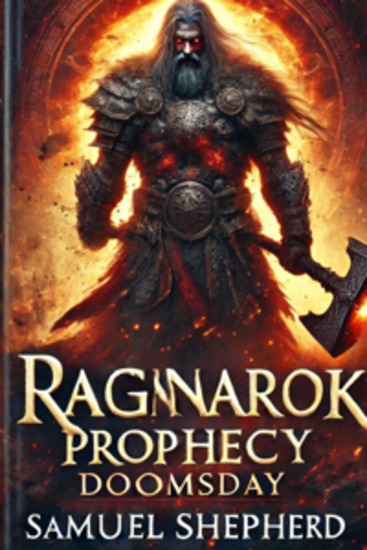
Ragnarok Prophecy - Doomsday - cover

Ragnarok Prophecy - Doomsday

Samuel Shepherd

Verlag: Samuel Shepherd

  • 0
  • 0
  • 0

Beschreibung

🔥 RAGNAROK PROPHECY: DOOMSDAY ⚡️
A Thrilling 4-Book Journey Into the End of the World – Myth, Science, and Secret Agendas Collide!
🌍 What if ancient myths weren’t just stories but warnings? What if the collapse of civilizations follows a hidden pattern? What if the end of the world is already in motion?
📖 Ragnarok Prophecy: Doomsday is a groundbreaking book series that takes you deep into the prophecies, conspiracies, and scientific realities of global catastrophe. From the Twilight of the Gods to modern-day existential threats, this four-book collection uncovers how mythology, history, and hidden forces shape the world’s fate.
💀 Are we doomed by fate, driven by science, or manipulated by unseen powers? The truth may be more terrifying than you think.

🔥 Book 1 - THE TWILIGHT OF THE GODS: Unveiling the Ancient Ragnarok Prophecy
🔮 Did the Norse predict the fall of civilization?
⚔️ Ragnarok, the Norse end-times, is not just a battle between gods—it is a prophecy of war, chaos, and rebirth. But its themes are echoed in Mayan, Hindu, Christian, and Hopi apocalyptic traditions. This book explores whether these stories are universal warnings or part of something much bigger and more real than anyone dares to admit.

🌎 Book 2 - APOCALYPSE NOW AND THEN: The Echoes of Ragnarok in Global Mythology
📜 Prophecies repeat—why?
🔥 From the Great Floods of ancient texts to Armageddon, from the Aztec Fifth Sun to the Book of Revelation, every culture has spoken of a time when the world will burn, drown, or fall into darkness. What if these aren’t mere stories but encoded patterns of collapse? Have civilizations risen and fallen before—without us knowing?

🌊 Book 3 - THE SCIENTIFIC RAGNAROK: How Climate Change, AI, and War Could End Civilization
☠️ Is the world unraveling in real-time?
⚠️ This book strips away legend and dives into cold, hard science. Rising sea levels, nuclear war, AI singularity, and bioengineered plagues—each capable of triggering a global collapse. But the most disturbing truth? These threats are accelerating faster than we ever imagined.

🏛️ Book 4 - RAGNAROK RISING: The Secret Societies and Occult Forces Behind the End Times
🔺 Is Ragnarok being controlled?
🕵️‍♂️ Behind every major global event, there are whispers of hidden hands—Freemasons, Illuminati, secret military factions, and ancient bloodlines—all with an agenda for the apocalypse. Some seek to survive, others to profit, and some to reshape the world entirely. What if the end isn’t coming by accident—but by design?

❌ THIS ISN’T FICTION. THIS IS HAPPENING.
🛑 Every war, every disaster, every new world crisis—it all follows a pattern. Whether natural, engineered, or predestined, the cycle is repeating again. The biggest question is: who will be left standing?
⚠️ Are we in the final phase of the Ragnarok Prophecy? Will the next world war, AI takeover, or environmental collapse push us into the abyss?

🔥 WHO IS THIS BOOK FOR?
✅ If you love ancient mythology, conspiracies, global events, and end-times prophecies, this is for you.
✅ If you’re fascinated by secret societies, hidden power structures, and unexplained knowledge, you won’t put this down.
✅ If you question mainstream narratives and want to know what’s really happening behind the scenes, this book demands your attention.

⚡️ TIME IS RUNNING OUT…
💀 The world isn’t what it seems. The clock is ticking. Whether you believe or fear what’s coming, the knowledge inside Ragnarok Prophecy: Doomsday is too important to ignore.
📖 Read it now—before it’s too late.
🛒 AVAILABLE NOW! 🚀🔥
Verfügbar seit: 09.02.2025.
Weitere Bücher, die Sie mögen werden

  • Islamic Invasions of Europe The: The History of the Ottoman and Moorish Campaigns across the Continent - cover

    Islamic Invasions of Europe The:...

    Charles River Editors

    • 0
    • 0
    • 0
    The history of the Spanish Peninsula is closely bound to that of the Moors. The term “Spain” was not in wide use until the region was united by the monarchs of Aragon and Castile, and the Moors called the lands they ruled in the Iberian Peninsula Al-Andalus, traditionally thought to be an Arabic transliteration of Vandal, the Germanic tribe which briefly ruled the region in the early fifth century. The English name Andalusia derives from the Spanish Andalucia, which is still used by Spain to name its southern region. 
    	Not surprisingly, three religions attempting to coexist during medieval times resulted in nearly incessant conflicts, marked by high taxation, disparate societies, rigid cultural controls, and systemic violence. Despite the odds, these three religions managed to live in a state of quasi-acceptance and peace in most of the major cities in the Iberian Peninsula like Cordoba and Tolaydough, with sporadic warfare occurring on the borders between Al-Andalus and the Christian kingdoms near the Pyrenees Mountains. Muslims, Christians, and Jews would attempt to reorganize their societies several times over the centuries through warfare, always with Jews on the lower rungs and Christians and Muslims fighting it out above them.  
    	The end of the Byzantine Empire had a profound effect not only on the Middle East but Europe as well. Constantinople had played a crucial part in the Crusades, and the fall of the Byzantines meant that the Ottomans now shared a border with Europe. The Islamic empire was viewed as a threat by the predominantly Christian continent to their west, and it took little time for different European nations to start clashing with the powerful Turks. In fact, the Ottomans would clash with Russians, Austrians, Venetians, Polish, and more before collapsing as a result of World War I, when they were part of the Central Powers. 
    Zum Buch
  • The Analysis of Mind - cover

    The Analysis of Mind

    Bertrand Russell

    • 0
    • 0
    • 0
    "The Analysis of Mind" is a book written by the British philosopher and mathematician Bertrand Russell, first published in 1921. The book is a comprehensive exploration of the nature of the human mind and its various functions, and is considered one of Russell's most important and influential works. 
    In "The Analysis of Mind", Russell argues that the mind is not a single, unified entity, but rather a collection of distinct mental processes, such as perception, memory, imagination, and reasoning. He examines these processes in detail, exploring their underlying structures, functions, and relationships to one another. 
    Russell also discusses the relationship between mind and body, arguing against the traditional dualistic view that sees the mind and body as separate and distinct entities. He proposes a more holistic approach, in which mental and physical events are seen as part of a single, integrated system. 
    Throughout "The Analysis of Mind", Russell draws on a wide range of sources, including philosophy, psychology, and neuroscience, and his writing is characterized by clarity and rigor. The book continues to be widely read and studied today, and remains an important contribution to the fields of philosophy and psychology.
    Zum Buch
  • You are what you eat - cover

    You are what you eat

    Brittany Forrester

    • 0
    • 0
    • 0
    For decades, the medical profession has advocated for nutritional management as a treatment strategy for various illnesses, including diabetes, heart disease, high blood pressure, and excessive cholesterol. There are currently no such recommendations for brain aging and dementia.Nutrition was only recently accorded scientific-field status. Eating is a valid technique for defending oneself against brain aging and disorders such as Alzheimer's. Scientists have gradually realized the vital link between the foods we eat and our mental health. This insight has spawned a rapidly rising body of studies indicating that we may be eating our way to dementia.What has gone unreported until now is that, of all the organs in our bodies, the brain is the one most easily harmed by a poor diet. Everything in the brain, from its architecture to its ability to perform, begs for optimal nutrition. Many of us are ignorant that the only way to fuel the brain is through our food. The meals we eat are broken down into nutrients, absorbed into the bloodstream, and transported to the brain to replenish depleted stores, stimulate cellular responses, and, most critically, be incorporated into brain tissue.We are what we eat!
    Zum Buch
  • Learn Chinese Idioms with Stories: Volume 3 - An Easy Guide with Meaning & Story - cover

    Learn Chinese Idioms with...

    Letitia Wu

    • 0
    • 0
    • 0
    Ready to learn more Chinese, one story at a time? 
    Learn Chinese Idioms with Stories (Volume 3) brings you 10 vivid idioms, each explained with simple language, memorable stories, and easy-to-understand insights. 
    Even if you don’t speak Chinese, you’ll enjoy these timeless stories — and gain a deeper understanding of Chinese thinking. 
    Inside, you’ll find: 
    - Engaging short stories for each idiom 
    - Clear, beginner-friendly explanations 
    - Cultural wisdom and life lessons 
    - Simple memory tips to help you remember 
    - A few example sentences — perfect for learners ready to go further 
    Whether you’re learning Chinese or simply curious about Chinese culture, this audiobook helps you: 
    ✔ Understand how Chinese people think 
    ✔ Learn real expressions in a natural way 
    ✔ Enjoy meaningful stories, anytime 
    No textbook needed. Just press play. 
    More stories. More wisdom. More Chinese you’ll never forget.
    Zum Buch
  • Not Paved for Us - Black Educators and Public School Reform in Philadelphia - cover

    Not Paved for Us - Black...

    Camika Royal, Gloria...

    • 0
    • 0
    • 0
    This illuminating book offers an extensive, expert analysis of a school system that bears the legacy, hallmarks, and consequences that lie at the intersection of race and education. Urban education scholar Camika Royal deftly analyzes decades of efforts aimed at improving school performance within the School District of Philadelphia (SDP), in a brisk survey spanning every SDP superintendency from the 1960s through 2017. 


    Royal interrogates the history of education and educational reforms, recounting city, state, and federal interventions. Her survey provides sociopolitical context and rich groundwork for a nuanced examination of why many large urban districts struggle to implement reforms with fidelity and in ways that advance Black students academically and holistically. 


    In a bracing critique, Royal bears witness to the ways in which positive public school reform has been obstructed: through racism and racial capitalism, but also via liberal ideals, neoliberal practices, and austerity tactics. 


    Not Paved for Us highlights the experiences of Black educators as they navigate the racial and cultural politics of urban school reform.
    Zum Buch
  • The Coffin Roads - Journeys to the West - cover

    The Coffin Roads - Journeys to...

    Ian Bradley

    • 0
    • 0
    • 0
    'Coffin roads' along which bodies were carried for burial are a marked feature of the landscape of the Scottish Highlands and islands – many are now popular walking and cycling routes. This book journeys along eight coffin roads to discover and explore the distinctive traditions, beliefs and practices around dying, death and mourning in the communities which created and used them.
    The result is a fascinating snapshot into place and culture. After more than a century when death was very much a taboo subject, this book argues that aspects of the distinctive West Highland and Hebridean way of death and approach to dying and mourning may have something helpful and important to offer to us today.
    
    
    Routes covered in this book are:
    The Kilmartin Valley – the archetypal coffin road in this ritual landscape of the dead.
    The Street of the Dead on Iona – perhaps the best known coffin road in Scotland.
    Kilearnadil Graveyard, Jura – a perfect example of a Hebridean graveyard.
    The coffin road through Morvern to Keil Church, Lochaline - among the best defined and most evocative coffin roads today.
    The Green Isle, Loch Shiel, Ardnamurchan - the oldest continuously used burial place anywhere in Europe.
    The coffin road on Eigg – with its distinctive 'piper's cairn' where the coffin of Donald MacQuarrie, the 'Great Piper of Eigg', was rested.
    The coffin road from Traigh Losgaintir to Loch Stocinis on Harris - popular with walkers and taken as the title for a best-selling thriller by Peter May.
    The coffin road on Barra – A detailed study of burial practices on Barra in the early 1950s provides a fascinating record of Hebridean attitudes to dying, death and mourning.
    Zum Buch