Join us on a literary world trip!
Add this book to bookshelf
Grey
Write a new comment Default profile 50px
Grey
Subscribe to read the full book or read the first pages for free!
All characters reduced
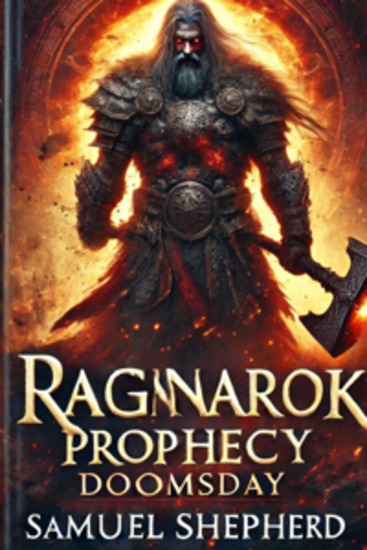
Ragnarok Prophecy - Doomsday - cover

Ragnarok Prophecy - Doomsday

Samuel Shepherd

Publisher: Samuel Shepherd

  • 0
  • 0
  • 0

Summary

🔥 RAGNAROK PROPHECY: DOOMSDAY ⚡️
A Thrilling 4-Book Journey Into the End of the World – Myth, Science, and Secret Agendas Collide!
🌍 What if ancient myths weren’t just stories but warnings? What if the collapse of civilizations follows a hidden pattern? What if the end of the world is already in motion?
📖 Ragnarok Prophecy: Doomsday is a groundbreaking book series that takes you deep into the prophecies, conspiracies, and scientific realities of global catastrophe. From the Twilight of the Gods to modern-day existential threats, this four-book collection uncovers how mythology, history, and hidden forces shape the world’s fate.
💀 Are we doomed by fate, driven by science, or manipulated by unseen powers? The truth may be more terrifying than you think.

🔥 Book 1 - THE TWILIGHT OF THE GODS: Unveiling the Ancient Ragnarok Prophecy
🔮 Did the Norse predict the fall of civilization?
⚔️ Ragnarok, the Norse end-times, is not just a battle between gods—it is a prophecy of war, chaos, and rebirth. But its themes are echoed in Mayan, Hindu, Christian, and Hopi apocalyptic traditions. This book explores whether these stories are universal warnings or part of something much bigger and more real than anyone dares to admit.

🌎 Book 2 - APOCALYPSE NOW AND THEN: The Echoes of Ragnarok in Global Mythology
📜 Prophecies repeat—why?
🔥 From the Great Floods of ancient texts to Armageddon, from the Aztec Fifth Sun to the Book of Revelation, every culture has spoken of a time when the world will burn, drown, or fall into darkness. What if these aren’t mere stories but encoded patterns of collapse? Have civilizations risen and fallen before—without us knowing?

🌊 Book 3 - THE SCIENTIFIC RAGNAROK: How Climate Change, AI, and War Could End Civilization
☠️ Is the world unraveling in real-time?
⚠️ This book strips away legend and dives into cold, hard science. Rising sea levels, nuclear war, AI singularity, and bioengineered plagues—each capable of triggering a global collapse. But the most disturbing truth? These threats are accelerating faster than we ever imagined.

🏛️ Book 4 - RAGNAROK RISING: The Secret Societies and Occult Forces Behind the End Times
🔺 Is Ragnarok being controlled?
🕵️‍♂️ Behind every major global event, there are whispers of hidden hands—Freemasons, Illuminati, secret military factions, and ancient bloodlines—all with an agenda for the apocalypse. Some seek to survive, others to profit, and some to reshape the world entirely. What if the end isn’t coming by accident—but by design?

❌ THIS ISN’T FICTION. THIS IS HAPPENING.
🛑 Every war, every disaster, every new world crisis—it all follows a pattern. Whether natural, engineered, or predestined, the cycle is repeating again. The biggest question is: who will be left standing?
⚠️ Are we in the final phase of the Ragnarok Prophecy? Will the next world war, AI takeover, or environmental collapse push us into the abyss?

🔥 WHO IS THIS BOOK FOR?
✅ If you love ancient mythology, conspiracies, global events, and end-times prophecies, this is for you.
✅ If you’re fascinated by secret societies, hidden power structures, and unexplained knowledge, you won’t put this down.
✅ If you question mainstream narratives and want to know what’s really happening behind the scenes, this book demands your attention.

⚡️ TIME IS RUNNING OUT…
💀 The world isn’t what it seems. The clock is ticking. Whether you believe or fear what’s coming, the knowledge inside Ragnarok Prophecy: Doomsday is too important to ignore.
📖 Read it now—before it’s too late.
🛒 AVAILABLE NOW! 🚀🔥
Available since: 02/09/2025.

Other books that might interest you

  • The American Revolution and French Revolution - The History of the Revolutions that Reshaped the West in the 18th Century - cover

    The American Revolution and...

    Charles River Editors

    • 0
    • 0
    • 0
    The American Revolution is replete with seminal moments that every American learns in school, from the “shot heard ‘round the world” to the Declaration of Independence, but the events that led up to the fighting at Lexington & Concord were borne out of 10 years of division between the British and their American colonies over everything from colonial representation in governments to taxation, the nature of searches, and the quartering of British regulars in private houses. From 1764-1775, a chain of events that included lightning rods like the Townshend Acts led to bloodshed in the form of the Boston Massacre, while the Boston Tea Party became a symbol of nonviolent protest.  
    	The political and military nature of the Revolutionary War was just as full of intrigue. While disorganized militias fought the Battles of Lexington & Concord, George Washington would lead the Continental Army in the field while men like Thomas Jefferson drafted the Declaration of Independence in Philadelphia and Benjamin Franklin negotiated overseas in France. Benedict Arnold would become one of his nation’s most vital war heroes and its most notorious traitor, French forces would play a crucial role at the end of the war, and the Treaty of Paris would conclude the Revolution with one last great surprise.  
    	The early years of the French Revolution were fueled by Enlightenment ideals, seeking the social overthrow of the caste system that gave the royalty and aristocracy decisive advantages over the lower classes. But history remembers the French Revolution in a starkly different way, as the same leaders who sought a more democratic system while out of power devolved into establishing an incredibly repressive tyranny of their own once they acquired it.  
    The height of Republican France’s tyranny came during a 10-month period forever known as the Reign of Terror, the most notorious and arguably most memorable part of the French Revolution.
    Show book
  • Women and Kink - Relationships Reasons and Stories - cover

    Women and Kink - Relationships...

    Jennifer Rehor, Julia Schiffman

    • 0
    • 0
    • 0
    Based on original research from nearly 1,600 women from the kink community, this book takes you on a journey into the motivations, meanings, and benefits of kink, in these women's own words. 


    Women and Kink presents a diverse range of personal and intimate stories about life, love, relationships, kink, sex, self-discovery, growth, resilience, community, and more. The book offers insight into the breadth of the kink community, with chapters discussing different aspects of kink and forms of engagement, both individually and within relationships. Filled throughout with personal vignettes and examples, the authors provide commentary, reflection questions, and thought-provoking considerations to listeners who are looking to explore a new area of their life. 


    By exploring personal stories of love, alternative sexualities, and reasons for participating in the "unconventional," the book supports and empowers each reader to build a relationship and life that best suits their needs. It is also an illuminating resource for sex therapists, counselors, and other mental health professionals interested in developing a kink-affirmative practice.
    Show book
  • Freedom: Escape Negativity & Overthinking to Live Happily & Find Your Purpose - cover

    Freedom: Escape Negativity &...

    Tommy Swindali

    • 0
    • 0
    • 0
    Success is a journey filled with ups and downs, many of which are of our own making… 
    Do you often compare yourself to others, wondering why their lives seem perfect while yours isn't? Do you lie awake at night, trapped in repetitive thoughts, questioning where it all went wrong? 
    Sometimes life can feel so overwhelming, we get anxious about the future or we get stuck on a past regret and find it difficult to move on. 
    These feelings are common, however most people try to avoid facing the true issues. So we avoid thinking about it, but change begins with a thought. 
    This book will help you to transform destructive thinking into constructive thoughts or peaceful moments. It will also help you to recognize the distractions and manipulation that steer you away from your purpose. 
    Inside this book, you will discover four pillars to help you with that: 
    • Purpose: Start reducing negativity by discovering your purpose. 
    • Lifestyle: Build a fulfilling life with a purpose-driven approach. 
    • Mindfulness: Understand that you are not your thoughts. 
    • Letting Go: Freedom explained, by letting go of unhelpful thoughts. 
    All of this and much more…. 
    With the knowledge and lessons found in this book, you can achieve more fulfilment, clarity, and inner peace. In turn you’ll be able to make better decisions, enjoy the moment and live a higher quality life. 
    Start transforming your thinking and improving your life with this book.
    Show book
  • Plato's Phaedo - cover

    Plato's Phaedo

    Plato

    • 0
    • 0
    • 0
    Socrates is in prison, sentenced to die when the sun sets. In this final conversation, he asks what will become of him once he drinks the poison prescribed for his execution. Socrates and his friends examine several arguments designed to prove that the soul is immortal.
     
    This quest leads him to the broader topic of the nature of mind and its connection not only to human existence but also to the cosmos itself. What could be a better way to pass the time between now and the sunset?
    Show book
  • Unsung Hero of Gettysburg - The Story of Union General David McMurtrie Gregg - cover

    Unsung Hero of Gettysburg - The...

    Edward G. Longacre

    • 0
    • 0
    • 0
    Gen. David McMurtrie Gregg (1833–1917) was one of the ablest and most successful commanders of cavalry in any Civil War army. Pennsylvania-born, West Point–educated, and deeply experienced in cavalry operations prior to the conflict, his career personified that of the typical cavalry officer in the mid-nineteenth-century American army. Gregg achieved distinction on many battlefields, ultimately gaining the rank of brevet major general as leader of the Second Division, Cavalry Corps, Army of the Potomac. 


    The highlight of his service occurred on July 3, 1863, the climactic third day at Gettysburg, when he led his own command as well as the brigade of Brig. Gen. George Armstrong Custer in repulsing an attempt by thousands of Confederate cavalries under the legendary J. E. B. Stuart in attacking the right flank and rear of the Union Army while Pickett's charge struck its front and center. 


    Historians credit Gregg with helping preserve the security of his army at a critical point, making Union victory inevitable. Unlike glory-hunters such as Custer and Stuart, Gregg was a quietly competent veteran who never promoted himself or sought personal recognition for his service. Rarely has a military commander of such distinction been denied a biographer's tribute. Gregg's time is long overdue.
    Show book
  • Psycholinguistics - A Very Short Introduction - cover

    Psycholinguistics - A Very Short...

    Fernanda Ferreira

    • 0
    • 0
    • 0
    This Very Short Introduction to psycholinguistics is an accessible and engaging description of how people use language. Talking and understanding language probably seem like simple and straightforward skills, but research in psycholinguistics has shown that complex computations take place behind the scenes when you communicate with others. Recent debates concerning how AI tools such as ChatGPT work highlight some of these core questions about the language faculty and how it is that humans comprehend, produce, and learn language. 


    The book begins with an overview of the fields of linguistics and psychology and how they have cooperated from the earliest days of psycholinguistics. Issues that are considered include: (1) How successfully do people adapt what they say to the needs of their audience when they design their phrases and sentences? (2) How do people read languages such as Chinese, which do not use an alphabetic writing system? (3) Do the size and efficiency of a person's memory affect how effectively people use language? (4) Is bilingualism cognitively advantageous, and if so, what are the mechanisms that lead to this so-called bilingual advantage? And (5) Do users of sign language gesture when they communicate? These questions and more are answered using insights from the latest research based on methods from the cognitive and neurosciences.
    Show book